
PHYSICS · ELECTRICITY · MAGNETISM
Michael Faraday
The Bookbinder Who Taught Magnets to Make Electricity
A poor London boy with little schooling learned from the best teachers he could find and gave the world the idea behind electric generators.
- 1791 to 1867
- England
- Physics
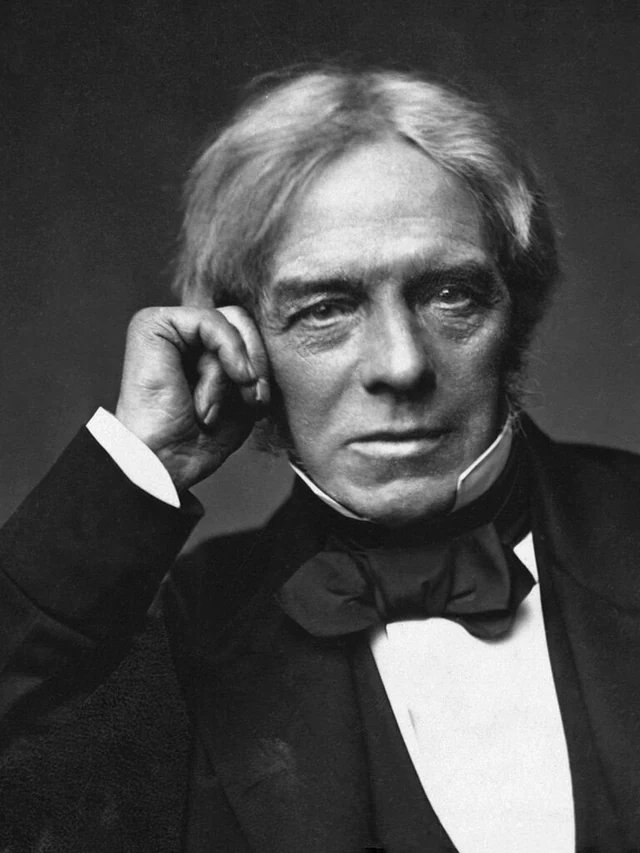

A life of discovery
The question they chased
Michael Faraday was born in 1791 near London. His father was a blacksmith and the family had little money. He had almost no formal schooling. At 14 he began a seven year apprenticeship with George Riebau, a bookbinder and bookseller. Faraday became fascinated by chemistry and went to science lectures whenever he could. He wanted to know how the invisible forces worked.
In 1812 he heard lectures by the chemist Humphry Davy at the Royal Institution. Faraday wrote up his notes, bound them himself, and sent the 300 page book to Davy. In 1813 Davy hired him as a chemical assistant. Faraday spent the next decades in that laboratory. In 1821 he built devices that turned electric current into motion. In 1831 he found that a changing magnetic field can make an electric current.
The big ideas
What Michael figured out
Faraday moved a magnet near a coil of wire and a current appeared. The key is change. A magnet that sits still does nothing, but a moving one pushes electric charge along the wire. Wind turbines, dams, and gas power plants all spin generators that depend on this.
In 1821 Faraday showed that a wire carrying current will circle around a magnet. A current and a magnet push on each other. That is the basic idea inside every electric motor.
Faraday built a large cage covered with metal and had it charged with strong electricity while he stood inside. He was not harmed. Electric charge stays on the outside of a conductor. This is why a car or an airplane can protect people inside from lightning.
Key moments
How it unfolded
- 1805At 14 he began a seven year apprenticeship with a bookbinder.
- 1813Humphry Davy hired him as a chemical assistant at the Royal Institution.
- 1821He built devices that turned electricity into motion and married Sarah Barnard.
- 1831He discovered electromagnetic induction, making electric current from a changing magnetic field.
- 1836He tested the metal cage that shows electric charge stays on the outside.
- 1839A serious illness begins that slows his work for years.
The person behind the science
The humble man in the laboratory
Faraday knew what it felt like to be looked down on. Many members of the scientific world were gentlemen and he was a tradesman's son. His bond with Davy also grew strained, partly over credit for work in 1821. Then in 1839 he fell seriously ill. He had to step back from his work. Over the years he dealt with headaches, giddiness, and memory loss, and he never fully recovered. He rested and then he returned to his experiments.
Faraday married Sarah Barnard in 1821. They had no children, but his nieces lived with them. Sarah was a steady companion in his life at the Royal Institution. Faraday was also a devout Christian in the Sandemanian church, where he served as deacon and later elder. In 1858 he retired to a house at Hampton Court that the royal household had given him. He died there in 1867 at age 75.
Small things that make them human
- A book made by handHe bound his own lecture notes into a book and sent it to Davy. That book helped him get his job.
- Plain Mr FaradayHe refused a knighthood and twice turned down the presidency of the Royal Society. He said he wished to stay plain Mr Faraday.
- A line he would not crossDuring the Crimean War he refused to advise the government on chemical weapons. He gave ethical reasons.
- A brief breakHis church community excluded him for a few weeks in 1844, and he was welcomed back.
A few surprising facts
Did you know
He gave nineteen Christmas Lectures for young people at the Royal Institution. His talks on the candle became a famous book.
On his early trip across Europe with Davy from 1813 to 1815, he met leading scientists. He was also often treated like a servant by Davy's wife.
He found that the amount of chemical change in a liquid depends on the amount of electricity passing through it. These are called his laws of electrolysis.
In 1823 he found a way to turn chlorine gas into a liquid.
Why it still matters
What this means for you
Faraday had no fancy start, and still he changed the world. He kept careful notebooks, tried experiments again when they failed, and told the truth about what he saw. Nearly every light you switch on depends on his work. His life also shows that a person can learn from anyone, and that you can be kind and humble and still do great work. When illness slowed him, he did not stop. He adjusted and kept going.
Ask the wire what the magnet does.
CURIOSITY ✦ RIGOR ✦ DISCOVERYTalk about it
Questions for your table
- Faraday taught himself by reading books he was binding. What is something you could teach yourself from what is already around you?
- Faraday refused honors and refused to work on weapons. What lines would you refuse to cross, even if others asked?
- Illness slowed Faraday but did not end his work. How do you adjust when something makes a task harder for you?
Try it today
Three small steps
- Notice: Find a small motor or generator at home, like a fan or a bike light, and look for the coil of wire inside or in a picture of one.
- Question: Why might a moving magnet matter more than a magnet that just sits still?
- Test: Ask your teacher for a coil of wire and a sensitive meter, then move a magnet in and out and watch for the needle to move only while the magnet moves.