
MATH · ASTRONOMY · NUMBERS
Carl Friedrich Gauss
The Quiet Mind That Found Order in Numbers and Stars
A poor boy from Brunswick found hidden patterns in numbers, tracked a lost world in the sky, and carried quiet grief.
- 1777 to 1855
- Germany
- Math
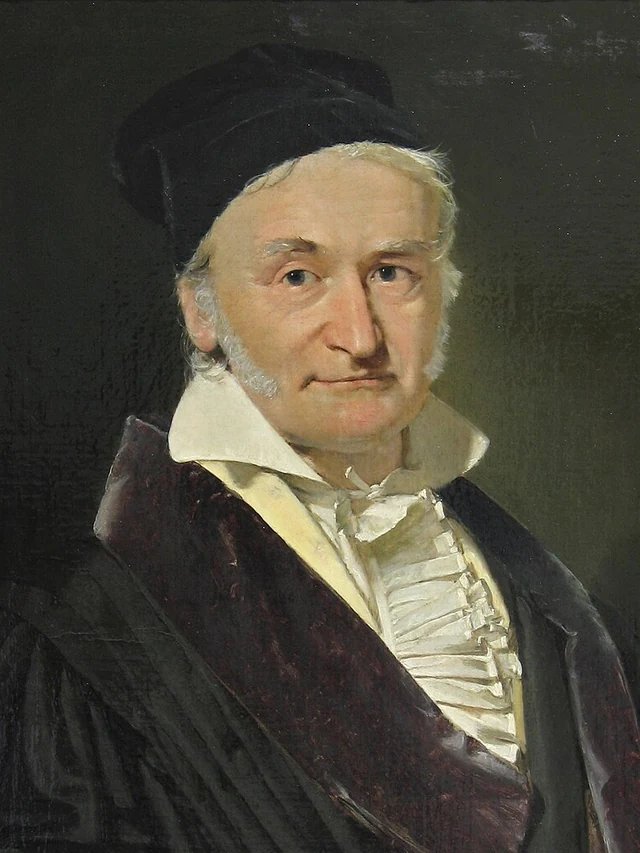

A life of discovery
The question they chased
Carl Friedrich Gauss was born in 1777 in Brunswick, Germany. His parents were poor and he was their only child. He did sums in his head so well that the Duke of Brunswick paid for his schooling. A famous story says that at age seven he added 1 to 100 in seconds. Historians doubt the details of that story, but the trick in it is real. Pair 1 with 100, 2 with 99, and every pair makes 101. There are 50 pairs. The answer is 5050.
Gauss chased one question all his life. What order is hiding underneath messy things? In 1796, at age 19, he showed that a regular shape with 17 sides can be drawn with only a compass and a straightedge. Nobody had known that. His book "Disquisitiones Arithmeticae" came out in 1801 and shaped the study of whole numbers. That same year he worked out where the lost object Ceres would reappear, and astronomers found it almost exactly there. From 1807 until his death he worked at Göttingen, first as director of the observatory and professor.
The big ideas
What Carl figured out
On a clock, 10 hours after 5 o'clock is 3 o'clock, not 15. Numbers wrap around. Gauss gave this kind of wrapping arithmetic a clear system in his 1801 book. Today the same idea helps protect passwords and bank codes.
Measurements are never perfect. Gauss used a method called least squares to find the path that sits closest to all the messy points. He used it on Ceres. Scientists still use it whenever they draw a trend line through data.
With Wilhelm Weber, Gauss made careful measurements of Earth's magnetic field in the early 1830s. He wanted strengths described with units of length, mass, and time so any lab could repeat the work. An older metric unit of magnetic field strength is named the gauss.
Key moments
How it unfolded
- 1796At age 19 he showed that a 17 sided shape can be drawn with compass and straightedge.
- 1801He published "Disquisitiones Arithmeticae" and predicted where Ceres would be found again.
- 1807He moved to Göttingen to teach and to direct the observatory.
- 1820He began leading a land survey of the Kingdom of Hanover that lasted until 1844.
- 1833He and Weber built an early electric telegraph at Göttingen.
- 1855He died at Göttingen at age 77, after lecturing until 1854.
The person behind the science
The man behind the numbers
Gauss's public life looks calm. His private life was not. In October 1809 his wife Johanna died, a month after their son Louis was born. Louis died a few months later. Gauss was shattered. He asked his friend Olbers, an astronomer, to take him in for a few weeks so he could gather new strength. He told Olbers that his life was valuable now mostly because it belonged to his small children.
Gauss married Johanna's close friend Minna in 1810. Minna was ill for more than ten years and died in 1831. Work gave him footing. So did his friends. In 1831 the young physicist Weber arrived at Göttingen, and the two men worked well together on magnetism until Weber was forced to leave in 1837 after a political dispute.
Small things that make them human
- Afraid of the noiseHe kept his ideas about curved geometry private. He told a friend his reputation might suffer if he spoke up.
- Days and nightsOn the survey he measured by day and calculated at night. He often wondered whether another job would have suited him better.
- A blunt replyWhen Farkas Bolyai sent him his son's new geometry, Gauss replied that praising it would be praising himself. He had reached similar ideas.
- Still teachingHe lectured to students until 1854, the year before he died.
A few surprising facts
Did you know
He did not publish everything. He explored a new kind of geometry on curved space but kept it private. His notes were printed only in 1900.
The 1 to 100 story may be dressed up. The same pairing trick shows up in a Jewish commentary from the 12th century, long before Gauss was born.
For the Hanover survey he used an instrument he invented, the heliotrope, which flashed sunlight between far apart stations.
He kept the skill of doing long calculations in his head for most of his life.
Why it still matters
What this means for you
Gauss shows that careful, patient work can outlast fast and flashy work. The tools he built are all around a student today. A trend line on a spreadsheet follows his least squares idea. Clock arithmetic hides inside the codes that protect your online accounts. His life also shows that a person can hold deep sorrow and still keep working, still keep teaching, and still make something that lasts.
Work carefully. Share only what you trust.
CURIOSITY ✦ RIGOR ✦ DISCOVERYTalk about it
Questions for your table
- Gauss waited to publish until he thought a result was complete. When is it wise to wait before sharing your work, and when is it better to share early?
- Gauss kept working after losing his wife and son. What helps you keep going when something sad has happened in your life?
- A best fit line never touches every point. Where in your own life do you make choices from messy, imperfect information?
Try it today
Three small steps
- Notice: Look at any scatter plot in a book or spreadsheet and see how the trend line sits between the dots instead of touching them all.
- Question: Add the numbers 1 to 20 by pairing them like Gauss did. How many pairs do you get and what does each pair add up to?
- Test: Use clock arithmetic to figure out what time it will be 100 hours from now, then check your answer on a phone or calendar.