
EARTH · NATURE · EXPLORATION
Alexander von Humboldt
The Explorer Who Saw Nature as One Connected Web
A lonely Prussian boy climbed mountains, measured everything he could, and taught the world that nature is one connected whole.
- 1769 to 1859
- Germany
- Earth science
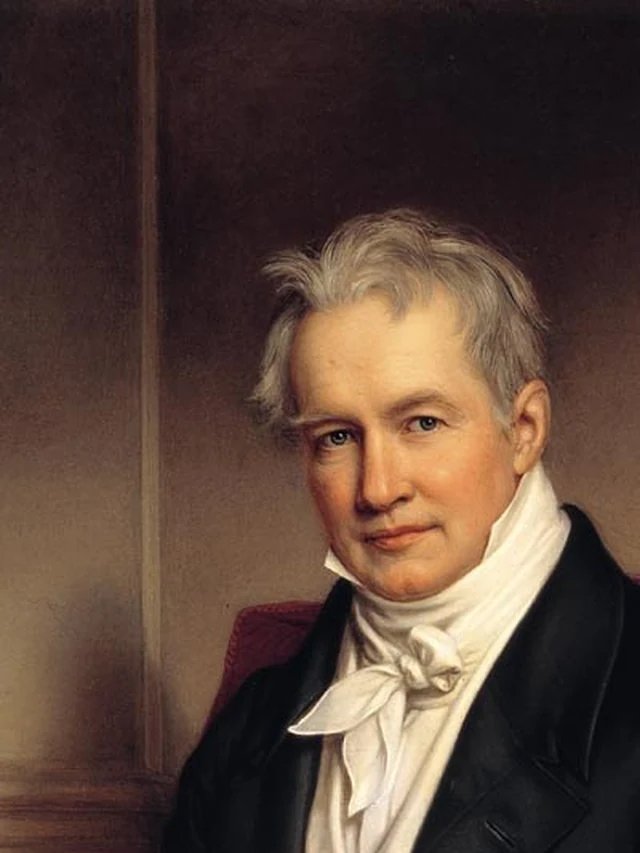

A life of discovery
The question they chased
Alexander von Humboldt was born in Berlin in 1769 to a wealthy Prussian family. His father died in 1779. His mother was emotionally distant and ambitious for her sons. Private tutors taught Alexander and his older brother Wilhelm. Alexander cared most about plants, rocks, and animals. He later studied at Frankfurt an der Oder and at Göttingen.
After his mother died in 1796, an inheritance paid for the journey he dreamed of. With the French botanist Aimé Bonpland he sailed in 1799 for Spanish America. They traveled for five years through forests, rivers, and mountains in lands that are now Venezuela, Cuba, Colombia, Ecuador, Peru, and Mexico. They measured temperatures, heights, and magnetism, and collected thousands of plants. Back in Europe, Humboldt spent decades writing about what he had seen.
The big ideas
What Alexander figured out
On the slopes of Chimborazo in Ecuador, Humboldt saw plants change as he climbed, from warm lowland forest at the bottom to cold bare slopes near the top. He drew a picture linking height, temperature, and plant life. His message was that living things, climate, and land belong together.
In 1817 he drew lines on a map connecting places with the same average temperature. These isotherms showed climate at a glance. Weather maps today use the same kind of line for temperature and air pressure.
Humboldt wanted scientists in many places to measure the Earth's magnetism. Gauss and Weber later organized a network of magnetic observatories around the world. Humboldt believed big truths come from many careful eyes working together.
Key moments
How it unfolded
- 1796His mother died, and his inheritance later paid for his travels.
- 1799He sailed from Spain with Aimé Bonpland for Spanish America.
- 1802He climbed Chimborazo to about 5,600 meters by modern estimates, a record for a European then, though not to the top.
- 1804He met Thomas Jefferson in Washington, then reached France on 3 August.
- 1829At age 59 he traveled about 18,000 kilometers across Russia.
- 1845The first volume of his huge work "Kosmos" appeared.
The person behind the science
The explorer who found his family in nature
Humboldt's home was not warm. His father died in 1779 and his mother was emotionally distant. He did not hide that he felt little closeness to her. Others planned his future, and nature became the place where he felt free. After his mother died in 1796, he finally had the freedom and the money to go.
On the journey, Bonpland was his companion for five years. By 1829 the fortune he had inherited was gone, spent on his expeditions and books. In 1827 he moved to Berlin and worked under the king's support. He spoke against slavery and against the harsh treatment of Indigenous people. Some scholars say he still did not give Indigenous knowledge enough credit. He kept writing "Kosmos" until he died.
Small things that make them human
- A cold homeHis mother kept her sons at a distance and pushed them toward ambitious careers.
- A friend on the trailAimé Bonpland shared five years of travel and danger with him.
- Money goneHis inheritance paid for travel and publishing, and he lived on a royal pension later.
- Against slaveryHe showed deep disgust for slavery and spoke against Spanish colonial abuse.
A few surprising facts
Did you know
Near the Orinoco River he and Bonpland took strong shocks from electric eels while studying them.
He fixed the exact spot where the Orinoco and Amazon river systems link. That link had been reported decades before, and he did not know it.
He spent nearly his whole fortune on travel and books. A pension from the Prussian king became his main income.
He worked on "Kosmos" until the very end of his life at age 89.
Why it still matters
What this means for you
Humboldt's big idea is the foundation of ecology. A forest, a river, a mountain, and the weather all affect each other. Every time you hear that cutting down trees changes rainfall, or that one species can change a whole food web, you hear his thinking. He also shows a student what curiosity can do. Go see the real thing, measure it, write it down, and share it. His lonely childhood did not decide the rest of his life.
Everything is connected. Go and see.
CURIOSITY ✦ RIGOR ✦ DISCOVERYTalk about it
Questions for your table
- Humboldt felt closed in as a boy and found freedom in nature. Where do you go to feel free and calm?
- Humboldt spoke against slavery, though some say he missed other wrongs. How should we judge people from history who did some things well and missed others?
- Humboldt thought many careful observers could understand the world better than one person alone. What could your class measure together?
Try it today
Three small steps
- Notice: Walk a short path and write down how the plants change as the ground gets wetter, drier, shadier, or higher.
- Question: If one kind of plant or animal disappeared from your area, what else might change?
- Test: Measure the temperature at five spots around your school at the same time, then draw a map joining spots that match.