
CHEMISTRY · BONDS · PROTEINS
Linus Pauling
The Man Who Showed What Holds the World Together
He explained what holds atoms together, won two Nobel Prizes on his own, and still missed the shape of DNA.
- 1901 to 1994
- United States
- Chemistry
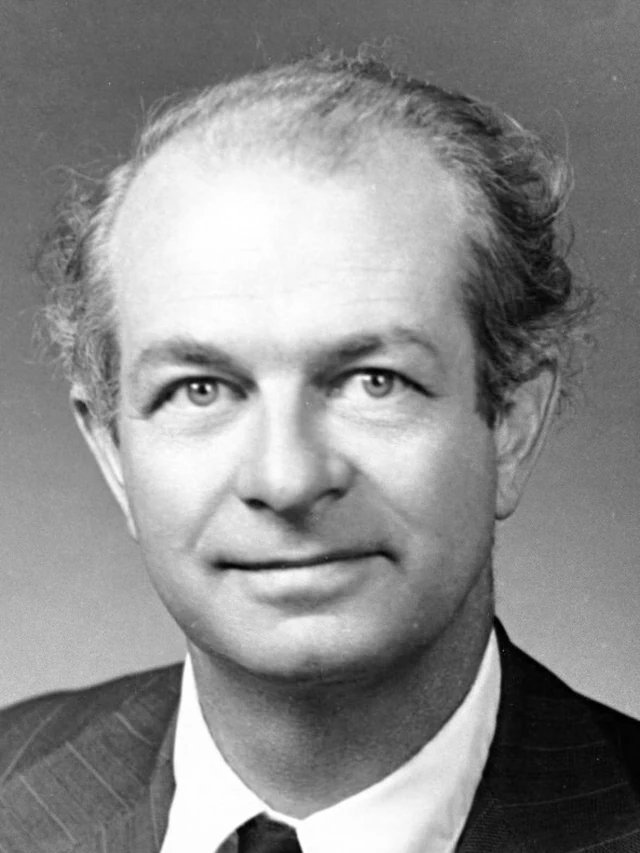

A life of discovery
The question they chased
Linus Pauling was born in Portland, Oregon, in 1901. His father died when Linus was nine. A friend's chemistry kit gave the boy a new obsession, and he began running experiments at home. He entered Oregon State at 16 without a high school diploma. The question he chased was what holds atoms together, and why molecules take the shapes they do.
He finished his doctorate at Caltech in 1925 and then studied in Europe with the physicists building quantum theory. He used their new ideas to explain chemical bonds. His 1939 book "The Nature of the Chemical Bond" became a standard of the field. Later he turned to the molecules of life, and in 1951 his team proposed the alpha helix, a coil shape found in proteins. In 1954 he won the Nobel Prize in Chemistry for his work on the chemical bond.
The big ideas
What Linus figured out
Atoms join by sharing or trading electrons. Pauling used the new quantum physics to explain how those bonds form and why they point in certain directions. Benzene, a ring of six carbon atoms, is a blend of two drawings at once, not a flicker between them.
Proteins are long chains that fold up. Pauling and his team worked out that parts of a chain can coil like a spring, the alpha helix, or lie in flat folded sheets. A protein's shape decides what it can do.
In 1949 Pauling and his colleagues showed that sickle cell anemia is tied to a change in hemoglobin, the protein that carries oxygen in red blood cells. It is often called the first disease understood at the level of a molecule. One small change in one molecule can change a life.
Key moments
How it unfolded
- 1925Pauling earns his doctorate at Caltech.
- 1939He publishes "The Nature of the Chemical Bond."
- 1949He and his colleagues publish "Sickle Cell Anemia, a Molecular Disease."
- 1951With Robert Corey and Herman Branson, he proposes the alpha helix and the beta sheet.
- 1954He receives the Nobel Prize in Chemistry.
- 1963He is awarded the Nobel Peace Prize for 1962, for his campaign against nuclear weapons tests.
The person behind the science
The boy who lost his father, and the man who spoke up
Pauling's life had hard stretches under the prizes. His father died in 1910, and the family had little money. As a teenager he worked in a grocery store and later as a machinist's apprentice to earn money. In 1953 he lost the race to the shape of DNA, and he never forgot it. In 1958 Caltech's trustees asked him to step down as head of his division, in the years when he was speaking out against nuclear testing.
His wife, Ava Helen, stayed beside him through all of it. They married in 1923 and were together until she died in 1981. He kept working on proteins and kept speaking about peace, even when it cost him. In 1954 and 1963 the world honored both halves of his life. A boy who started college without a diploma ended with two Nobel medals.
Small things that make them human
- Jobs as a teenagerHe worked at a grocery store and then as a machinist's apprentice while still a teen.
- Married for 58 yearsHe married Ava Helen Miller on June 17, 1923, and they had four children.
- Honest about his missHe called his failed DNA model the biggest disappointment of his life, and he kept doing science.
- A full houseBy the end he had four children and thirteen grandchildren.
A few surprising facts
Did you know
He is the only person to win two unshared Nobel Prizes. One was in chemistry and one was for peace.
He once built a three-strand model of DNA, and it was wrong. Watson and Crick found the double helix in early 1953. Pauling later called it the biggest disappointment of his life.
In 1952 the State Department refused him a passport to attend a science meeting in London. His full passport was restored shortly before his 1954 Nobel ceremony.
Late in life he promoted large daily doses of vitamin C. Careful trials did not support his claims. A great scientist can still be wrong.
Why it still matters
What this means for you
Pauling shows that big ideas can start with a plain question about what things are made of and how they fit. His work on molecules is why doctors can link a disease to a change in one protein. He also shows that a brilliant person can be wrong, and that you can speak up for what you believe is right even when it costs you. Both lessons help in a science class and outside it.
Ask what holds it together.
CURIOSITY ✦ RIGOR ✦ DISCOVERYTalk about it
Questions for your table
- Pauling's father died when he was nine, and he still found a path. Who or what helps you keep going when something hard happens?
- He got the shape of DNA wrong and said it hurt. How do you handle it when you get something wrong in front of other people?
- He spoke out about nuclear tests when it was not popular. When is it worth speaking up for something you believe, even if it costs you something?
Try it today
Three small steps
- Notice: Find three different materials in your room today and ask what might be holding each one together.
- Question: Ask a teacher how one tiny change in a molecule can change what a whole thing does.
- Test: Stretch a rubber band and a piece of string, compare how each one springs back, and write what you think the long molecules inside are doing.