
PHYSICS · NUCLEAR · ESTIMATION
Enrico Fermi
The Physicist Who Could Estimate Almost Anything
He led the team that built the first nuclear reactor, and he taught a generation to attack hard problems with a good guess.
- 1901 to 1954
- Italy and the United States
- Physics
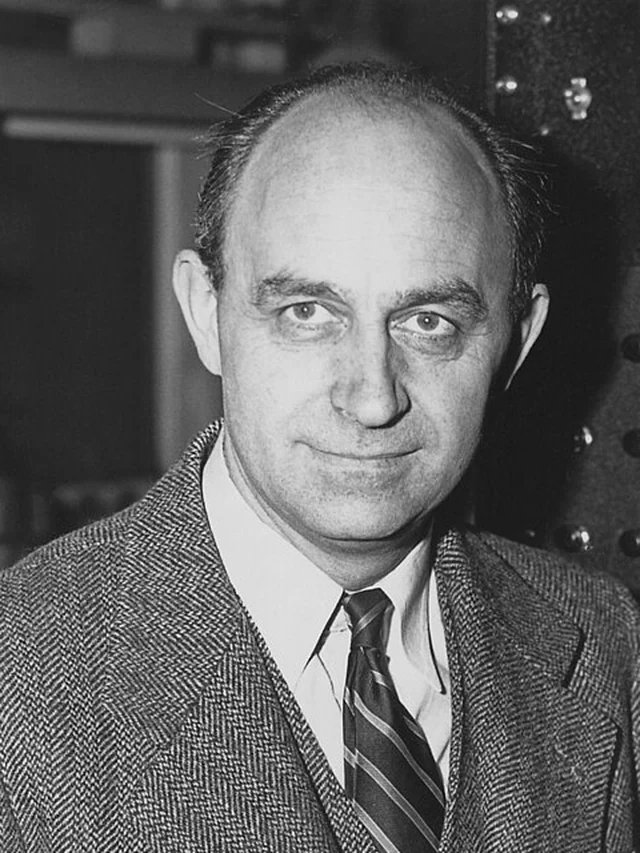

A life of discovery
The question they chased
Enrico Fermi was born in Rome in 1901. His brother Giulio shared his love of science, and the two were close. In 1915 Giulio died after an operation for a throat abscess, and Enrico was devastated. He threw himself into study. With his friend Enrico Persico he built gyroscopes and measured the Earth's magnetic field. At 17 he wrote an entrance essay for the Scuola Normale Superiore in Pisa, solving a problem about a vibrating string, and the examiner judged it worthy of a doctorate.
At 24 Fermi became a professor in Rome, where a new chair in theoretical physics was created for him. He gathered a young group nicknamed the Via Panisperna boys, after the street of their institute. In 1934 he developed a theory of beta decay, and his group found that slow neutrons are captured more easily than fast ones. The neutron work earned him the Nobel Prize in Physics in 1938. Because his wife, Laura, was Jewish, the family did not go back to Italy. They moved to the United States, and in 1942 Fermi led the team that built the first nuclear reactor.
The big ideas
What Enrico figured out
A neutron is a particle with no electric charge that can enter a nucleus. Fermi's team found that slow neutrons are captured more easily than fast ones. A slow ball is easier to catch than a fast one, and a slow neutron spends more time near a nucleus.
When a uranium nucleus splits, it releases more neutrons that can split other nuclei, like dominoes toppling in a row. On December 2, 1942, Fermi's team showed this chain could keep going on its own in a pile of uranium and graphite at the University of Chicago. They kept it controlled and steady.
Fermi loved quick estimates. To guess how many basketballs fit in a gym, break the question into small guesses about the gym and the ball. Some guesses will be too high and some too low, and the errors often balance out.
Key moments
How it unfolded
- 1922Fermi earns his doctorate at the Scuola Normale Superiore in Pisa.
- 1934His team in Rome finds that slow neutrons are captured more easily than fast ones.
- 1938He wins the Nobel Prize in Physics at age 37 and does not return to Italy after the ceremony.
- 1942On December 2 he leads the team that creates the first self-sustaining nuclear chain reaction.
- 1944He becomes a United States citizen and joins the work at Los Alamos.
- 1954Fermi dies in Chicago at age 53.
The person behind the science
The modest leader
Fermi met the loss of his brother at 14 by working. Years later he faced the loss of his homeland. In 1938 the Italian racial laws threatened his wife. After the ceremony in Stockholm the family moved on to the United States, and Fermi left behind the group he had built in Rome. He reached New York in January 1939. Later he advised against building the hydrogen bomb on moral and technical grounds.
Fermi was known for being modest and willing to do any job, from deep theory to routine chores. That made him liked at every rank. He loved tennis and mountain climbing, and he led friends on climbs. He was also an inspiring teacher, careful in his preparation and fond of simple explanations. His lecture notes later became books that are still in print. Among his students were Emilio Segrè, Owen Chamberlain, and Tsung-Dao Lee. He died in Chicago in November 1954.
Small things that make them human
- Mountain guideOn climbs he often acted as the guide for his friends.
- Careful notebooksHe kept his calculations in notebooks, and they are now held at the University of Chicago.
- Simple firstHe disliked complicated theories and preferred the most direct approach.
- Friends from the startPersico, and later Franco Rasetti, were close friends who shared his work.
A few surprising facts
Did you know
His friends nicknamed him The Pope because of his confident way of leading a group.
He once helped a graduate student move a table at Princeton and cut tin sheets with shears in a machine shop at Columbia.
At the first atomic test in 1945 he dropped strips of paper and used how far the blast pushed them to guess its power. He said about 10 kilotons, and the real number was about 18.6.
The element fermium is named for him.
Why it still matters
What this means for you
Fermi shows that big ideas can start with simple questions and honest guesses. The Fermi method is a skill every student can learn, because it turns a scary problem into a few small ones. His work also reminds us that science carries responsibility, and that a person can be both brilliant and humble. Students can borrow his habit of estimating first, then checking carefully.
Make a good guess, then check it.
CURIOSITY ✦ RIGOR ✦ DISCOVERYTalk about it
Questions for your table
- Fermi threw himself into study after his brother died. How do people you know cope with a hard loss, and what helps?
- Fermi was liked by people at every rank because he was willing to do any job. What small job could you take on that would help your class or team?
- He estimated first and checked later. When is a rough answer useful, and when do you need to be exact?
Try it today
Three small steps
- Notice: Look around your classroom and pick something countable, like ceiling tiles or books on a shelf.
- Question: Ask how many of them there are, then make a guess before you count.
- Test: Break your guess into smaller guesses, then count and see how close you came.