
BIOLOGY · GENETICS · MAIZE
Barbara McClintock
The Woman Who Watched Genes Move
She read the secrets of corn one kernel at a time, found genes that jump, and waited decades for the world to catch up.
- 1902 to 1992
- United States
- Life science
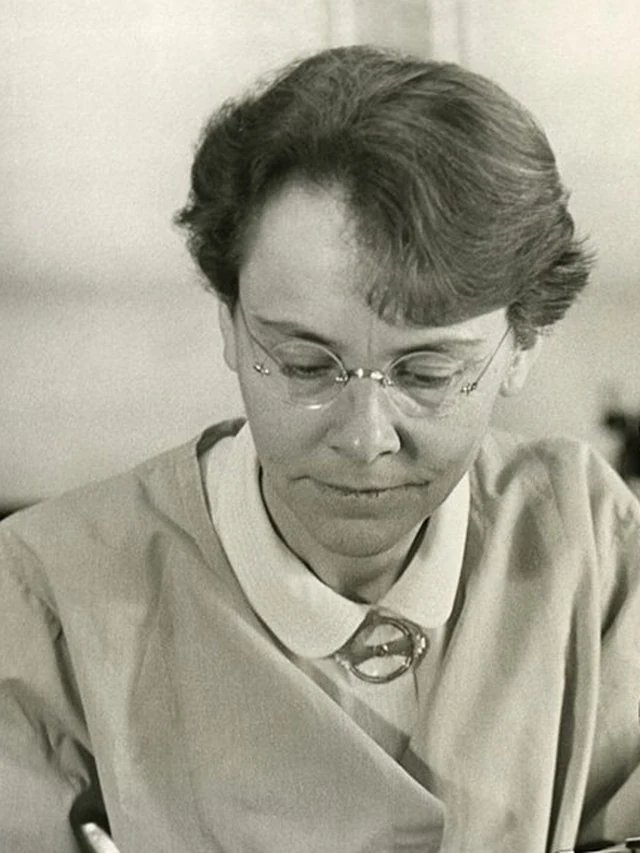

A life of discovery
The question they chased
Barbara McClintock was born in Hartford, Connecticut, in 1902 and grew up in Brooklyn. She was a solitary, independent child. She later spoke of her capacity to be alone. Her mother worried that college would make her unmarriageable, but her father backed her studies. She earned her PhD in botany at Cornell in 1927.
She studied maize, the plant we call corn. Its kernels carry color patterns that pass from parent to child, and McClintock tied those patterns to what she saw in the chromosomes. In 1931 she and Harriet Creighton showed that when chromosomes trade pieces, traits are reshuffled too. By 1948 she saw that some pieces of genetic material can move from place to place. She called them controlling elements.
The big ideas
What Barbara figured out
Before cells make eggs or pollen, paired chromosomes can swap matching sections. McClintock and Creighton showed in 1931 that this swap lines up with the reshuffling of traits in the offspring. Geneticists had inferred it. They gave a physical picture of it.
Not every gene stays fixed in place. In corn, a small piece can leave one spot and land in another. When one jumps out of a gene for color, that gene starts working again, and a speck of color shows up on a pale kernel.
Her moving pieces could switch nearby genes on or off. That means a cell's genes are not just a list of instructions. They are a system with controls. Scientists now find jumping genes in plants, animals, and people.
Key moments
How it unfolded
- 1927She earns her PhD in botany at Cornell.
- 1931With Harriet Creighton she links the swapping of chromosome pieces to the reshuffling of traits.
- 1944She is elected to the National Academy of Sciences, only the third woman to be honored that way.
- 1948She discovers that some genetic elements in corn can move.
- 1951She presents her results at Cold Spring Harbor, and the response is poor at first.
- 1983She wins the Nobel Prize in Physiology or Medicine, the sole winner that year, at age 81.
The person behind the science
The scientist who liked to be alone
McClintock was shy and not driven by ambition. She never married and gave her life to research. As a child she had a hard relationship with her mother and lived for a time with an aunt and uncle. At the University of Missouri in the 1930s she felt left out of faculty life and unsure of her future. Historians disagree about exactly why she left in 1941.
After 1951 her ideas about moving genes met a cool response. In 1953 she stopped publishing detailed accounts of her controlling elements. She did not stop working. In December 1941 Milislav Demerec had offered her a place at Cold Spring Harbor, and she stayed there for decades, growing corn and checking her results. Colleagues such as Harriet Creighton, Marcus Rhoades, and George Beadle were part of her working life. In 1970 she received the National Medal of Science, and in 1981 she was among the first MacArthur Fellows.
Small things that make them human
- A name chosen to fitShe was born Eleanor. Her parents changed it to Barbara because they thought it suited her.
- A home at the labDemerec offered her a temporary job at Cold Spring Harbor in December 1941. She became permanent staff in 1943.
- Trusted collaboratorsShe worked closely with scientists such as Harriet Creighton, who helped her prove the 1931 result.
- A mentor to the youngLate in life she mentored young scientists at Cold Spring Harbor, including Nancy Hopkins and Robert Martienssen.
A few surprising facts
Did you know
In 1945 she became the first woman president of the Genetics Society of America, a year after joining the National Academy.
In 1957 she won funding to study old corn varieties from Central and South America, and she kept working on her own questions.
Historians still disagree about why her work was set aside. Evelyn Fox Keller points to gender. Nathaniel Comfort points to her hard-to-read writing and limited data.
More than thirty years passed between her discovery and her Nobel Prize.
Why it still matters
What this means for you
McClintock shows what close looking can do. She did not have a giant machine. She had corn, a microscope, and patience. If you have an idea that people do not understand yet, you can keep working and keep your evidence clear. In her case the world caught up. Today jumping genes are part of how scientists understand how genomes change over time.
Look closely and trust what you see.
CURIOSITY ✦ RIGOR ✦ DISCOVERYTalk about it
Questions for your table
- McClintock liked being alone when she worked, and her mother doubted her path. Where do you think best, and who backs you when others doubt you?
- Her ideas got a poor response in 1951. What would you do if people did not understand something you had worked hard on?
- She found big answers by studying one plant for years. What is one thing you could look at closely for a week and learn something new from?
Try it today
Three small steps
- Notice: Look closely at an ear of corn, a leaf, or a flower and write down three details you never saw before.
- Question: Ask what changes in a living thing during its life and what stays the same.
- Test: Plant five seeds from the same packet, then measure and record how each one grows over two weeks to see how much they differ.