
MATH · COMPUTING · CODES
Alan Turing
The Man Who Imagined Thinking Machines
On paper he invented the idea of the modern computer, then used his mind to help break wartime codes.
- 1912 to 1954
- England
- Math
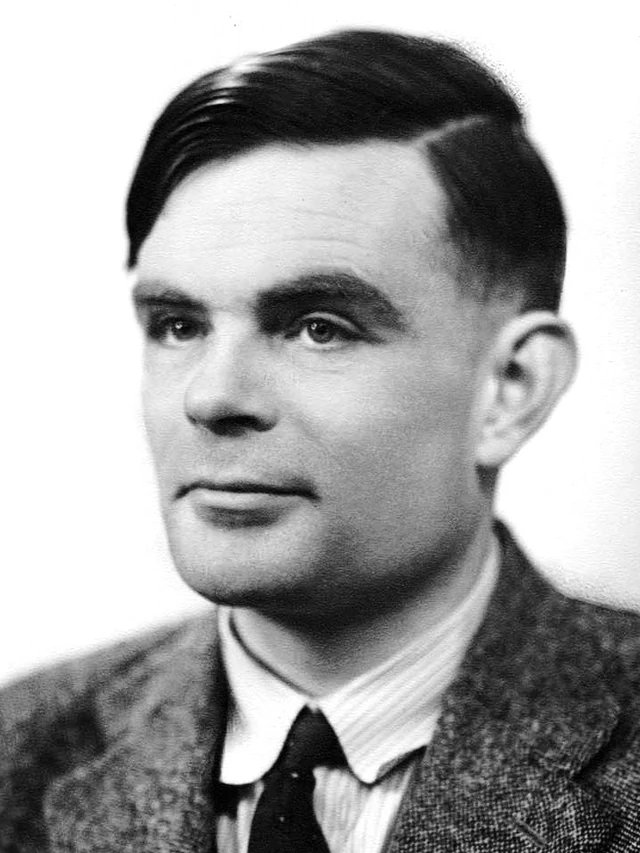

A life of discovery
The question they chased
Alan Turing was born in Maida Vale, London, in 1912. His parents worked overseas, so he boarded at Sherborne School in Dorset from age 13. The school focused on classical subjects, which did not suit him, so he studied math and science on his own. There he found his best friend, Christopher Morcom. The question Turing chased all his life was what a machine could do and whether a machine could think.
At King's College, Cambridge, he studied mathematics and became a fellow in 1935. In 1936 he published "On Computable Numbers," which described an imaginary machine that could follow any set of step-by-step rules. He earned a doctorate at Princeton in 1938. When war began he joined the codebreakers at Bletchley Park and helped break the German Enigma code. After the war he built early computers and wrote about machine intelligence.
The big ideas
What Alan figured out
Imagine a long paper tape and a simple device that reads one square at a time, follows a rule, and writes a mark. Turing showed that one such machine could imitate any other if it was given the right instructions. That idea is the root of programmable computers.
The German military used Enigma machines to scramble messages. Turing specified the electromechanical bombe, a machine that found Enigma settings faster than earlier methods. He also led Hut 8, the section that worked on German naval codes. His work is credited with shortening the war.
In 1950 Turing wrote "Computing Machinery and Intelligence." He proposed a test. If a person chatting by text cannot tell whether the other side is a person or a machine, the machine has passed. People still use the Turing test to talk about artificial intelligence.
Key moments
How it unfolded
- 1930His close friend Christopher Morcom dies in February, and Turing is deeply saddened.
- 1936He publishes "On Computable Numbers" and introduces the Turing machine.
- 1939He joins the codebreaking work at Bletchley Park.
- 1948He joins the University of Manchester and tries out for the British Olympic marathon team, though an injury holds him back.
- 1950He publishes his paper on machine intelligence that proposes the Turing test.
- 1952He publishes a paper on how chemicals spreading and reacting could make patterns like spots and stripes in living things.
The person behind the science
The friend, the runner, the odd genius
Turing was an independent boy who often worked alone. The friend who brought him out was Christopher Morcom, who encouraged his curiosity. Morcom died of bovine tuberculosis in 1930, a few weeks into their last term, when both boys were still in school. Turing was deeply saddened. He accepted prizes in Morcom's memory and kept writing to Morcom's mother for years afterward. Historians say the loss deepened his interest in the mind, though that link is a careful guess.
Turing had a close circle of colleagues. At Bletchley he worked beside Joan Clarke, a fellow codebreaker, and in 1941 he asked her to marry him. The engagement ended, and they did not marry. His mother, Sara, stayed in his life, and at Princeton he studied under Alonzo Church. He also had running, and he got close to the standard for the Olympic team. In 1952 he was convicted under a law now recognized as unjust, and he died two years later at the age of 41.
Small things that make them human
- A chained mugHe chained his mug to a radiator pipe so it could not be stolen.
- Letters to a friend's motherHe kept writing to Morcom's mother long after his friend died.
- Always runningHe jogged to meetings and chased a place on the 1948 Olympic team.
- Prefers to think aloneHe preferred to work alone and in isolation.
A few surprising facts
Did you know
The story told about his first day at Sherborne is that he rode his bicycle more than 60 miles to get there during a transport strike.
A colleague, Jack Good, remembered that Turing chained his mug to a radiator pipe so no one would take it.
In 1948 his marathon trial time was about 11 minutes slower than the 2 hours 35 minutes that won silver at the Olympics that year.
After he joined Manchester in 1948, he worked where the Baby, described as the first stored-program computer, was built.
Why it still matters
What this means for you
Every phone, laptop, and video game rests on ideas Turing explored. His codebreaking shortened a terrible war, and his questions about machine thinking now fill our news. Britain apologized for how it treated him in 2009, and a royal pardon followed in 2013. Students can learn from his curiosity, his hard work, and the way he saw a problem in a fresh light. They can also learn that a society can be wrong about a person, and can try to make it right.
Ask what a machine could do.
CURIOSITY ✦ RIGOR ✦ DISCOVERYTalk about it
Questions for your table
- Turing studied math and science on his own because school did not offer what he wanted. What do you teach yourself outside class, and why?
- Morcom's death shaped Turing, and he kept in touch with Morcom's mother. How can staying connected help people through loss?
- Turing asked whether a machine can think. What would a machine need to do before you would say it was thinking?
Try it today
Three small steps
- Notice: Watch how a simple set of rules, like a recipe or a game, tells you exactly what to do at each step.
- Question: Ask what the smallest set of steps would be to tell a robot how to make a sandwich.
- Test: Write step-by-step instructions for a short task, give them to a friend who must follow them exactly, and see where they fail.