
PHYSICS · GRAVITY · LIGHT
Isaac Newton
The Lonely Mind That Found the Rules of Motion
A fatherless boy who built toy windmills grew into a guarded, stubborn genius who showed that one law moves both apples and planets.
- 1643 to 1727
- England
- Physics
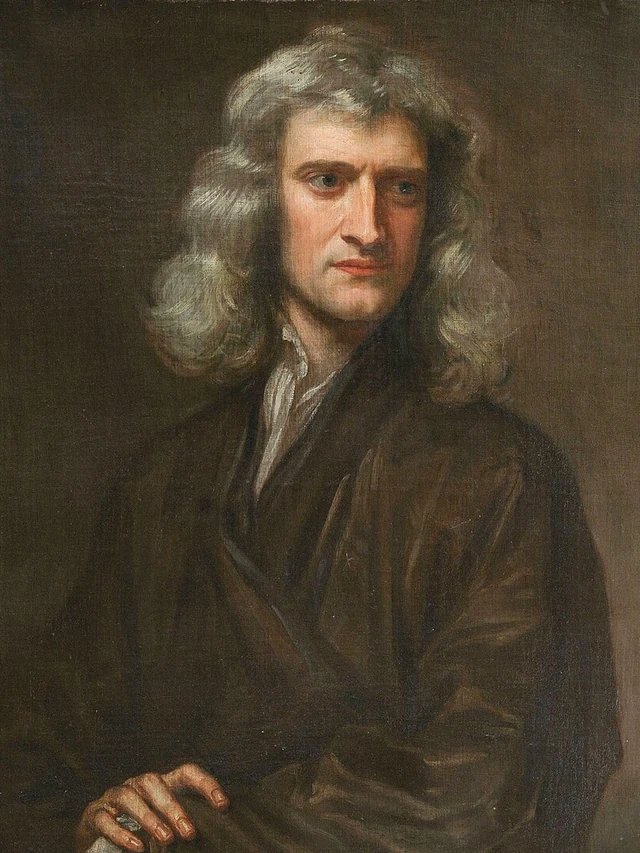

A life of discovery
The question they chased
Isaac Newton was born in a farmhouse in Lincolnshire, England. His father had died three months before. He arrived early and so small that his mother said he could have fit inside a quart mug. The question that followed him all his life was simple. What rules make things move, and do the same rules work in the sky?
In 1687 he published the "Principia," with help and money from his friend Edmond Halley. It laid out three laws of motion and the law of gravity. Before Newton, many people thought heaven and earth ran by different rules. He showed they did not. He also split sunlight with a prism, built the first working reflecting telescope, and worked out a form of calculus.
The big ideas
What Isaac figured out
A moving thing keeps moving the same way until a force changes it. A bigger force makes a bigger change, and a heavier object needs more force. Every push has an equal push back. Think of a skateboard. Step off it and it rolls away the other direction.
Newton said the pull that drops an apple also holds the Moon in its path around Earth. Picture a cannonball fired from a tall mountain. Fire it faster and it lands farther away. Fast enough, and it keeps falling around the whole planet. That is an orbit.
Newton passed sunlight through a glass prism and got a rainbow. Then he showed a second prism could put the colors back into white light. So color was not something the glass added. It was already inside the light.
Key moments
How it unfolded
- 1661Newton enters Trinity College, Cambridge, working for his keep as a servant to richer students.
- 1665The Great Plague closes Cambridge and sends him home to Woolsthorpe for about two years of deep thinking.
- 1687The "Principia" is published and changes how people understand motion.
- 1696He leaves Cambridge for London to become Warden of the Royal Mint, and later its Master.
- 1703He becomes President of the Royal Society, a post he keeps until he dies.
- 1705Queen Anne knights him.
The person behind the science
The boy who was left behind
When Newton was about three, his mother married a minister and moved away. She left him with his grandmother. He disliked his stepfather and held some resentment toward his mother for the marriage. He grew into a private, watchful man who trusted few people and took offense easily. He could hold one problem in his mind for days.
The hardest stretch came around 1693. He wrote to Samuel Pepys that he had not eaten or slept well for a year and that his old steadiness of mind was gone. He sent angry, confused letters to friends, and a close friendship with the young Nicolas Fatio de Duillier ended. Historians do not agree on the cause. Some point to exhaustion, some to chemical fumes from his experiments. No one knows for sure. He recovered, went back to work, and three years later took on the Mint.
Small things that make them human
- A fight he never forgaveRobert Hooke said he gave Newton the idea of the inverse square law. Newton said Hooke only guessed and never proved it. In the Principia he did credit Hooke, Wren and Halley for seeing the idea.
- A rival across the seaNewton and Gottfried Leibniz argued for years over who invented calculus. Newton wrote the final remarks of the Royal Society report that sided with him. Most historians today say each man found it on his own.
- The Mint was no easy jobNewton helped finish the Great Recoinage in about two years. He pursued the counterfeiter William Chaloner until he was convicted in 1699.
- Hours at the furnaceHe built his own furnaces for alchemy and sometimes worked for weeks at a stretch. He also studied the Bible in its original languages and kept some of his private beliefs hidden.
A few surprising facts
Did you know
As a boy he built a model windmill. An early biographer, writing long after, said a mouse turned it. He also made sundials, a water clock, kites and paper lanterns.
He wrote over a million words on alchemy and religion. He kept almost all of it private.
He never married. When he died he was the first scientist given a burial in Westminster Abbey.
At the Mint he held more than 100 cross-examinations in about eighteen months to track down coin counterfeiters.
Why it still matters
What this means for you
Newton shows that a hard start does not decide how far you can go. He was alone a lot, he was stubborn, and he made enemies. He also asked big questions and stuck with them for years. His laws are still how engineers plan bridges and how scientists plan flights to Mars. And his life is a reminder to be fair to people who disagree with you. Even brilliant people struggle with that.
Stay with the question until it gives way.
CURIOSITY ✦ RIGOR ✦ DISCOVERYTalk about it
Questions for your table
- Newton worked alone for long stretches and rarely shared his ideas. What are the good and bad sides of that for a student working on a hard problem?
- Newton and Hooke each believed the other was unfair. How would you handle a disagreement over who deserves credit for a group project?
- Newton had a rough year in 1693 and then went back to work and took on a new job. What helps you start again after a bad stretch?
Try it today
Three small steps
- Notice: Drop a ball and toss a ball sideways from the same height at the same time, and watch which lands first.
- Question: Pick one thing you use every day and ask what forces act on it and which way each one pushes.
- Test: Hold a clear glass of water in sunlight near a white wall and see whether you can make a rainbow appear.