
MICROSCOPES · MICROBES
Antonie van Leeuwenhoek
The Cloth Merchant Who Found a World in a Drop of Water
He sold cloth for a living and taught himself to grind lenses. Antonie van Leeuwenhoek went on to see bacteria for the first time.
- 1632 to 1723
- Netherlands
- Life science
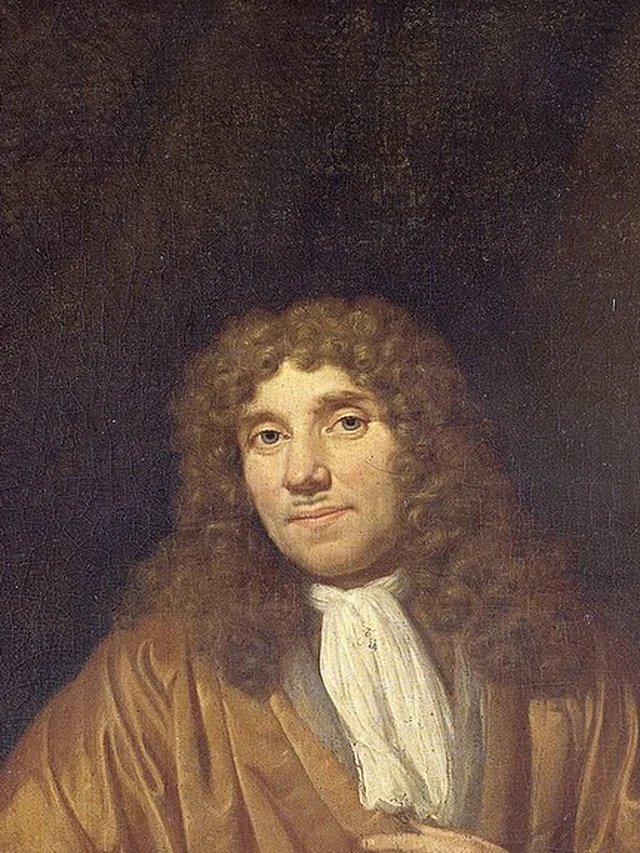

A life of discovery
The question they chased
Antonie van Leeuwenhoek was born in Delft in the Dutch Republic on 24 October 1632. His father was a basket-maker. After six years as an apprentice in Amsterdam, he opened a draper's shop in Delft in 1654. He also held civic jobs, including surveyor and wine tester. He had no university training and was largely self-taught. His question was simple. What is hiding inside things that are too small to see?
Leeuwenhoek taught himself to grind lenses and built hundreds of them. He made at least 25 microscopes, each with a single tiny lens, and nine survive. The best of them magnify about 275 times. From 1673 he wrote letters in Dutch to the Royal Society of London, and they were translated and printed. In 1674 he saw moving specks in lake water and decided they were tiny living animals, which he called animalcules. In 1676 more of his reports followed, and many people did not believe him.
The big ideas
What Antonie figured out
Leeuwenhoek built single-lens microscopes. One small, well-ground lens can show far more than a poor pair of lenses. His skill at grinding glass was his advantage, and he kept some of his methods to himself.
A drop of pond water looks clear to the eye. Under his lens it held swimming living things. He later described what we now know as bacteria and single-celled organisms. Life, he showed, comes in sizes nobody had imagined.
He described red blood cells, and he was among the first to see blood flowing through the thinnest vessels, the capillaries. This filled in a gap that William Harvey's work had left open.
Key moments
How it unfolded
- 1632Antonie is born in Delft on 24 October.
- 1654He opens his own draper's shop in Delft and marries Barbara de Mey.
- 1673His first letter is printed by the Royal Society in London.
- 1676He reports tiny living creatures in water and is also named trustee of the painter Jan Vermeer's estate.
- 1677After a committee checks his work, the Royal Society fully accepts his observations.
- 1723He dies in Delft at age 90.
The person behind the science
The shopkeeper with a secret
Leeuwenhoek's life had real sorrow. He married Barbara de Mey in 1654, and they had five children. Four died as babies. Only their daughter Maria lived. Barbara died in 1666. He later married Cornelia Swalmius in 1671, and they had no children. Through these years he kept his shop open and kept grinding lenses.
His claims met doubt at first. The Royal Society sent a committee to check what he saw, and in 1677 it fully accepted his findings. He kept working into old age. Notable visitors came to Delft, including the scientists Christiaan Huygens and Gottfried Leibniz and the philosopher John Locke. A cloth merchant with no degree had become someone whom important people wanted to meet.
Small things that make them human
- A big pile of lettersHe sent about 190 letters to the Royal Society in his lifetime, and about 560 letters in all to groups and people.
- A duty to shareHe seemed to feel that writing down his discoveries was a duty, so others could learn from them.
- A possible sparkRobert Hooke's illustrated book “Micrographia” may have inspired him to take up the microscope.
- A very long lifeHe lived to the age of 90 and died in Delft, the city where he was born.
A few surprising facts
Did you know
He probably knew the painter Jan Vermeer, since both lived near the market in Delft, and he served as trustee of Vermeer's estate in 1676.
He was elected to the Royal Society in 1680 but never attended a meeting.
Tsar Peter the Great of Russia visited him, and in 1697 Leeuwenhoek gave him a special device for viewing eels.
He kept his best lens-making methods to himself, even while he shared what he saw with the world.
Why it still matters
What this means for you
Leeuwenhoek proves you do not need a degree to discover something new. You need patience, good tools, and a willingness to look at ordinary things closely. He also shows how hard it is to be believed when you see something no one else has seen. His answer was not to get angry. He let other people check. Every germ you wash from your hands is part of a world he opened.
Ordinary water holds a whole world.
CURIOSITY ✦ RIGOR ✦ DISCOVERYTalk about it
Questions for your table
- Leeuwenhoek had no college degree and still changed science. What do you think he had that mattered more than a degree?
- People doubted him until a committee checked his work. How do you feel when someone does not believe what you saw, and what helps you respond well?
- He lost four children and his first wife and still kept working. What keeps you going when something heavy happens?
Try it today
Three small steps
- Notice: Take a clear drop of water from a puddle or a vase and look at it with a magnifier or a phone camera zoomed all the way in.
- Question: Write down one thing around you that is too small to see, and say how you could find out what it is.
- Test: Look at the same ordinary object, such as a leaf or a grain of salt, with and without a magnifier and write down five new things you notice.