
BOTANY · NAMING · CLASSIFICATION
Carl Linnaeus
The Man Who Gave Living Things Their Names
A boy who often left lessons to hunt for plants grew up to give science a simple way to name living things.
- 1707 to 1778
- Sweden
- Life science
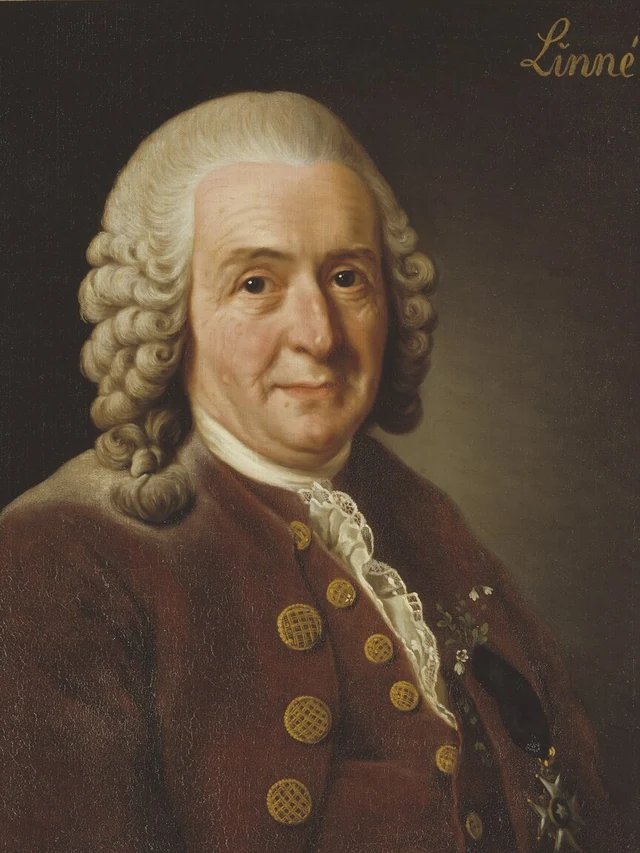
A life of discovery
The question they chased
Carl Linnaeus was born on 23 May 1707 in Råshult in the Swedish region of Småland. His father, Nils, was a Lutheran minister and a hobby botanist. He taught Carl Latin and geography and gave him his own plot to grow plants. In school Carl rarely studied and often wandered off to find plants. His father even thought about making him a cobbler's apprentice. The question that followed him was this. How do you make sense of so many kinds of living things?
A headmaster and a local doctor named Johan Rothman saw his gift and helped him. He went to Uppsala University in 1728. In 1732 he traveled for about six months through Lapland, on foot and on horseback, and wrote “Flora Lapponica” about the plants he found. In 1735 his “Systema Naturae” appeared in the Netherlands as a twelve-page work. In 1753 his “Species Plantarum” described over 7,300 plant species and became the starting point for naming plants.
The big ideas
What Carl figured out
Linnaeus gave each kind of plant a short name made of two Latin words. The first word is the genus, like a family name. The second picks out the species. It is how scientists everywhere can talk about the same plant, even if they speak different languages.
He sorted nature into nested groups, much like folders on a computer. By the tenth edition of “Systema Naturae” in 1758 he had placed about 4,400 kinds of animals and 7,700 kinds of plants into his system.
A short, agreed name makes it much easier to share facts about a plant or animal. That is why field guides list a Latin name for each one. Species Plantarum is now the starting point of modern plant naming.
Key moments
How it unfolded
- 1707Carl is born in Råshult on 23 May.
- 1732He sets off on a six-month trip to Lapland to study its plants.
- 1735The first edition of “Systema Naturae” is printed in the Netherlands.
- 1739He marries Sara Elisabeth Moræa after finding steady work as a doctor.
- 1753“Species Plantarum” is published and becomes the starting point for plant names.
- 1778He dies on 10 January at age 70.
The person behind the science
The boy who loved plants more than school
School was not easy for Carl. He disliked his tutor, and at the grammar school in Växjö some professors doubted that he would ever be a scholar. Later in life he knew real grief too. His daughter Sara Magdalena lived only 15 days, and his son Johannes died at age three. Then his own body began to fail. He had a fever in 1764, sciatica in 1773, and a stroke in 1774.
Several people stood by him. Daniel Lannerus, a headmaster, saw his passion for plants. Dr. Rothman offered to teach him at home. At Uppsala the professor Olof Celsius gave him a place to live and use of a library, and Olof Rudbeck the Younger chose him to give lectures. He married Sara Elisabeth Moræa in 1739 and they had seven children. A second stroke in 1776 took his memory, and he died in January 1778.
Small things that make them human
- Almost a cobblerHis father considered a cobbler's apprenticeship until a headmaster noticed Carl's interest in plants.
- A walk of 2,000 kilometersHis Lapland trip covered more than 2,000 kilometers, funded by a grant from the Royal Society of Sciences.
- Students sent far awayChristopher Tärnström died in 1746 on Côn Sơn Island, and six other apostles also died on their expeditions.
- A mind that fadedHis memory was lost after a stroke in his last years, a hard thing for a man who named thousands of plants.
A few surprising facts
Did you know
His father once thought about making him a cobbler's apprentice because school was going so badly.
He called his time working for a rich patron in Holland, George Clifford, the happiest time of his life.
He called 17 of his students his apostles, and he sent them around the world to collect plants. Several died on their journeys.
He placed humans among the primates, which upset some naturalists and church leaders of his time.
Why it still matters
What this means for you
Every time you read a label that says Homo sapiens or Quercus alba, you are using a system Linnaeus made popular. It is a good reminder that a simple tool can help the whole world work together. His story is also honest about limits. Some of his groupings of people are now criticized for supporting racist ideas. A student can admire the useful part of a scientist's work and still say clearly that other parts were wrong.
Give it a name and share it.
CURIOSITY ✦ RIGOR ✦ DISCOVERYTalk about it
Questions for your table
- Linnaeus struggled in school and still became a famous scientist. What was it that his teachers noticed, and what might they notice about you?
- His naming system helped scientists worldwide, but some of his groups of people are criticized today. How should we treat the good and the harmful parts of a famous person's work?
- Linnaeus lost two young children and later lost his memory. Who or what helps you through times of loss?
Try it today
Three small steps
- Notice: Walk outside and pick three different leaves, then write what is the same and what is different about them.
- Question: Sort ten things in your backpack into groups within groups, like folders, and explain your rule at each step.
- Test: Look up the Latin two-part name of a tree or bird near your home and see if a friend can find it using only that name.