
CHEMISTRY · OXYGEN · MEASUREMENT
Antoine Lavoisier
The Chemist Who Put Everything on the Scale
He weighed everything. Antoine Lavoisier showed that burning does not destroy matter and gave oxygen its name.
- 1743 to 1794
- France
- Chemistry
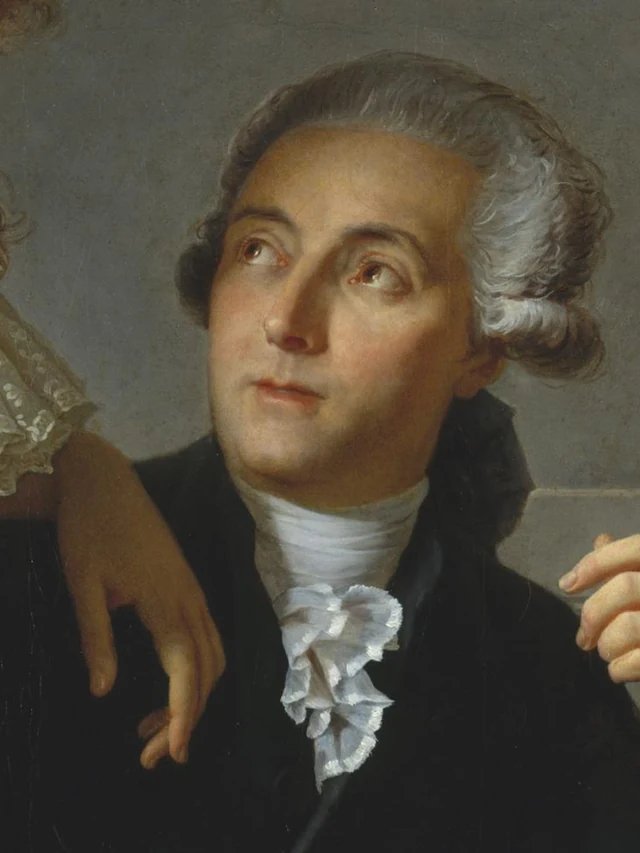

A life of discovery
The question they chased
Antoine Lavoisier was born in Paris on 26 August 1743. His mother died when he was five, and he grew up wealthy. He went to the Collège Mazarin at age 11 and later earned a law degree, but he never practiced law. Science pulled him away. In 1768 he received a provisional place at the Academy of Sciences. The question that drove him was simple. What really happens when something burns?
His answer came from the balance scale. He weighed materials before and after a reaction, often in sealed containers, and he found that nothing went missing. When things burn, they join with a part of the air. He named that part oxygen in 1778. In 1783 he recognized hydrogen as an element, and he helped show that water is made of hydrogen and oxygen. In 1789 he published “Traité élémentaire de chimie,” often seen as an early modern chemistry textbook.
The big ideas
What Antoine figured out
Light a candle inside a sealed jar and weigh the whole jar before and after. The weight stays the same. The wax and air changed into new things, but nothing vanished. Chemists call this conservation of mass.
People once taught that burning released a substance called phlogiston. Lavoisier argued the opposite. A burning material combines with oxygen from the air. A rusting nail does the same thing, just slowly.
In 1787 he helped reform chemical naming so that a name told you something about what was inside. A clear name makes it easier for the next student to understand.
Key moments
How it unfolded
- 1743Antoine is born in Paris on 26 August.
- 1771He marries Marie-Anne Paulze, who becomes his partner in the laboratory.
- 1778He names oxygen.
- 1789He publishes his chemistry textbook, “Traité élémentaire de chimie.”
- 1791He serves on the commission that recommends the metric system.
- 1794He dies in Paris on 8 May, at age 50, after the Revolution turns against the old tax collectors.
The person behind the science
The scientist and the partner beside him
Lavoisier lost his mother at five. As an adult he was wealthy, and he had joined the Ferme générale. That was a company that collected taxes for the king, and many people hated it. When the French Revolution turned against the old system, that job put him in danger. An order for the arrest of the tax collectors was issued in November 1793. He hid for a few days, then turned himself in on 30 November.
At the trial, he drafted a defense for the group. The trial lasted less than a day, and he was executed on 8 May 1794 along with 27 others. Marie-Anne had been at his side the whole time. She had translated, drawn, edited, and hosted the scientists who met at their home. About a year and a half after his death, the government cleared his name. When his belongings were returned to Marie-Anne, a note said he had been falsely convicted.
Small things that make them human
- A partner in the labMarie-Anne worked beside him in the lab at the Paris Arsenal and made sketches and engravings of his instruments.
- Law, but not for himHe earned a law degree and passed into the bar, then walked away from law for science.
- Evenings with scientistsMarie-Anne hosted gatherings where scientists talked about chemistry.
- Editor of his memoirsShe edited and published his memoirs.
A few surprising facts
Did you know
In 1775 he became one of four gunpowder commissioners and got a house and a lab at the Royal Arsenal. He trained Éleuthère Irénée du Pont, who later started a gunpowder company in America.
He studied prison hygiene in 1780 and 1791 and suggested improvements, but most of his advice was ignored.
A popular story says a judge told him the Republic had no need of scientists. Historians think this line was almost certainly never said.
His wife, Marie-Anne, translated English chemistry for him, and she drew and engraved the laboratory instruments for his book.
Why it still matters
What this means for you
Lavoisier changed chemistry by trusting measurements over stories. When you weigh your reactants and products in a lab, you are doing what he did. His life is also a reminder that good science often depends on a team, and that the people beside the famous name matter. And when you read about hard times in history, remember that Marie-Anne carried his work forward after he was gone.
Weigh it, and the truth shows up.
CURIOSITY ✦ RIGOR ✦ DISCOVERYTalk about it
Questions for your table
- Lavoisier trusted the scale over the popular story about burning. When has a measurement surprised you or changed your mind?
- Marie-Anne translated, drew, edited, and hosted. Why do you think her name was left out of so many history books, and who are the helpers behind projects in your life?
- Lavoisier faced hard days because of a job he held. How can a choice you make at a young age affect you later, and how do you deal with that?
Try it today
Three small steps
- Notice: Weigh a piece of steel wool on a kitchen scale, wet it, let it rust for a day, and weigh it again.
- Question: Write down what you think happens to a candle's wax as it burns and where it goes.
- Test: Put baking soda and vinegar in a balloon sealed over a bottle, weigh the whole thing before and after, and compare the numbers.