
Appendix II
Minkowski’s Four-Dimensional Space (“World”) [Supplementary to Section XVII]
We can characterise the Lorentz transformation still more simply if we introduce the
imaginary  in place of t, as time-variable. If, in accordance with this, we insert
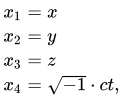 and similarly for the accented system K′, then the condition which is identically satisfied by the transformation can be expressed
thus:
(12)
 (12)
That is, by the afore-mentioned choice of “coordinates,” (11a) is transformed into this equation.
We see from (12) that the imaginary time co-ordinate  , enters into the condition of transformation in exactly the same way as the space
co-ordinates
 . It is due to this fact that, according to the theory of relativity, the “time” , enters into natural laws in the same form as the space co-ordinates .
A four-dimensional continuum described by the “co-ordinates”  , was called “world” by Minkowski, who also termed a point-event a “world-point.”
From a “happening” in three-dimensional space, physics becomes, as it were, an “existence
“in the four-dimensional “world.”
This four-dimensional “world” bears a close similarity to the three-dimensional “space”
of (Euclidean) analytical geometry. If we introduce into the latter a new Cartesian
co-ordinate system ( ) with the same origin, then , are linear homogeneous functions of which identically satisfy the equation

The analogy with (12) is a complete one. We can regard Minkowski’s “world” in a formal manner as a four-dimensional Euclidean space (with an imaginary time coordinate); the Lorentz transformation corresponds to a “rotation” of the co-ordinate system in the four-dimensional “world.”