Lecture V
The Two Great Sculptors—Water and Ice
In our last lecture we saw that water can exist in three forms:—1st, as an invisible vapour; 2nd, as liquid water; 3rd, as solid snow and ice.
To-day we are going to take the two last of
To understand why they deserve this name we must first consider what the work of a sculptor is. If you go into a statuary yard you will find there large blocks of granite, marble, and other kinds of stone, hewn roughly into different shapes; but if you pass into the studio, where the sculptor himself is at work, you will find beautiful statues, more or less finished; and you will see that out of rough blocks of stone he has been able to cut images which look like living forms. You can even see by their faces whether they are intended to be sad, or thoughtful, or gay, and by their attitude whether they are writhing in pain, or dancing with joy, or resting peacefully. How has all this history been worked out from the shapeless stone? It has been done by the sculptor's chisel. A piece chipped off here, a wrinkle cut there, a smooth surface rounded off in another place, so as to give a gentle curve; all these touches gradually shape the figure and mould it out of the rough stone, first into a rude shape and afterwards, by delicate strokes, into the form of a living being.
Now, just in the same way as the wrinkles and curves of a statue are cut by the sculptor's chisel, so the hills and valleys, the steep slopes and gentle curves on the face of our earth, giving it all its beauty, and the varied landscapes we love so well, have been cut out by water and ice passing over them. It is true that some of the greater wrinkles of the earth, the lofty mountains, and the high masses of land which rise above the sea, have been caused by earthquakes and
Go for a walk in the country, or notice the landscape as you travel on a railway journey. You pass by hills and through valleys, through narrow steep gorges cut in hard rock, or through wild ravines up the sides of which you can hardly scramble. Then you come to grassy slopes and to smooth plains across which you can look for miles without seeing a hill; or, when you arrive at the seashore, you clamber into caves and grottos, and along dark narrow passages leading from one bay to another. All these—hills, valleys, gorges, ravines, slopes, plains, caves, grottos, and rocky shores—have been cut out by water. Day by day and year by year, while everything seems to us to remain the same, this industrious sculptor is chipping away, a few grains here, a corner there, a large mass in another place, till he gives to the country its own peculiar scenery, just as the human sculptor gives expression to his statue.
Our work to-day will consist in trying to form some idea of the way in which water thus carves out the surface of the earth, and we will begin by seeing how much can be done by our old friends the rain-drops before they become running streams.
Everyone must have noticed that whenever rain falls on soft ground it
makes small round holes in
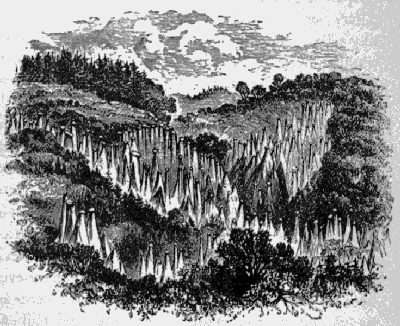 Fig. 24.—Earth-pillars near Botzen, in the Tyrol. (Adapted from Lyell's
'Principles.')
Where these pillars stand there was once a solid mass of clay and stones, into which the rain-drops crept, loosening the earthy particles; and then when the sun dried the earth again, cracks were formed so that the next shower loosened it still more, and carried some of the mud down into the valley below. But here and there large stones were buried in the clay, and where this happened the rain could not penetrate,
Another way in which rain changes the surface of the earth is by sinking down through loose soil from the top of a cliff to a depth of many feet till it comes to solid rock, and then lying spread over a wide space. Here it makes a kind of watery mud, which is a very unsafe foundation for the hill of earth above it, and so after a time the whole mass slips down and makes a fresh piece of land at the foot of the cliff. If you have ever been at the Isle of Wight you will have seen an undulating strip of ground, called the Undercliff, at Ventnor and other places, stretching all along the sea below the high cliffs. This land was once at the top of the cliff, and came down by a succession of landslips such as we have been describing. A very great landslip of this kind happened in the memory of living people, at Lyme Regis, in Dorsetshire, in the year 1839.
You will easily see how in forming earth-pillars and causing landslips rain changes the face of the country,
Now just this, which we can watch whenever a heavy shower of rain comes down on the road, happens also all over the world. Up in the mountains, where there is always a great deal of rain, little rills gather and fall over the mountain sides, meeting in some stream below. Then, as this stream flows on, it is fed by many runnels of water, which come from all parts of the country, trickling along ruts, and flowing in small brooks and rivulets down the gentle slope of the land till they reach the big stream, which at last is important enough to be called a river. Sometimes this river comes to a large hollow in the land and there the water gathers and forms a lake; but still at the lower end of this lake out it comes again, forming a new river, and growing and growing by receiving fresh streams until at last it reaches the sea.
The River Thames, which you all know, and whose course you will find clearly described in Mr. Huxley's
But what has this to do with sculpture or cutting out of valleys? If you will only take a glass of water out of any river, and let it stand for some hours, you will soon answer this question for yourself. For you will find that even from river water which looks quite clear, a thin layer of mud will fall to the bottom of the glass, and if you take the water when the river is swollen and muddy you will get quite a thick deposit. This shows that the brooks, the streams, and the rivers wash away the land as they flow over it and carry it from the mountains down to the valleys, and from the valleys away out into the sea.
But besides earthy matter, which we can see, there is much matter dissolved in the water of rivers (as we mentioned in the last lecture), and this we cannot see.
If you use water which comes out of a chalk country you will find that after a time the kettle in which you have been in the habit of boiling this water has a hard crust on its bottom and sides, and this crust
Imagine to yourselves the whole of St. Paul's churchyard filled with oyster-shells, built up in a large square till they reached half as high again as the top of the cathedral, then you will have some idea of the amount of chalk carried invisibly past Bonn in the water of the Rhine every year.
Since all this matter, whether brought down as mud or dissolved, comes
from one part of the land to be carried elsewhere or out to sea, it is
clear that some gaps and hollows must be left in the places from which
it is taken. Let us see how these gaps are made. Have you ever clambered
up the mountain-side, or even up one of those small ravines in the
hill-side, which have generally a little stream trickling through them?
If so, you must have noticed the number of pebbles, large and small,
lying in patches here and there in the stream, and many pieces of broken
rock, which are often scattered along the sides of the ravine; and how,
as you climb, the path grows steeper, and the rocks become rugged and
stick out in strange shapes.
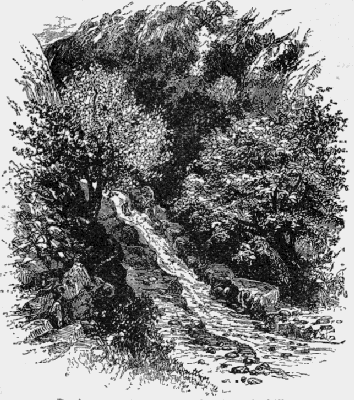 Fig. 25.—Ravine worn by water in the side of a hill.
The history of this ravine will tell us a great deal about the carving of water. Once it was nothing more than a little furrow in the hill-side down which the rain found its way in a thin thread-like stream. But by and by, as the stream carried down some of
Shall you not feel a fresh interest in all the little valleys, ravines, and gorges you meet with in the country, if you can picture them being formed in this way year by year? There are many curious differences in them which you can study for yourselves. Some will be smooth, broad valleys, and here the rocks have been soft and easily worn, and water trickling down the sides of the first valley has cut other channels so as to make smaller valleys running across it. In other places there will be narrow ravines, and here the rocks have been hard, so that they did not wear away gradually, but broke off and fell in blocks, leaving high cliffs on each side. In some places you will come to a beautiful waterfall, where the water has tumbled over a steep cliff, and then eaten its way back, just like a saw cutting through a piece of wood.
There are two things in particular to notice in a waterfall like this. First, how the water and spray dash against the bottom of the cliff down which it falls, and grind the small pebbles against the rock. In this way the bottom of the cliff is undermined, and so great pieces tumble down from time to time, and keep the fall upright instead of its being sloped away
In this and other ways the water works its way back in a surprising
manner. The Isle of Wight gives us some good instances of this; Alum Bay
Chine and the celebrated Blackgang Chine have been entirely cut out by
waterfalls. But the best known and most remarkable example is the
Niagara Falls, in America. Here, the River Niagara first wanders through
a flat country, and then reaches the great Lake Erie in a hollow of the
plain. After that, it flows gently down for about fifteen miles, and
then the slope becomes greater and it rushes on to the Falls of Niagara.
These falls are not nearly so high as many people imagine, being only
165 feet, or about half the height of St. Paul's Cathedral, but they are
2700 feet or nearly half-a-mile wide, and no less than 670,000
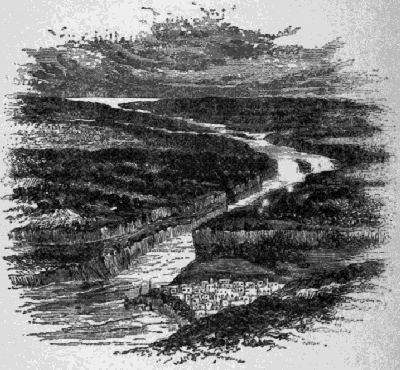 Fig. 26.—Bird's-eye view of Lake Erie, Niagara Falls, and Queenstown. (Lyell.)
Sir Charles Lyell, when he was at Niagara, came to the conclusion that,
taking one year with another, these falls eat back the cliff at the rate
of about one foot a year, as you can easily imagine they would do, when
you think with what force the water must dash against the bottom of the
falls. In this way a deep cleft has been cut right back from Queenstown
for a distance of seven miles, to the place where the falls now are.
This helps us a little to understand how
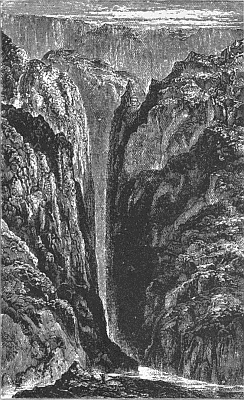 Fig 27.—GREAT CAÑON, COLORADO RIVER.(From Lieut. Ives' Report.)
But even this chasm cut by the falls of Niagara is nothing compared with the cañons of Colorado. Cañon is a Spanish word for a rocky gorge, and these gorges are indeed so grand, that if we had not seen in other places what water can do, we should never have been able to believe that it could have cut out these gigantic chasms. For more than three hundred miles the River Colorado, coming down from the Rocky Mountains, has eaten its way through a country made of granite and hard beds of limestone and sandstone, and it has cut down straight through these rocks, leaving walls from half-a-mile to a mile high, standing straight up from it. The cliffs of the Great Cañon, as it is called, stretch up for more than a mile above the river which flows in the gorge below! Fancy yourselves for a moment in a boat on this river, as shown in Figure 27, and looking up at these gigantic walls of rock towering above you. Even half-way up them, a man, if he could get there, would be so small you could not see him without a telescope; while the opening at the top between the two walls would seem so narrow at such an immense distance that the sky above would have the appearance of nothing more than a narrow streak of blue. Yet these huge chasms have not been made by any violent breaking apart of the rocks or convulsion of an earthquake. No, they have been gradually, silently, and steadily cut through by the river which now glides quietly in the
"No description," says Lieutenant Ives, one of the first explorers of this river, "can convey the idea of the varied and majestic grandeur of this peerless water-way. Wherever the river turns, the entire panorama changes. Stately façades, august cathedrals, amphitheatres, rotundas, castellated walls, and rows of time-stained ruins, surmounted by every form of tower, minaret, dome and spire, have been moulded from the cyclopean masses of rock that form the mighty defile." Who will say, after this, that water is not the grandest of all sculptors, as it cuts through hundreds of miles of rock, forming such magnificent granite groups, not only unsurpassed but unequalled by any of the works of man?
But we must not look upon water only as a cutting instrument, for it does more than merely carve out land in one place, it also carries it away and lays it down elsewhere; and in this it is more like a modeller in clay, who smooths off the material from one part of his figure to put it upon another.
Running water is not only always carrying away mud, but at the same time laying it down here and there wherever it flows. When a torrent brings down stones and gravel from the mountains, it will depend on the size and weight of the pieces how long they will be in falling through the water. If you take a handful of gravel and throw it into a glass full of water, you will notice that the stones in it will fall to the bottom at once, the grit and coarse sand will take
From this it will happen that stones will generally lie near to the bottom of torrents at the foot of the banks from which they fall, while the gravel will be carried on by the stream after it leaves the mountains. This too, however, will be laid down when the river comes into a more level country and runs more slowly. Or it may be left together with the finer mud in a lake, as in the lake of Geneva, into which the Rhone flows laden with mud and comes out at the other end clear and pure. But if no lake lies in the way the finer earth will still travel on, and the river will take up more and more as it flows, till at last it will leave this too on the plains across which it moves sluggishly along, or will deposit it at its mouth when it joins the sea.
You all know the history of the Nile; how, when the rains fall very heavily in March and April in the mountains of Abyssinia, the river comes rushing down, and brings with it a load of mud which it spreads out over the Nile valley in Egypt. This annual layer of[11] and the River Mississippi in America drains such a large tract of country that its delta grows, Mr. Geikie tells us, at the rate of 86 yards in a year.
All this new land laid down in Egypt, in India, in America, and in other places, is the work of water. Even on the Thames you may see mud-banks, as at Gravesend, which are made of earth brought from the interior of England. But at the mouth of the Thames the sea washes up very strongly every tide, and so it carries most of the mud away and prevents a delta growing up there. If you will look about when you are at the seaside, and notice wherever a stream flows down into the sea, you may even see little miniature deltas being formed there, though the sea generally washes them away again in a few hours, unless the place is well sheltered.
This, then, is what becomes of the earth carried down by rivers. Either on plains, or in lakes, or in
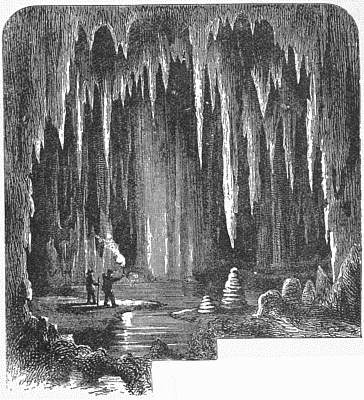
But it is in the caves and hollows of the earth that this dissolved matter is built up into the most beautiful forms. If you have ever been to Buxton in Derbyshire, you will probably have visited a cavern called Poole's Cavern, not far from there, which when you enter it looks as if it were built up entirely of rods of beautiful transparent white glass, hanging from the ceiling, from the walls, or rising up from the floor. In this cavern, and many others like it,[12] water comes dripping through the roof, and as it falls slowly drop by drop it leaves behind a little of the carbonate of lime it has brought out of the rocks. This carbonate of lime forms itself into a thin, white film on the roof, often making a complete circle, and then, as the water drips from it day by day, it goes on growing and growing till it forms a long needle-shaped or tube-shaped rod, hanging like an icicle. These rods are called stalactites, and they are so beautiful, as their minute crystals glisten when a light is taken into the cavern, that one of them near Tenby is called the "Fairy Chamber." Meanwhile, the water which drips on to the floor also leaves some carbonate of limestalagmites) meet in the middle and form one column. And thus we see that underground, as well as above-ground, water moulds beautiful forms in the crust of the earth. At Adelsberg, near Trieste, there is a magnificent stalactite grotto made of a number of chambers one following another, with a river flowing through them; and the famous Mammoth Cave of Kentucky, more than ten miles long, is another example of these wonderful limestone caverns.
But we have not yet spoken of the sea, and this surely is not idle in altering the shape of the land. Even the waves themselves in a storm wash against the cliffs and bring down stones and pieces of rock on to the shore below. And they help to make cracks and holes in the cliffs, for as they dash with force against them they compress the air which lies in the joints of the stone and cause it to force the rock apart, and so larger cracks are made and the cliff is ready to crumble.
It is, however, the stones and sand and pieces of rock lying at the foot of the cliff which are most active in wearing it away. Have you never watched the waves breaking upon a beach in a heavy storm? How they catch up the stones and hurl them down again, grinding them against each other! At high tide in such a storm these stones are thrown against the foot of the cliff, and each blow does something towards knocking away part of the rock, till at last, after many storms
Professor Geikie tells us that the waves beat in a storm against the
Bell Rock Lighthouse with as much force as if you dashed a weight of 3
tons against every square inch of the rock, and Stevenson found stones
of 2 tons' weight which had been thrown during storms right over the
ledge of the lighthouse. Think what force there must be in waves which
can lift up such a rock and throw it, and such force as this beats upon
our sea-coasts and eats away the land.
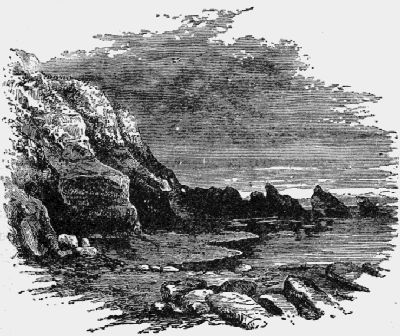 Fig. 28.—Cliffs off Arbroath, showing the waste of the shore.
Fig. 28 is a sketch on the shores of Arbroath which I made some years ago. You will not find it diffi
Thus, you see, the whole of the beautiful scenery of the sea—the shores, the steep cliffs, the quiet bays, the creeks and caverns—are all the work of the "sculptor" water; and he works best where the rocks are hardest, for there they offer him a good stout wall to batter, whereas in places where the ground is soft it washes down into a gradual gentle slope, and so the waves come flowing smoothly in and have no power to eat away the shore.
And now, what has Ice got to do with the sculpturing of the land? First, we must remember how much the frost does in breaking up the ground. The farmers know this, and always plough after a frost, because the moisture, freezing in the ground, has broken up the clods, and done half their work for them.
But this is not the chief work of ice. You will remember how we learnt in our last lecture that snow, when it falls on the mountains, gradually slides down into the valleys, and is pressed together by the gathering snow behind until it becomes moulded into a solid river of ice (see Fig. 29, Frontispiece). In Greenland and in Norway there are enormous ice-rivers or glaciers, and even in Switzerland some of them are very large. The Aletsch glacier, in the Alps, is fifteen miles long, and some are even longer than this. They move very slowly—on an average about 20 to 27 inches in the centre, and 13 to 19 inches at the sides every twenty-four hours, in summer and autumn. How they move, we cannot stop to discuss now; but if you will take a slab of thin ice and rest it upon its two ends only, you can prove to yourself that ice does bend, for in a few hours you will find that its own weight has drawn it down in the centre so as to form a curve. This will help you to picture to yourselves how glaciers can adapt themselves to the windings of the valley, creeping slowly onwards until they come down to a point where the air is warm enough to melt them, and then the ice flows away in a stream of water. It is very curious to see the number of little rills running down the great masses of ice at the glacier's mouth, bringing down with them gravel, and every now and then a large stone, which falls splashing into the stream below. If you look at the glacier in the Frontispiece, you will see that these stones come from those long lines of stones and boulders stretching along the sides and centre of the glacier. It is easy to understand
These stones are being continually, though slowly, conveyed by the glacier, from all the mountains along its sides, down to the place where it melts. Here it lets them fall, and they are gradually piled up till they form great walls of stone, which are called moraines. Some of the moraines left by the larger glaciers of olden time, in the country near Turin, form high hills, rising up even to 1500 feet.
Therefore, if ice did no more than carry these stone blocks, it would alter the face of the country; but it does much more than this. As the glacier moves along, it often cracks for a considerable way across its surface, and this crack widens and widens, until at last it becomes a great gaping chasm, or crevasse as it is called, so that you can look down it right to the bottom of the glacier. Into these crevasses large blocks of rock fall, and when the chasm is closed again as the ice presses on, these masses are frozen firmly into the bottom of the glacier, much in the same way as a steel cutter is fixed in the bottom of a plane. And they do just the same kind of work; for as the glacier slides down the valley, they scratch and
You may always know where a glacier has been, even if no trace of ice remains; for you will see rocks with scratches along them which have been cut by these stones; and even where the rocks have not been ground away, you will find them rounded like those in the left-hand of the Frontispiece, showing that the glacier-plane has been over them. These rounded rocks are called "roches moutonnées," because at the distance they look like sheep lying down.
You have only to look at the stream flowing from the mouth of a glacier to see what a quantity of soil it has ground off from the bottom of the valley; for the water is thick, and coloured a deep yellow by the mud it carries. This mud soon reaches the rivers into which the streams run; and such rivers as the Rhone and the Rhine are thick with matter brought down from the Alps. The Rhone leaves this mud in the Lake of Geneva, flowing out at the other end quite clear and pure. A mile and a half of land has been formed at the head of the lake since the time of the Romans by the mud thus brought down from the mountains.
Thus we see that ice, like water, is always busy carving out the surface of the earth, and sending down material to make new land elsewhere. We know that in past ages the glaciers were much larger than they are in our time; for we find traces of them over large
In those ancient days, there were even glaciers in England; for in Cumberland and in Wales you may see their work, in scratched and rounded rocks, and the moraines they have left. Llanberis Pass, so famous for its beauty, is covered with ice-scratches, and blocks are scattered all over the sides of the valley. There is one block high up on the right-hand slope of the valley, as you enter from the Beddgelert side, which is exactly poised upon another block, so that it rocks to and fro. It must have been left thus balanced when the ice melted round it. You may easily see that these blocks were carried by ice, and not by water, because their edges are sharp, whereas, if they had been rolled in water, they would have been smoothed down.
We cannot here go into the history of that great Glacial Period long ago, when large fields of ice covered all the north of England; but when you read it for yourselves and understand the changes on the earth's surface which we can see being made by ice now, then such grand scenery as the rugged valleys of Wales, with large angular stone blocks scattered over them, will tell you a wonderful story of the ice of bygone times.
And now we have touched lightly on the chief ways in which water and ice
carve out the surface of the earth. We have seen that rain, rivers,
springs, the waves of the sea, frost, and glaciers all do their part in
chiselling out ravines and valleys, and in producing rugged peaks or
undulating plains—here cutting through rocks so as to form precipitous
cliffs, there laying down new land to add to the flat country—in one
place grinding stones to powder, in others piling them up in gigantic
ridges. We cannot go a step into the country without seeing the work of
water around us; every little gully and ravine tells us that the
sculpture is going on; every stream, with its burden of visible or
invisible matter, reminds us that some earth is being taken away and
carried to a new spot. In our little lives we see indeed but very small
changes, but by these we learn how greater ones have been brought about,
and how we owe the outline of all our beautiful scenery, with its hills
and valleys, its mountains and plains, its cliffs and caverns, its quiet
nooks and its grand rugged precipices, to the work of the "Two great
sculptors, Water and Ice."