Lecture IV
A Drop of Water on Its Travels
We are going to spend an hour to-day in following a drop of water on its travels. If I dip my finger in this basin of water and lift it up again, I bring with it
These are questions we are going to try to answer to-day; and first, before we can in the least understand how water travels, we must call to mind what we have learnt about the sunbeams and the air. We must have clearly pictured in our imagination those countless sun-waves which are for ever crossing space, and especially those larger and slower undulations, the dark heat-waves; for it is these, you will remember, which force the air-atoms apart and make the air light, and it is also these which are most busy in sending water on its travels. But not these alone. The sun-waves might shake the water-drops as much as they liked, and turn them into invisible vapour, but they could not carry them over the earth if it were not for the winds and currents of that aerial ocean which bears the vapour on its bosom, and wafts it to different regions of the world.
Let us try to understand how these two invisible workers, the sun-waves and the air, deal with the dropssee any steam above the water, because it is in the form of an invisible gas. But as the steam comes out of the mouth of the kettle you see a cloud. Why is this? Because the vapour is chilled by coming out into the cold air, and its particles are drawn together again into tiny, tiny drops of water, to which Dr. Tyndall has given the suggestive name of water-dust. If you hold a plate over the steam you can catch these tiny drops, though they will run into one another almost as you are catching them.
The clouds you see floating in the sky are made of exactly the same kind
of water-dust as the cloud from the kettle, and I wish to show you that
this is also really the same as the invisible steam within the kettle.
I
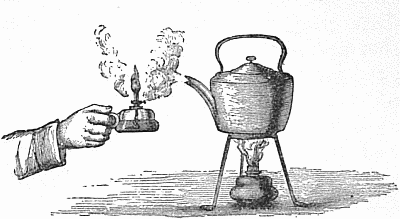
Fig. 18.
Now, although we never see any water travelling from our earth up into the skies, we know that it goes there, for it comes down again in rain, and so it must go up invisibly. But where does the heat come from which makes this water invisible? Not from below, as in the case of the kettle, but from above, pouring down from the sun. Wherever the sun-waves touch the rivers, ponds, lakes, seas, or fields of ice and snow
Can you imagine these water-particles, just above any pond or lake, rising up and getting entangled among the air-atoms? They are very light, much lighter than the atmosphere; and so, when a great many of them are spread about in the air which lies just over the pond, they make it much lighter than the layer of air above, and so help it to rise, while the heavier layer of air comes down ready to take up more vapour.
In this way the sun-waves and the air carry off water every day, and all day long, from the top of lakes, rivers, pools, springs, and seas, and even from the surface of ice and snow. Without any fuss or noise or sign of any kind, the water of our earth is being drawn up invisibly into the sky.
It has been calculated that in the Indian Ocean three-quarters of an inch of water is carried off from the surface of the sea in one day and night; so that as much as 22 feet, or a depth of water about twice the height of an ordinary room, is silently and invisibly lifted up from the whole surface of the ocean in one year. It is true this is one of the hottest parts of the earth, where the sun-waves are most active;
What, then, becomes of all this water? Let us follow it as it struggles upwards to the sky. We see it in our imagination first carrying layer after layer of air up with it from the sea till it rises far above our heads and above the highest mountains. But now, call to mind what happens to the air as it recedes from the earth. Do you not remember that the air-atoms are always trying to fly apart, and are only kept pressed together by the weight of air above them? Well, as this water-laden air rises up, its particles, no longer so much pressed together, begin to separate, and in so doing they use up part of the heat which they carried up from the earth, and thus the air becomes colder. Then you know at once what must happen to the invisible vapour,—it will form into tiny water-drops, like the steam from the kettle. And so, as the air rises and becomes colder, the vapour gathers into visible masses, and we can see it hanging in the sky, and call it clouds. When these clouds are highest they are about ten miles from the earth, but when they are made of heavy drops and hang low down, they sometimes come within a mile of the ground.
Look up at the clouds as you go home, and think that the water of which
they are made has all been drawn up invisibly through the air. Not,
however, necessarily here in London, for we have already seen that air
travels as wind all over the world, rushing in to fill spaces made by
rising air wherever they occur, and so these clouds may be made of
vapour collected in the Mediterranean, or in the Gulf of Mexico off
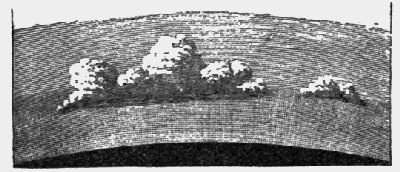 Fig. 19.
Clouds formed by ascending vapour as it enters cold spaces in the atmosphere.
Sometimes, if the air is warm, these water-particles may travel a long way without ever forming into clouds; and on a hot, cloudless day the air is often very full of invisible vapour. Then, if a cold wind comes sweeping along, high up in the sky, and chills this vapour, it forms into great bodies of water-dust clouds, and the sky is overcast. At other times clouds hang lazily in a bright sky, and these show us that just where they are (as in Fig. 19) the air is cold and turns the invisible vapour rising from the ground into visible water-dust, so that exactly in those spaces we see it as clouds. Such clouds form often on a warm, still summer's day, and they are shaped like masses of wool, ending in a straight line below. They are not merely hanging in the sky, they are really resting upon a tall column of invisible vapour which stretches right up from the earth; and that straight
And now, suppose that while these or any other kind of clouds are overhead, there comes along either a very cold wind, or a wind full of vapour. As it passes through the clouds, it makes them very full of water, for, if it chills them, it makes the water-dust draw more closely together; or, if it brings a new load of water-dust, the air is fuller than it can hold. In either case a number of water-particles are set free, and our fairy force "cohesion" seizes upon them at once and forms them into large water-drops. Then they are much heavier than the air, and so they can float no longer, but down they come to the earth in a shower of rain.
There are other ways in which the air may be chilled, and rain made to fall, as, for example, when a wind laden with moisture strikes against the cold tops of mountains. Thus the Khasia Hills in India, which face the Bay of Bengal, chill the air which crosses them on its way from the Indian Ocean. The wet winds are driven up the sides of the hills, the air expands, and the vapour is chilled, and forming into drops, falls in torrents of rain. Sir J. Hooker tells us that as much as 500 inches of rain fell in these hills in nine months. That is to say, if you could measure off all the ground over which the rain fell, and spread the whole nine months' rain over it, it would make a lake 500 inches, or more than 40 feet deep! You will not be surprised that the country on the other side of these hills gets hardly any rain, for all the water has
In this way, from different causes, the water of which the sun has robbed our rivers and seas, comes back to us, after it has travelled to various parts of the world, floating on the bosom of the air. But it does not always fall straight back into the rivers and seas again, a large part of it falls on the land, and has to trickle down slopes and into the earth, in order to get back to its natural home, and it is often caught on its way before it can reach the great waters.
Go to any piece of ground which is left wild and untouched, you will find it covered with grass, weeds, and other plants; if you dig up a small plot you will find innumerable tiny roots creeping through the ground in every direction. Each of these roots has a sponge-like mouth by which the plant takes up water. Now, imagine rain-drops falling on this plot of ground and sinking into the earth. On every side they will find rootlets thirsting to drink them in, and they will be sucked up as if by tiny sponges, and drawn into the plants, and up the stems to the leaves. Here, as we shall see in Lecture VII., they are worked up into food for the plant, and only if the leaf has more water than it needs, some drops may escape at
Again, much of the rain falls on hard rock and stone, where it cannot sink in, and then it lies in pools till it is shaken apart again into vapour and carried off in the air. Nor is it idle here, even before it is carried up to make clouds. We have to thank this invisible vapour in the air for protecting us from the burning heat of the sun by day and intolerable frost by night.
Let us for a moment imagine that we can see all that we know exists between us and the sun. First, we have the fine ether across which the sunbeams travel, beating down upon our earth with immense force, so that in the sandy desert they are like a burning fire. Then we have the coarser atmosphere of oxygen and nitrogen atoms hanging in this ether, and bending the minute sun-waves out of their direct path. But they do very little to hinder them on their way, and this is why in very dry countries the sun's heat is so intense. The rays beat down mercilessly, and nothing opposes them. Lastly, in damp countries we have the larger but still invisible particles of vapour hanging about among the air-atoms. Now, these watery particles, although they are very few (only about one twenty-fifth part of the whole atmosphere), do hinder the sun-waves. For they are very greedy of heat, and though the light-waves pass easily through them, they catch the heat-waves and use them to help themselves to expand. And so, when there is invisible vapour in the air, the sunbeams come to us deprived
This is how the water-vapour shields us by day, but by night it is still more useful. During the day our earth and the air near it have been storing up the heat which has been poured down on them, and at night, when the sun goes down, all this heat begins to escape again. Now, if there were no vapour in the air, this heat would rush back into space so rapidly that the ground would become cold and frozen even on a summer's night, and all but the most hardy plants would die. But the vapour which formed a veil against the sun in the day, now forms a still more powerful veil against the escape of the heat by night. It shuts in the heat-waves, and only allows them to make their way slowly upwards from the earth—thus producing for us the soft, balmy nights of summer and preventing all life being destroyed in the winter.
Perhaps you would scarcely imagine at first that it is this screen of vapour which determines whether or not we shall have dew upon the ground. Have you ever thought why dew forms, or what power has been at work scattering the sparkling drops upon the grass? Picture to yourself that it has been a very hot summer's day, and the ground and the grass have been well warmed, and that the sun goes down in a clear sky without any clouds. At once the heat-waves which have been stored up in the ground, bound back into the air, and here some are greedily absorbed by the vapour, while others make their way slowly upwards. The grass, especially, gives out these heat-waves very quickly, because the blades, being very
We can easily make artificial dew for ourselves. I have here a bottle of ice which has been kept outside the window. When I bring it into the warm room a mist forms rapidly outside the bottle. This mist is composed of water-drops, drawn out of the air of the room, because the cold glass chilled the air all round it, so that it gave up its invisible water to form dew-drops. Just in this same way the cold blades of grass chill the air lying above them, and steal its vapour.
But try the experiment, some night when a heavy dew is expected, of spreading a thin piece of muslin over some part of the grass, supporting it at the four corners with pieces of stick so that it forms an awning. Though there may be plenty of dew on the grass all round, yet under this awning you will find scarcely any. The reason of this is that the muslin checks the heat-waves as they rise from the grass, and so the grass-blades are not chilled enough to draw together the water-drops on their surface. If you walk out early in the summer mornings and look at the fine cobwebs flung across the hedges, you will see plenty of drops on the cobwebs themselves sparkling like diamonds; but underneath on the leaves there will be none, for even the delicate cobweb
Again, if you walk off the grass on to the gravel path, you find no dew there. Why is this? Because the stones of the gravel can draw up heat from the earth below as fast as they give it out, and so they are never cold enough to chill the air which touches them. On a cloudy night also you will often find little or no dew even on the grass. The reason of this is that the clouds give back heat to the earth, and so the grass does not become chilled enough to draw the water-drops together on its surface. But after a hot, dry day, when the plants are thirsty and there is little hope of rain to refresh them, then they are able in the evening to draw the little drops from the air and drink them in before the rising sun comes again to carry them away.
But our rain-drop undergoes other changes more strange than these. Till now we have been imagining it to travel only where the temperature is moderate enough for it to remain in a liquid state as water. But suppose that when it is drawn up into the air it meets with such a cold blast as to bring it to the freezing point. If it falls into this blast when it is already a drop, then it will freeze into a hailstone, and often on a hot summer's day we may have a severe hailstorm, because the rain-drops have crossed a bitterly cold wind as they were falling, and have been frozen into round drops of ice.
But if the water-vapour reaches the freezing air while it is still an
invisible gas, and before it has
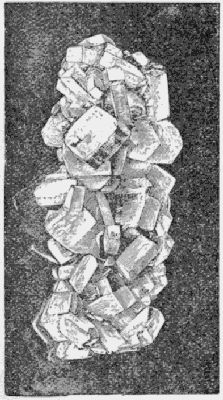 Fig. 20.
A piece of sugar-candy, photographed of the natural size.
The particles of nearly all substances, when left free and not hurried, can build themselves into crystal forms. If you melt salt in water and then let all the water evaporate slowly, you will get salt-crystals;—beautiful cubes of transparent salt all built on the same pattern. The same is true of sugar; and if you will look at the spikes of an ordinary stick of sugar-candy, such as I have here, you will see the kind of crystals which
But it is not only easily melted substances such as sugar and salt which form crystals. The beautiful stalactite grottos are all made of crystals of lime. Diamonds are crystals of carbon, made inside the earth. Rock-crystals, which you know probably under the name of Irish diamonds, are crystallized quartz; and so, with slightly different colourings, are agates, opals, jasper, onyx, cairngorms, and many other precious stones. Iron, copper, gold, and sulphur, when melted and cooled slowly build themselves into crystals, each of their own peculiar form, and we see that there is here a wonderful order, such as we should never have dreamt of, if we had not proved it. If you possess a microscope you may watch the growth of crystals yourself by melting some common powdered nitre in a little water till you find that no more will melt in it. Then put a few drops of this water on a warm glass slide and place it under the microscope. As the drops dry you will see the long transparent needles of nitre forming on the glass, and notice how regularly these crystals grow, not by taking food inside like living beings, but by adding particle to particle on the outside evenly and regularly.
Can we form any idea why the crystals build themselves up so
systematically? Dr. Tyndall says we can, and I hope by the help of these
small bar magnets to show you how he explains it. These little pieces of
steel, which I hope you can see lyingc, Fig. 21) round
one end of each of the magnets, and if I bring two red ends together
they will not cling together but roll apart.
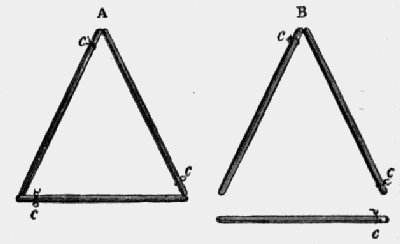 Fig. 21.
Bar magnets attracting and repelling each other.
c, Cotton tied round the north pole of the magnet.
If, on the contrary, I put a red end against an end where there is no cotton, then the two bars cling together. This is because every magnet has two poles or points which are exactly opposite in character. One of these is called the north pole of the magnet, because, if the rod hangs freely, that end will point to the north, and the other is the south pole, pointing to the south. Now, when I bring two red ends, that is, two north poles together, they drive each other away. See! the magnet I am not holding runs away from the other. The same will happen if I bring two south poles together. But if I bring a red end and
Now picture to yourselves that all the particles of those substances which form crystals have poles like our magnets, then you can imagine that when the heat which held them apart is withdrawn and the particles come very near together, they will arrange themselves according to the attraction of their poles and so build up regular and beautiful patterns.
So, if we could travel up to the clouds where this fairy power of
crystallization is at work, we should find the particles of water-vapour
in a freezing atmosphere being built up into minute solid crystals of
snow. If you go out after a snow-shower and search carefully, you will
see that the snow-flakes are not mere lumps of frozen water, but
beautiful six-pointed crystal stars, so white and pure that when we want
to speak of anything being spotlessly white, you say that it is "white
as snow." Some of these crystals are simply flat slabs with six sides,
others are stars
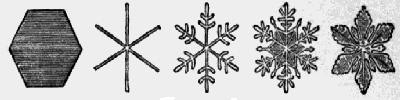 Fig. 22.—Snow-crystals.
But how about ice? Here, you will say, is frozen water, and yet we see
no crystals, only a clear transparent mass. Here, again, Dr. Tyndall
helps us. He says (and as I have proved it true, so may you for
yourselves, if you will) that if you take a magnifying glass, and look
down on the surface of ice on a sunny day, you will see a number of
dark, six-sided stars, looking like flattened flowers, and in the centre
of each a bright spot. These flowers, which are seen when the ice is
melting, are our old friends the crystal stars
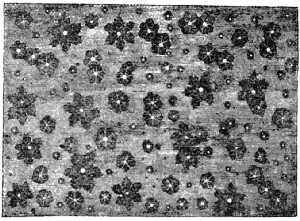 Fig. 23.—Water-flowers in melting ice.—Tyndall.
And this leads us to notice that ice always takes up more room than water, and that this is the reason why our water-pipes burst in severe frosts; for as the water freezes it expands with great force, and the pipe is cracked, and then when the thaw comes on, and the water melts again, it pours through the crack the ice has made.
It is not difficult to understand why ice should take more room; for we know that if we were to try to arrange bricks end to end in star-like shapes, we must leave some spaces between, and could not pack them so closely as if they lay side by side. And so, when this giant force of crystallization constrains the atoms of frozen water to grow into star-like forms, the solid mass must fill more room than
We have now seen our drop of water under all its various forms of invisible gas, visible steam, cloud, dew, hoar-frost, snow, and ice, and we have only time shortly to see it on its travels, not merely up and down, as hitherto, but round the world.
We must first go to the sea as the distillery, or the place from which water is drawn up invisibly, in its purest state, into the air; and we must go chiefly to the seas of the tropics, because here the sun shines most directly all the year round, sending heat-waves to shake the water-particles asunder. It has been found by experiment that, in order to turn 1 lb. of water into vapour, as much heat must be used as is required to melt 5 lbs. of iron; and if you consider for a moment how difficult iron is to melt, and how we can keep an iron poker in a hot fire and yet it remains solid, this will help you to realize how much heat the sun must pour down in order to carry off such a constant supply of vapour from the tropical seas.
Now, when all this vapour is drawn up into the air, we know that some of it will form into clouds as it gets chilled high up in the sky, and then it will pour down again in those tremendous floods of rain which occur in the tropics.
But the sun and air will not let it all fall down at once, and the winds which are blowing from the equator to the poles carry large masses of it away with them. Then, as you know, it will depend on
But if the vapour travels on till it reaches high mountains in cooler lands, such as the Alps of Switzerland; or is carried to the poles and to such countries as Greenland or the Antarctic Continent, then it will come down as snow, forming immense snow-fields. And here a curious change takes place in it. If you make an ordinary snowball and work it firmly together, it becomes very hard, and if you then press it forcibly into a mould you can turn it into transparent ice. And in the same way the snow which falls in Greenland and on the high mountains of Switzerland becomes very firmly pressed together, as it slides down into the valleys. It is like a crowd of people passing from a broad thoroughfare into a narrow street. As
Then we have what is called a "glacier," or river of ice, and this solid river comes creeping down till, in Greenland, it reaches the edge of the sea. There it is pushed over the brink of the land, and large pieces snap off, and we have "icebergs." These icebergs—made, remember, of the same water which was first drawn up from the tropics—float on the wide sea, and melting in its warm currents, topple over and over[10] till they disappear and mix with the water, to be carried back again to the warm ocean from which they first started. In Switzerland the glaciers cannot reach the sea, but they move down into the valleys till they come to a warmer region, and there the end of the glacier melts, and flows away in a stream. The Rhone and many other rivers are fed by the glaciers of the Alps; and as these rivers flow into the sea, our drop of water again finds its way back to its home.
But when it joins itself in this way to its companions, from whom it was parted for a time, does
But the drops of water in rivers are by no means as pure as when they rose up into the sky. We shall see in the next lecture how rivers carry down not only sand and mud all along their course, but even solid matter such as salt, lime, iron, and flint, dissolved in the clear water, just as sugar is dissolved, without our being able to see it. The water, too, which has sunk down into the earth, takes up much matter as it travels along. You all know that the water you drink from a spring is very different from rain-water, and you will often find a hard crust at the bottom of kettles and in boilers, which is formed of the carbonate of lime which is driven out of the clear water when it is boiled. The water has become "hard" in consequence of having picked up and dissolved the carbonate of lime on its way through the earth, just in the same way as water would become sweet if you poured it through a sugar-cask. You will also have heard of iron-springs, sulphur-springs, and salt-springs, which come out of the earth, even if you have never tasted any of them, and the water of all these springs finds its way back at last to the sea.
And now, can you understand why sea-water
Some day, when you are at the seaside, take some sea-water and set it on the hob till a great deal has simmered gently away, and the liquid is very thick. Then take a drop of this liquid, and examine it under a microscope. As it dries up gradually, you will see a number of crystals forming, some square—and these will be crystals of ordinary salt; some oblong—these will be crystals of gypsum or alabaster; and others of various shapes. Then, when you see how much matter from the land is contained in sea-water, you will no longer wonder that the sea is salt; on the contrary, you will ask, Why does it not grow salter every year?
The answer to this scarcely belongs to our history of a drop of water, but I must just suggest it to you. In the sea are numbers of soft-bodied animals, like the jelly animals which form the coral, which require hard material for their shells or the solid branches on which they live, and they are greedily watching for these atoms of lime, of flint, of magnesia, and of other
And now we have reached the end of the travels of our drop of water. We
have seen it drawn up by the fairy "heat," invisible into the sky; there
fairy "cohesion" seized it, and formed it into water-drops, and the
giant, "gravitation," pulled it down again to the earth. Or, if it rose
to freezing regions, the fairy of "crystallization" built it up into
snow-crystals, again to fall to the earth, and either to be melted back
into water by heat, or to slide down the valleys by force of
gravitation, till it became squeezed into ice. We have detected it, when
invisible, forming a veil round our earth, and keeping off the intense
heat of the sun's rays by day, or shutting it in by night. We have seen
it chilled by the blades of grass, forming sparkling dew-drops or
crystals of hoar-frost, glistening in the early morning sun; and we have
seen it in the dark underground, being drunk up greedily by the roots of
plants. We have started with it from the tropics, and travelled over
land and sea, watching it forming rivers, or flowing underground in
springs, or moving onwards to the high mountains or the poles, and
coming back again in glaciers and