
PHYSICS · NUCLEAR · FISSION
Lise Meitner
The Physicist Who Explained the Splitting Atom
Shut out of the main labs because she was a woman, she helped explain how the atom splits and refused to build a bomb.
- 1878 to 1968
- Austria, Germany, and Sweden
- Physics
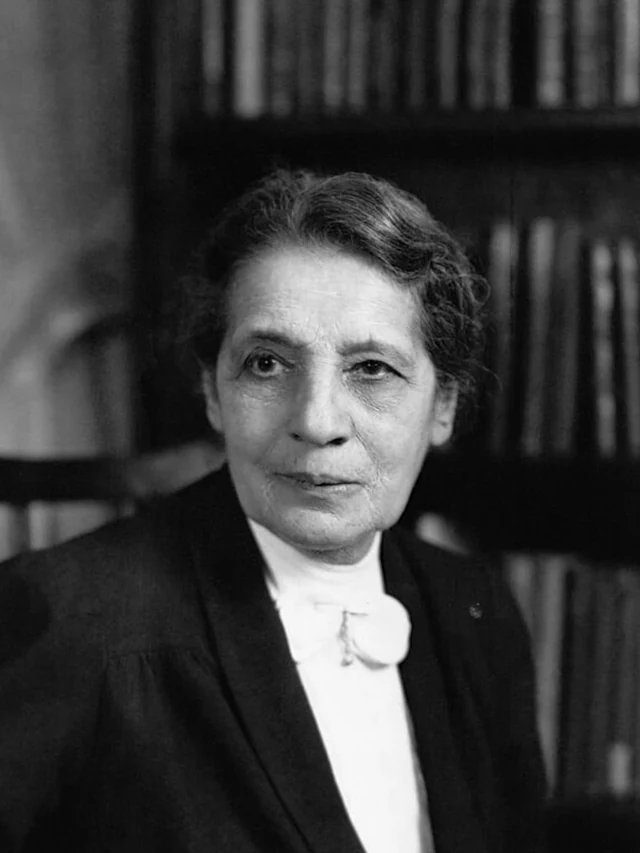

A life of discovery
The question they chased
Lise Meitner was born in Vienna in 1878 into a Jewish family. She earned her physics doctorate at the University of Vienna in 1906, the second woman to do so there. In 1907 she traveled to Berlin to hear Max Planck lecture. There she joined the chemist Otto Hahn to study radioactivity. Their question was what happens inside the tiny nucleus of an atom.
At first she worked unpaid as a guest in Hahn's section. Women were not allowed in the main parts of the institute, so she worked in a former woodworking shop in the basement, which had its own outside door. In the First World War she trained as an X-ray technician and served in the Austrian army. With Hahn she announced the element protactinium in 1918. In 1938 she and her nephew Otto Frisch worked out what Hahn's strange experiment had shown, which was that the uranium nucleus had split.
The big ideas
What Lise figured out
A nucleus is a tight bundle of protons and neutrons, and it acts something like a drop of water. A drop can stretch and pinch into two smaller drops. Meitner and Frisch saw that a uranium nucleus hit by a neutron could do the same.
Hahn found barium after he bombarded uranium with neutrons. Barium has a much lighter nucleus than uranium, so it was a puzzle. Meitner and Frisch explained that the uranium had split, and Frisch confirmed it in an experiment in January 1939.
The two pieces left after a split weigh a little less than the original nucleus. That missing mass turns into energy, and Einstein's equation E=mc² tells how much. Meitner used that idea to show where the energy came from.
Key moments
How it unfolded
- 1906Meitner receives her physics doctorate from the University of Vienna.
- 1907She moves to Berlin and begins to work with Otto Hahn on radioactivity.
- 1918She and Hahn announce protactinium.
- 1938After Austria is taken over by Germany, she flees through the Netherlands to Sweden in July with the help of Dirk Coster.
- 1939She and Otto Frisch explain that the uranium nucleus has split, and Frisch's experiment in January confirms it.
- 1945Hahn alone is announced as the winner of the Nobel Prize in Chemistry for 1944.
The person behind the science
The scientist who never lost her humanity
For years Meitner worked without pay in a basement shop while men worked in the main labs. Then the world around her turned dangerous. In 1938 Germany took over Austria, and she became stateless. She left Berlin in July and crossed to the Netherlands, then went on to Sweden. In December Hahn sent her a result that puzzled him, and she had to work it out at a distance with her nephew. Later the Nobel committee gave the chemistry prize to Hahn alone.
Her friendships helped her carry all this. Planck's twin daughters, Emma and Grete, shared her love of music and became her friends. Dirk Coster helped her escape. Her nephew Frisch was her closest working partner. She and Hahn stayed close friends, and a biographer wrote that she never spoke of him with anything but deep affection. She refused an offer to join the work on the bomb, and after the war she wrote that she was sorry the bomb had to be invented. She retired to England in 1960 and died in her sleep in Cambridge in 1968, at the age of 89.
Small things that make them human
- A love of musicShe shared a love of music with Planck's twin daughters.
- Back door labHer old wood shop had a private entrance, so she could work without breaking the rules.
- An X-ray nurseIn the First World War she X-rayed wounded soldiers for the Austrian army.
- Loyal to a friendA biographer wrote that she spoke of Hahn only with deep affection, even after the prize went to him alone.
A few surprising facts
Did you know
Max Planck did not support women entering universities in general, yet he welcomed her and later made her his assistant, her first paid job.
She was nominated 19 times for the Nobel Prize in Chemistry and 30 times for the Nobel Prize in Physics.
Element 109 is named meitnerium in her honor, and the name became official in 1997.
Her gravestone reads that she was a physicist who never lost her humanity.
Why it still matters
What this means for you
Meitner's work helped open the door to nuclear energy, which now powers cities and also carries heavy responsibilities. Her life shows that being left out of a prize does not change what you have done. It also shows a scientist who thought about how her knowledge would be used. Students who feel overlooked can see in her someone who kept thinking clearly, stayed kind, and stuck to her principles.
Do the science, and keep your conscience.
CURIOSITY ✦ RIGOR ✦ DISCOVERYTalk about it
Questions for your table
- Meitner worked in a basement because women were not allowed in the main labs. How can you tell when a rule is unfair, and what can you do about it?
- She stayed friends with Hahn even after the prize went only to him. Have you ever stayed kind to someone who got the credit you deserved?
- She refused to work on the bomb. How should scientists think about how their discoveries will be used?
Try it today
Three small steps
- Notice: Watch a water drop swell on a faucet until it breaks into two parts and describe what you see.
- Question: Ask why a larger drop is easier to pull apart than a small one.
- Test: Use a dropper to place a drop of water on wax paper, touch it with a toothpick, and see what shape holds it together.