
PHYSICS · ATOMS · NUCLEUS
Ernest Rutherford
The Farm Boy Who Found the Heart of the Atom
A loud, cheerful New Zealander fired tiny particles at gold foil and discovered that every atom hides a dense center.
- 1871 to 1937
- New Zealand, Canada, and England
- Physics
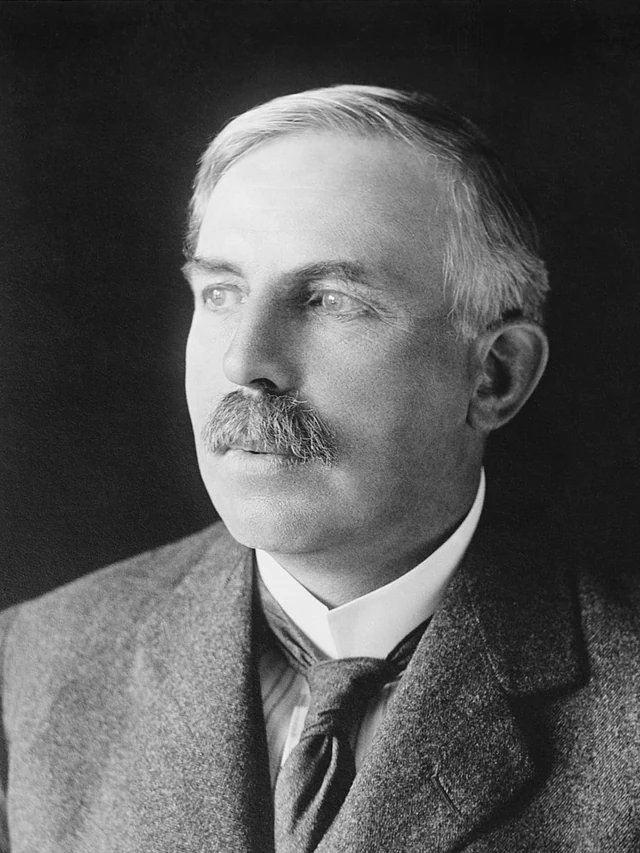

A life of discovery
The question they chased
Ernest Rutherford was born in 1871 on the South Island of New Zealand. His family was not wealthy. He won scholarships that took him to Canterbury College, and later a research place at the Cavendish Laboratory in Cambridge, England. He sometimes joked about the day he left farm work, saying he had just dug his last potato. His question was the one that drove all his work. What are atoms really made of?
At McGill University in Canada he worked with Frederick Soddy and showed that radioactivity is atoms changing from one kind into another. He named alpha and beta rays and the idea of half-life. He won the 1908 Nobel Prize in Chemistry. Then in Manchester, England, his team fired particles at thin gold foil and the results shocked everyone. Rutherford later said it was quite the most incredible event that had ever happened to him in his life.
The big ideas
What Ernest figured out
A radioactive atom can break apart on its own and become a different element. No one can say when one particular atom will go. But in a big group, half of them change in a fixed time called the half-life. If the half-life is one hour, half remain after one hour and a quarter after two.
Rutherford's team shot alpha particles at gold foil. Nearly all of them went straight through, but a few bounced back sharply. That meant an atom is mostly empty space with a tiny, dense center, the nucleus. If an atom were a stadium, the nucleus would be about the size of a grain of sand.
In 1919 Rutherford found that alpha particles hitting nitrogen could knock fast particles out of its nucleus. He named them protons the next year. The nucleus had parts, and it could be changed. Later work showed the nitrogen had turned into oxygen.
Key moments
How it unfolded
- 1898He takes a professor's job at McGill University in Montreal.
- 1908He wins the Nobel Prize in Chemistry for his work on how elements break down.
- 1909His team, led day to day by Hans Geiger and Ernest Marsden, runs the gold foil experiment in Manchester.
- 1911He proposes that atoms have a nucleus.
- 1919He finds the proton and becomes head of the Cavendish Laboratory in Cambridge.
- 1932His students James Chadwick, John Cockcroft, and Ernest Walton make major discoveries at the Cavendish.
The person behind the science
The crocodile with a big heart
Rutherford was forward driving, loud, and full of enthusiasm. He came from a small colony on the far side of the world and made his way by winning scholarships. He married Mary Newton in 1900, and they had one daughter, Eileen. Eileen died in 1930 after the birth of her fourth child. Rutherford was still leading one of the most famous labs in the world. He kept leading it.
He stood up for people with less power. At Cambridge he campaigned for women to have the same privileges as men. In 1933 he became president of the Academic Assistance Council, which helped more than a thousand university refugees escape Nazi Germany. In the first world war he refused to work with the chemist Fritz Haber on chemical weapons. Many people who trained under him became leaders in physics, including Chadwick, Cockcroft, Walton, and Blackett. Niels Bohr worked with him in Manchester.
Small things that make them human
- The last potatoHe joked that he had dug his last potato when he left farming for science.
- A crocodile in his honorKapitza commissioned a crocodile carving on the Mond Laboratory in Cambridge in Rutherford's honor.
- Standing up for refugeesAs head of the Academic Assistance Council, he helped more than 1,000 scholars flee Nazi Germany.
- Called Ern at homeHis family called him Ern.
A few surprising facts
Did you know
His colleague Peter Kapitza nicknamed him "the crocodile." Kapitza himself said it showed respect. Others say it was because of Rutherford's booming voice that arrived before he did, or because a crocodile never looks back.
In 1933 he called the idea of getting useful power out of atoms "moonshine." Even great scientists get predictions wrong.
He was awarded the Nobel Prize in Chemistry, not physics. He is often described as a physicist.
At his death he was buried in Westminster Abbey in London, near the tombs of Isaac Newton and Charles Darwin.
Why it still matters
What this means for you
Every time you hear about nuclear medicine, power plants, or radioactive dating, you hear about the nucleus Rutherford found. He teaches us that a surprising result is worth chasing. He also shows that a scientist can be loud, funny, kind, and tough all at once. The team at Manchester did not expect particles to bounce back. They noticed it and asked why, and a new picture of the atom followed.
Be curious, be loud, be kind.
CURIOSITY ✦ RIGOR ✦ DISCOVERYTalk about it
Questions for your table
- Rutherford's team expected the particles to pass through. What happened when the result surprised them, and how do you react when your result is not what you expected?
- He used his position to help women and refugees. How can a person with some power help people with less?
- Rutherford left a farm for a lab. What first step took you somewhere you did not expect?
Try it today
Three small steps
- Notice: Roll a marble across a table where something hidden is under a cloth, and watch how it bounces or passes.
- Question: Ask what the path tells you about the shape of what is hidden.
- Test: Roll it ten more times from different directions and sketch what you think is under the cloth.