
MATH · ALGEBRA · SYMMETRY
Emmy Noether
The Woman Who Showed Why Nature Keeps Its Books Balanced
She was kept out of classrooms and worked for years without pay, then found a rule that guides modern physics.
- 1882 to 1935
- Germany and the United States
- Math
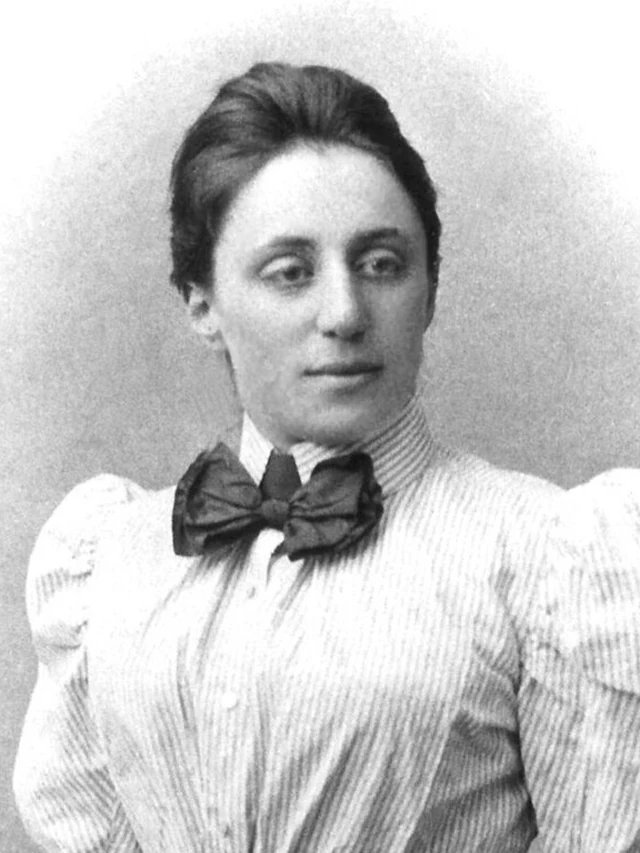

A life of discovery
The question they chased
Emmy Noether was born in 1882 in Erlangen, Germany. Her father, Max, taught mathematics at the university there. In those years a woman could sit in a university class only if the professor agreed. Emmy was one of two women among 986 students, and she earned her doctorate in 1907 anyway. The question she chased was what stays the same when everything else changes.
In 1915 the famous mathematicians David Hilbert and Felix Klein invited her to Göttingen. Some professors there did not want a woman on the faculty. So for four years she lectured under Hilbert's name and received no pay. During that time she proved a theorem that ties symmetry to the great conservation laws of physics. She also helped build abstract algebra, a way of studying the rules that numbers and other objects follow.
The big ideas
What Emmy figured out
A symmetry is a change that leaves the rules of a system the same. Noether proved that each smooth symmetry comes paired with a quantity that never changes. If the rules work the same today as tomorrow, then energy is conserved.
If the rules work the same in every direction, then angular momentum is conserved. A skater who pulls in her arms spins faster because her spin has to stay balanced out. Noether's theorem explains why that balance is no accident.
Instead of studying one number at a time, Noether studied the rules that whole families of objects follow. One of her results says that in certain systems, called Noetherian rings, a chain of ever larger collections called ideals must eventually stop growing. Algebra books still teach her way of thinking.
Key moments
How it unfolded
- 1907Noether earns her doctorate at Erlangen with the highest honors.
- 1908She begins teaching at the Erlangen math institute without pay, and she keeps at it until 1915.
- 1915Hilbert and Klein invite her to Göttingen, and she lectures there under Hilbert's name.
- 1918She publishes the theorem that links symmetries to conservation laws.
- 1919Göttingen finally approves her habilitation, and she becomes a lecturer in her own right.
- 1933Because she is Jewish, the government removes her right to teach, and she soon begins a new post at Bryn Mawr College in Pennsylvania.
The person behind the science
The teacher who shared the credit
For years Noether did a professor's work without a professor's title or pay. Colleagues remembered that she cared little about clothes or manners. She could be a blunt and demanding critic, and she argued hard when she disagreed. She was also known for patience with students and for helping them toward their own ideas.
When the new government took away her job in 1933, friends did not leave her to face it alone. The Rockefeller Foundation helped pay for her move to Bryn Mawr. There she made friends with Anna Wheeler and worked with a group of women students and young researchers, including Olga Taussky-Todd. Pavel Alexandrov had been a close friend since her Göttingen years. Hermann Weyl wrote that her courage, her frankness, and her kind spirit were a comfort to people during the dark years. She died in April 1935 after an operation, only about a year and a half after reaching her new home.
Small things that make them human
- Lived on littleShe spent plainly and put half her pay aside for a nephew's future.
- Hard on bad argumentsShe pushed people to think more clearly, and some found her sharp, though others found her kind.
- A circle of studentsHer Göttingen students, the Noether boys, included Ernst Witt and Max Deuring.
- Friends in a new landAt Bryn Mawr she found fellow mathematicians who welcomed her and her ideas.
A few surprising facts
Did you know
She lived simply and saved half of her salary for her nephew Gottfried.
She often gave away credit for her own ideas, and her students were nicknamed the Noether boys.
A famous textbook called "Moderne Algebra" by B. L. van der Waerden drew heavily on her work.
After reading one of her 1918 papers, Albert Einstein wrote to Hilbert that the old guard at Göttingen should take lessons from her.
Why it still matters
What this means for you
Noether's story shows two things at once. Good ideas can come from people the system tries to keep out, and some of the best help the world gets comes from people who were never given a fair start. Her theorem is still used every day by physicists who look for the quantities that must be conserved. Any student who has felt left out of a room can see in her a person who kept working and kept teaching anyway.
Look for what stays the same.
CURIOSITY ✦ RIGOR ✦ DISCOVERYTalk about it
Questions for your table
- Noether taught for years without pay because she believed the work mattered. When have you worked hard at something before anyone gave you credit for it?
- She gave away credit for her ideas and helped her students shine. What does it look like to lift other people up in your own classes or teams?
- Her theorem says that a kind of sameness leads to a saved quantity. Where do you see a pattern in your daily routine that stays the same no matter what else changes?
Try it today
Three small steps
- Notice: Watch a ball roll across a table or a swing go back and forth, and name one thing that seems to stay the same each time.
- Question: Ask yourself why a spinning chair turns faster when you pull your arms in.
- Test: Sit on a spinning stool holding your arms out, then pull them in, and see whether you spin faster.