
BIOLOGY · MEDICINE · PENICILLIN
Alexander Fleming
The Man Who Noticed the Mold
A messy lab, a spoiled dish, and a sharp eye gave the world its first antibiotic, and others carried it to patients.
- 1881 to 1955
- Scotland and England
- Life science
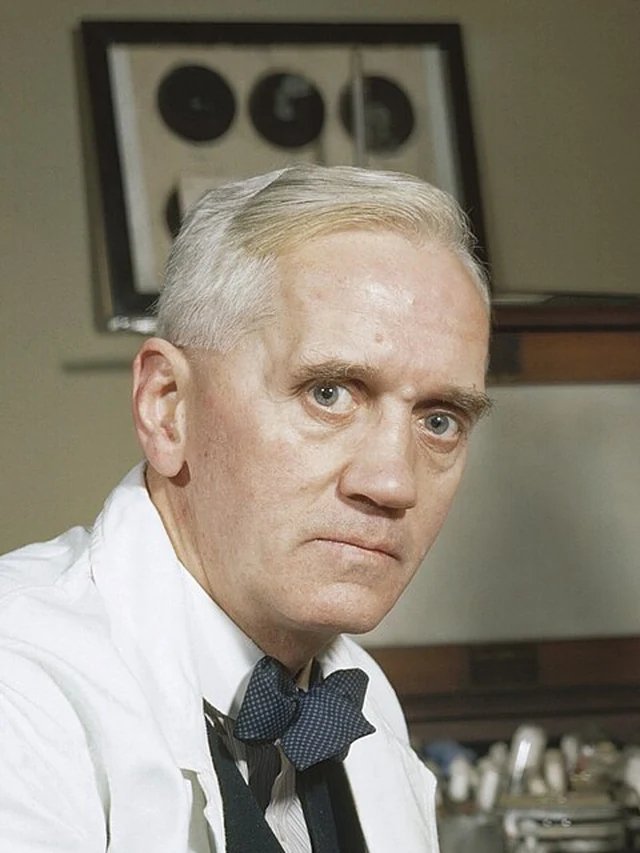

A life of discovery
The question they chased
Alexander Fleming was born in 1881 on Lochfield farm near Darvel, Scotland. He later moved to London and spent about four years working in a shipping office. Then an uncle left him some money, and his older brother Tom, a doctor, suggested he study medicine. He enrolled at St Mary's Hospital Medical School in 1901 and qualified in 1906. Fleming stayed at St Mary's and chased a question about how the body and medicines fight germs.
During the First World War he served in the Royal Army Medical Corps and worked in battlefield hospitals in France. He saw that antiseptics often made infected wounds worse. In 1921 he noticed lysozyme, a natural germ fighter, in nasal mucus, and he reported it in 1922. In 1928 he returned from a holiday to find a mold growing on his culture dishes. Around the mold was a clear zone where the bacteria had not grown.
The big ideas
What Alexander figured out
Fleming saw a bare ring around a fuzzy spot of mold, like a patch of lawn that will not grow near a mushroom. Fleming called the mold Penicillium notatum, and today it is classed as Penicillium rubens. It made a substance that stopped certain bacteria from growing, and he named that substance penicillin.
Seeing the ring was only the start. Fleming found it hard to purify penicillin and make enough of it. Howard Florey and Ernst Chain at Oxford did that work, with help from wartime support, and turned penicillin into a real medicine.
Fleming warned that giving too little penicillin, or for too short a time, can let bacteria become resistant. A few germs survive, and they pass on whatever helped them survive. That warning still guides doctors today.
Key moments
How it unfolded
- 1901Fleming enrolls at St Mary's Hospital Medical School in London.
- 1915He marries Sarah Marion McElroy.
- 1921He notices lysozyme, a natural germ fighter, in nasal mucus and reports it the next year.
- 1928He notices that a mold on a culture dish has stopped nearby bacteria from growing.
- 1944He is knighted.
- 1945He shares the Nobel Prize in Physiology or Medicine with Howard Florey and Ernst Chain.
The person behind the science
The careless scientist with the sharp eye
Fleming was brilliant, but he was not a tidy worker. Colleagues remembered a lab in chaos. After 1928 he faced a hard practical problem. He could not purify penicillin or make enough of it, and through most of the 1930s the discovery was mostly forgotten. He became a professor of bacteriology in 1928 and kept working at St Mary's.
When Florey and Chain made penicillin work in the 1940s, Fleming was quick to share the praise. He did not pretend the credit was his alone. At home his wife, Sarah, whom he married in 1915, was part of his life for more than thirty years until she died in 1949. Their son, Robert, became a family doctor. In 1953 Fleming married Amalia Koutsouri-Vourekas, a Greek colleague at St Mary's. He died in London in March 1955 at 73.
Small things that make them human
- A late startHe did not begin medical school until about age 20, after years in an office.
- A brother's nudgeTom Fleming, a physician, was the one who pointed him toward medicine.
- Praise for partnersHe spoke warmly of Florey and Chain and downplayed his own fame.
- A doctor in the familyHis son Robert grew up to become a general practitioner.
A few surprising facts
Did you know
He worked in a shipping office for about four years before he began to study medicine.
His lab was often a mess. He kept the contaminated dish and showed it to a former assistant, Merlin Pryce, who reminded him that a similar accident had led to his lysozyme find.
He called his fame the Fleming Myth and praised Florey and Chain for their work.
As a young man he served as a private in the London Scottish Regiment and joined his medical school's rifle club.
Why it still matters
What this means for you
Penicillin and the antibiotics that followed have saved countless lives, from blood infections to simple cuts that once could turn deadly. Fleming's story shows that a prepared and curious person can turn an annoying mistake into a discovery. It also shows that real medicine takes teamwork, because Florey and Chain finished what Fleming started. His warning about resistance still matters to every student, because taking medicine the right way protects everyone.
Notice what the mistake is trying to say.
CURIOSITY ✦ RIGOR ✦ DISCOVERYTalk about it
Questions for your table
- Fleming noticed something odd that others might have tossed out. When have you noticed a small surprise that turned out to matter?
- Florey and Chain finished the work Fleming started. Why do big discoveries often need more than one person?
- Fleming warned about using antibiotics the wrong way. How can your habits, like finishing a prescription, help your community?
Try it today
Three small steps
- Notice: Look at a piece of bread or fruit that has started to mold and describe its colors and edges without touching it.
- Question: Ask why doctors say to take an antibiotic for the full time even after you feel better.
- Test: Seal a small piece of bread in a clear bag in a dry spot and another in a damp spot, and check each day for mold without opening the bags.