
BIOLOGY · EVOLUTION · NATURE
Charles Darwin
The Man Who Took Twenty Years to Say What He Saw
A restless collector, often sick and often worried, spent decades gathering proof for one idea about how all living things are connected.
- 1809 to 1882
- England
- Life science
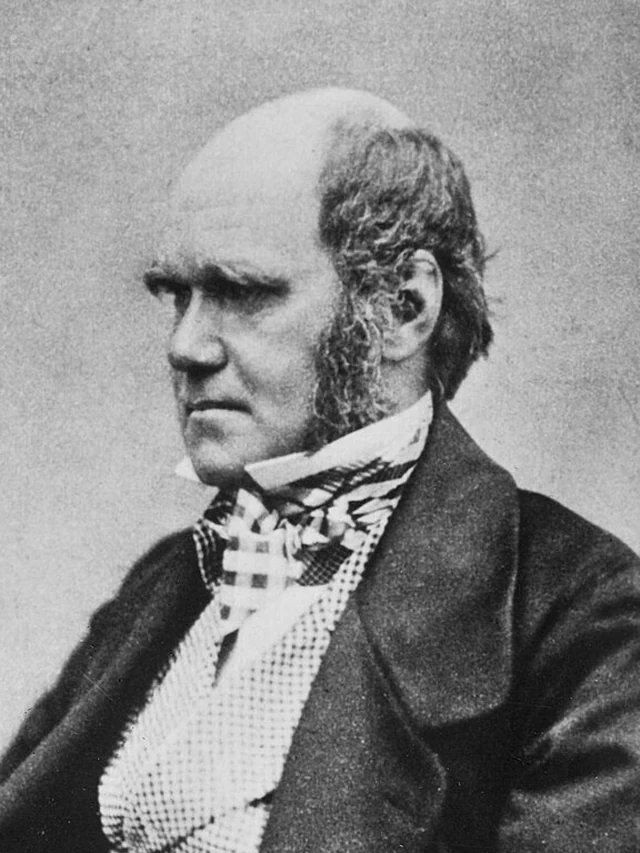

A life of discovery
The question they chased
Charles Darwin was born in 1809 in Shrewsbury, England. He loved the outdoors more than school. His father sent him to Edinburgh to study medicine, but Darwin neglected his studies and that annoyed his father. So he went to Cambridge to prepare for life as a country clergyman. In 1831 a chance came up that changed everything. He joined the ship HMS Beagle for a voyage that lasted until 1836.
On the voyage he collected fossils, plants, and animals in South America and on Pacific islands, including the Galápagos. Back in England, by 1838 he had worked out an idea. Living things vary. Those that fit their surroundings leave more offspring. Over many generations, kinds of living things change. He called this natural selection. He published "On the Origin of Species" in 1859. Booksellers took all 1,250 copies of the first printing on the day it went on sale.
The big ideas
What Charles figured out
Offspring are never exact copies of their parents. Some small differences help an animal find food or escape danger. Those animals leave more young, and the helpful trait spreads. It works slowly, over many lifetimes.
Darwin argued that living things are related by descent. Different kinds are like branches that grew from shared ancestors. Birds he collected in the Galápagos turned out to be a dozen separate kinds of finch, each with a beak fitted to its food.
His last book, in 1881, was about earthworms. He showed that the slow, steady work of worms moves and mixes huge amounts of soil over the years. Small actions, repeated for a long time, can reshape the ground.
Key moments
How it unfolded
- 1831He sailed from England on HMS Beagle at age 22.
- 1836The Beagle returned to England after nearly five years.
- 1838He worked out the idea of natural selection.
- 1858A letter from Alfred Russel Wallace described the same idea, and friends arranged for both men's work to be presented together.
- 1859"On the Origin of Species" was published.
- 1881He published his book on earthworms, his last.
The person behind the science
The worried man behind the theory
Darwin was ill off and on from 1838 for the rest of his life. He had stomach pains, vomiting, boils, and heart trouble, and no one ever found the cause. He feared that his illness could be passed to his children. In 1851 his daughter Annie became ill and died at age ten. He wrote to a friend that she had suffered hardly at all and had died peacefully. The loss hurt him and Emma deeply. Some historians link Annie's death to the fading of his Christian belief, though he kept his deepest thoughts private.
Emma, his cousin, married him in 1839 and stayed beside him through every hard year. They moved to Down House in Kent in 1842 to get away from the pressures of London. There he worked in short stretches between rests. His friends carried him too. Hooker read his long essay in 1847. Lyell urged him to publish. When Wallace's letter arrived in 1858, they helped make sure both men were honored.
Small things that make them human
- A poor medical studentHe neglected his studies at Edinburgh. His father was unhappy, and Darwin had to find a new path.
- Twenty years of waitingHe had the main idea in 1838. He spent years on other work and published in 1859.
- A loud defenderThomas Huxley supported him publicly. After reading the book, Huxley said it was stupid not to have thought of it himself.
- Home at DownDown House was his working place and home for forty years, until he died there in 1882.
A few surprising facts
Did you know
At first he thought some Galápagos birds were a mix of blackbirds, grosbeaks, and finches. The bird expert John Gould told him they were all finches.
Alfred Russel Wallace reached the same idea on his own. Darwin's friends Charles Lyell and Joseph Hooker arranged for both men's work to be read together at the Linnean Society on 1 July 1858.
Darwin and his wife Emma had ten children. Two died as babies.
He expected to be buried in the churchyard in Downe but was buried in Westminster Abbey in 1882.
Why it still matters
What this means for you
Darwin looked closely at ordinary things like beaks, pigeons, and worms, and he asked why they were the way they were. He checked his idea against evidence for years before sharing it. He shared credit when another scientist reached it too. For a student, that is a good model. Observe carefully, write down what you see, and be honest when others find something too. His life also shows that worry and illness do not have to stop work that matters.
Look closely. Wait. Then speak plainly.
CURIOSITY ✦ RIGOR ✦ DISCOVERYTalk about it
Questions for your table
- Darwin waited many years before sharing his idea. What is something you want to be sure of before you say it out loud?
- Darwin's friends helped him when Wallace's paper arrived. Who helps you when you feel worried about your work?
- Darwin lived with illness his whole adult life and still kept working. What small steps can you take when you do not feel your best?
Try it today
Three small steps
- Notice: Pick one kind of plant or bird near your home and write down three ways individuals of that kind differ from each other.
- Question: Why might a slightly different beak, color, or size help one animal survive better than another in the same place?
- Test: Collect 20 leaves from one tree, measure their lengths, and see how much they vary.