Introductory Chapter
For the children who own this book
Original page 1
LET me tell you how this book came to be written. Once upon a time, not so very long ago, a lot of children were spending the summer together in the country. Tom and Agnes were brother and sister and were together all the day long; bicycling or playing golf in the morning, reading or studying in the afternoon. The people who lived in the village used to call them the inseparables because they were always seen together during their whole vacation from June to September.
Their cousins Fred and Mary always spent a part of every summer with them; and when they came there were four inseparables, not two. The children liked the same games, liked to read the same books, to talk about the same kind of things, and so they got on very well together; though sometimes the two boys would go off by themselves for a hard day's tramp in the hills, or to shoot woodchucks, or for a very long bicycle ride, leaving their sisters at home to play in the garden with dolls, or to do fancywork and embroidery, or to play tennis, or to read a book together. Tom was thirteen years old then, and his sister Agnes was nine; cousin Fred was ten and his sister Mary was twelve.
Original page 2
When the summer afternoons began to get very warm, in July, a rule was made that the children should spend them in the house, or on the wide, shady porch, or else under the trees on the lawn, or in the garden. Golf, tennis, and wheeling had to be done in the morning; the afternoons were to be spent in something different. Tom's father used to say that the proverb
All work and no play Makes Jack a dull boy
was only half a proverb. It was just as true, he said, that
All play and no work Makes Jack a sad shirk.
And so a part of every summer afternoon was given up to reading some good book, or to study, or to work of some sort. The two boys had their guns and wheels to keep thoroughly bright and clean, and a dozen other things of the sort; the two girls had sewing to do; and all of them, together agreed to keep the pretty garden free from weeds.
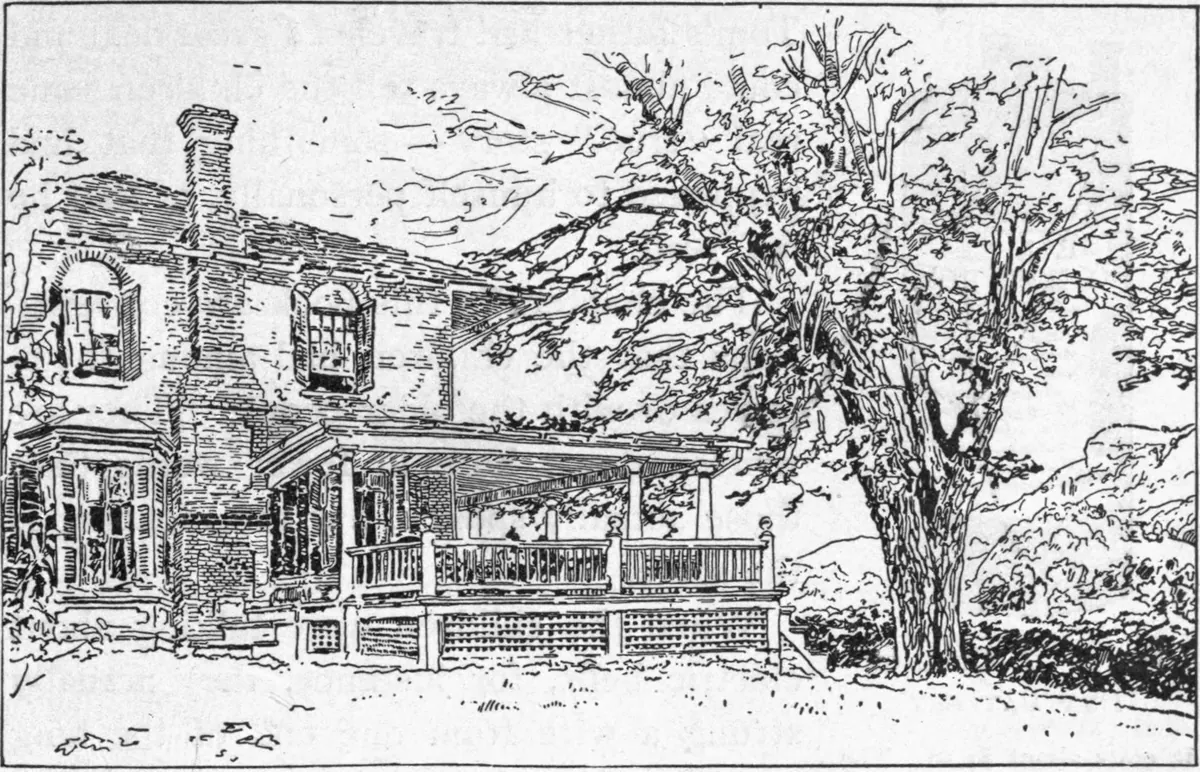
Almost any afternoon you might see the four inseparables tucked away in a corner of the broad piazza, each one busy about something, and all talking and laughing — except, of course, when one of them was reading, and the others paying good attention. Tom's big brother Jack was at home from college, and in the afternoons he was almost always on the porch reading, or else on the green lawn lying under the trees; and Tom's older sisters, Mabel and Eleanor, were there too, sewing, or embroidering, or reading, or talking together.
So there were two groups, the four children — the inseparables— and the three older ones. When the children came to something in their book that they did not quite understand, Tom would call out to his big brother Jack to explain it to
Original page 3
them, and Jack would usually get up and come over to where the children were and tell them what they wanted to know. Almost every day there were conversations of the sort, and explanations by some one of the older ones to the four children. All kinds of questions would come up, like these:
FIG. 1. THE PORCH
"Jack, tell us why a 'possum pretends to be dead when he is only frightened and wants to get away."
"Jack, tell us why a rifle shoots so much straighter than a shot-gun or a musket."
"Jack, what's the reason that a lobster hasn't red blood?" or else:
" Eleanor, what is the difference between a fern and a tree? "
"Is that coral bead made by an animal or an insect?"
"What is amber, anyway?" and so on.
Original page 4
The children had no end of questions to ask, and Jack or one of the older girls could generally answer them. When they could not give a complete answer the dictionary was brought out; and if that was not enough, a volume of the encyclopaedia. Sometimes the questions were talked over at the dinner table and the whole family had something to say. Tom's father had traveled a great deal and could almost always tell the children some real "true" story — something that had happened to himself personally, or that he had read.
The chapters in this book are conversations that the children had among themselves or with the older people. They are written down here in fewer words than those actually spoken, but the meaning is the same.
When the children were talking about electric bells, for instance, they actually strung a wire from one end of the long
It costs about $1.10. The
two wires are to be fastened porch to the other, and put a real bell at
to the two screw posts in one en£ Qf jt and a push button and a the picture — one at the..
left-hand side, and one in battery at the other. In this book there
the middle, of the top of is a picture showing exactly what they
did; but, after all, you cannot understand
an electric bell half so well by a picture as you can by the
real bell and the real wire.1 So when one of the children
who is reading this book comes to an experiment he must read
all that the book says about it, and understand it as well as he
1 Children should be careful to read the titles printed under each picture with attention. The titles explain what the picture means.
FIG. 2. A CELL OF DRY BATTERY
Original page 5
can. If he can get an electric battery, and a bell, and wire, and a push button, then the picture in this book will tell him exactly how to join them together; and when he has done this and actually tried the experiment — and made it succeed — he will know as much about electric bells as he needs to know.
If he cannot get the bell and the wire, and so forth, he can probably see a bell of the sort somewhere; and if he keeps his eyes open and thinks about what he has read, he can certainly understand how it works. Here is the battery always trying to send out a stream of electricity along any wires joined to the two screws at the top. Here is the wire, which is almost
Push Button
Battery ' ' 1
'Bell
FIG. 3
a complete loop — almost but not quite. If the loop were continuous,— if the wire were all in one piece, — then the stream of electricity would flow along the wire from the battery and would ring the bell.
The use of the push button is to make the wire continuous
— to join the two ends of it so that the stream of electricity
can pass along it. When you have done this — when you have
joined the ends of the loop of wire — the bell rings, and only
then, which is just as it should be.
This book gives the pictures and the explanations. They can be understood by paying attention; and when they are once understood a great number of things will be clear that
Original page 6
all children ought to know, and that have to be learned sometime. Why not now? The sooner the better.
If you read what is written in the book and perfectly understand it, that is very well. If there is an experiment to be tried, and you can get the things to try it with, so much the better. If you have any trouble in understanding, ask some one — your father, your mother, your teacher — to explain to you. If you can find another book — a dictionary or an encyclopaedia — that describes the same experiment, read that too. Perhaps it will tell you what you want to know, better, or more simply, or more fully, or in a different way. Then, finally, keep your eyes open to actually see in the world the things that are talked about in this book. When you see them try to understand them. Remember what you have read here, and you will find that you understand a good many things that you see about you every day. Somebody understands these things, — push buttons, electric lamps, telescopes, and so forth. Why should FIG. 5. A PUSH BUTTON not you? You can if you pay it costs thirty cents. The two attention enough. The world is,
wires are fastened to two screws ',. T..
inside the push button. after all, your world. It belongs to
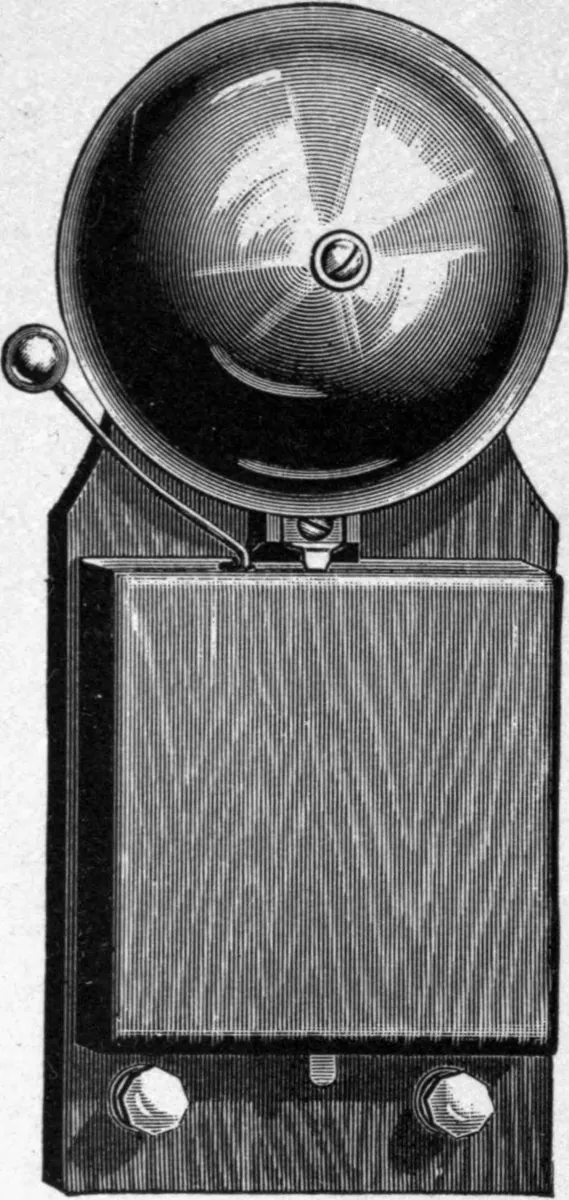
FIG. 4. AN ELECTRIC BELL
It costs seventy-five cents. The
wires are fastened to the two
screws at the bottom of the box.
Original page 7
you as much as it belongs to any one. The things in it can all be explained and understood. It is everybody's business to try to understand them at any rate. All these things concern you. The more you know about them, the better citizen you can be — the more useful to your country, to your friends, and to yourself.
Original page 8
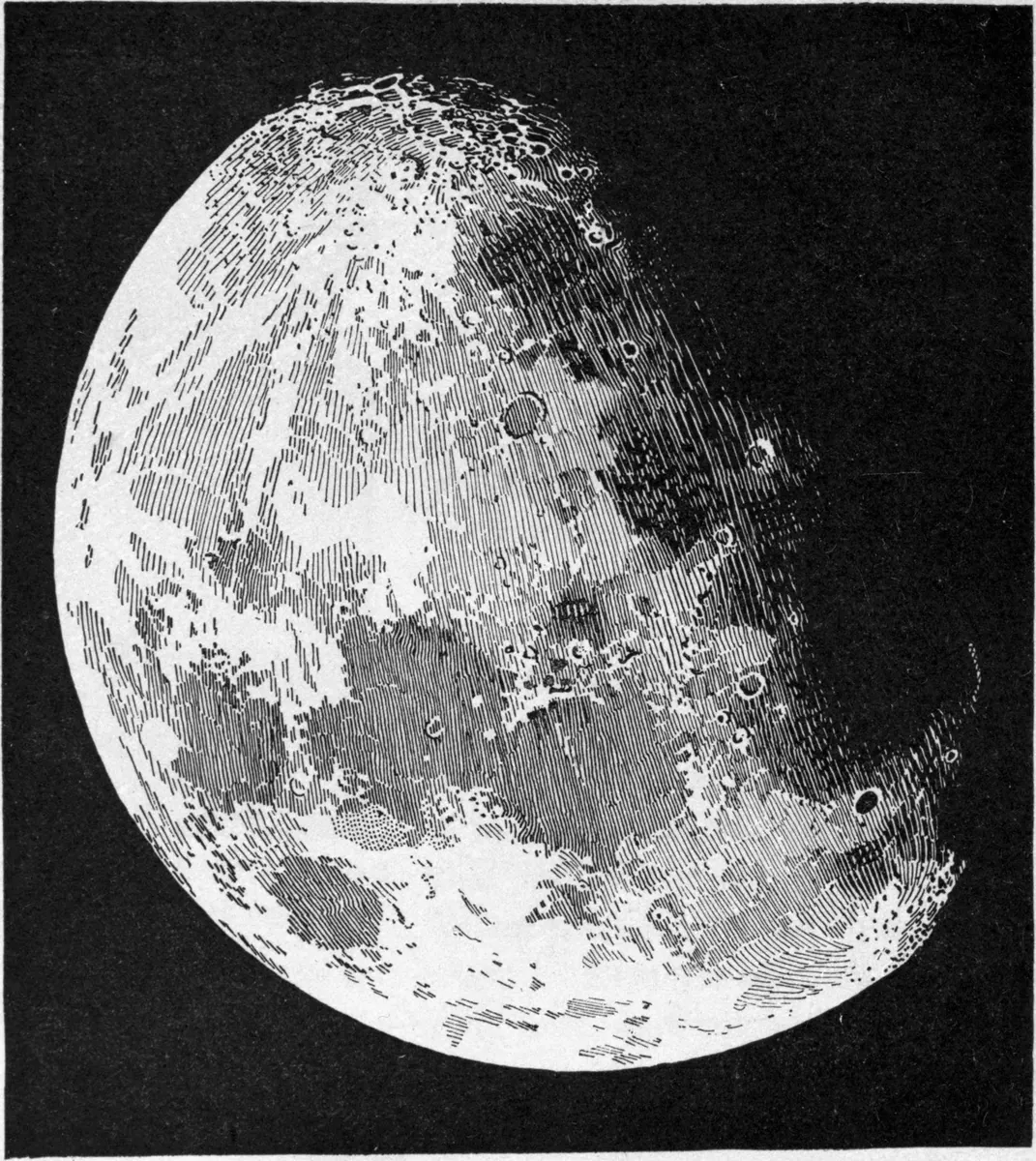
THE MOON The moon, from a photograph taken with the great telescope of the Lick Observatory.