Book IV · Meteorology
The Science of the Weather
Original page 161
The Atmosphere; the Colors of Sunset. ~ " I wonder why it is," said Agnes, "that sunsets and sunrises are red. It is the same sun at noon and at sunset, and the same sky; but sunsets are red, and the sky is never red at noon."
Jack. There are two main reasons, Agnes. In the first place, we are looking at the sun through an air that is full of dust; and in the second place, the more dust you look through the redder a thing looks that is beyond. At sunset (and sunrise) you see the sun through a greater thickness of air than you do at noon.
Mary. I do not understand how that is.
Jack. Tom, see if you can explain it by a little drawing. Tom. Is n't it like this? When the sun is nearly overhead at noon we see it through a less thickness of air than when it is setting (or rising). (See Fig. 144.)
Jack. That is right. The greater the thickness of air the more dust there is in it; and, moreover, the more dust the redder the sun looks.
Agnes. How do you know that, Jack?
Jack. Well, you could try the experiment by pointing a long wooden box filled with dusty air at the sun, and then by taking
Original page 162
a box twice as long and doing the same thing. But the simplest proof is this: In 1883 there was a huge volcanic eruption of a mountain in Java, called Krakatoa. The whole air for hundreds of miles round was darkened with the dust from the volcano. The winds scattered this dust round the whole earth, so that for two years afterwards all the sunsets in
Sun, at noon.
•Sun, sett ing ^
FIG. 144
A person on the earth's surface at A sees the sun overhead at noon through a thickness of air (AS), and the sun at sunset through a thickness of air (AC). AC is considerably greater than AB.
Europe and America were very red indeed, much redder than usual. There was an extra amount of dust in the air at that time, and so the sunsets and sunrises were redder than usual. It is the same thing in sand storms on deserts. The sun looks red through them.
Fred. Suppose you should go up on a high mountain, what then?
Original page 163
Jack. The higher up you go the less dust you look through. If you are on Mount Washington in the White Mountains (5000 feet high), or on Mount Hamilton in California (4000 feet), the sky looks very pure and blue, and if you go to the top of the high Alps or on Pikes Peak (14,000 feet), the sky is a dark violet color — it begins to look a little black even.
Fred. And in balloons?
Jack. It is blacker yet. The less dust you are looking through the whiter, or the bluer rather, the sun looks to you. If you were quite outside the earth's atmosphere — on the moon, for instance — the sun would not look yellow at all; it would be bluish.
Mary. Where does the dust come from, Jack?
Jack. Oh, from dusty plains, from smoke, the pollen of plants, and from volcanoes. Just think of the millions of tons of coal that are burned every winter.
Mary. Well, then, why doesn't the air become thick with smoke by and by and stay so?
Jack. See if you can answer that, Tom. Tom. Is it because every rain storm carries the dust particles down with the raindrops? I have noticed that the air is clearer after rain.
Jack. Yes, that is a good reason; and a great part of the dust falls on the ocean, too, and is lost in that way.
Twilight. — "If you will look out any evening half an hour after sunset, you will see a faint arch in the sky in the west that is a little brighter than the rest. That is the twilight arch, and it is caused by the sun's rays reflected and scattered from dust high up in our air. You had better look for it on the next clear evening. It is easy to see.
Dust in the Atmosphere. — " One of the things that physicians want to know is how pure the air is at any place — how free
Original page 164
from dust. They put little plates of glass covered with sticky varnish out of doors and then count the pieces of dust on the glass with a microscope. High mountains and the snowy arctic regions have the purest air of course; but even there there is a great deal more than you would think."
The Rainbow. — "Is the rainbow caused by dust, Jack? " said Agnes; "part of it is red."
Jack. No, Agnes; that is different. You see all the colors are in the rainbow, not red alone.
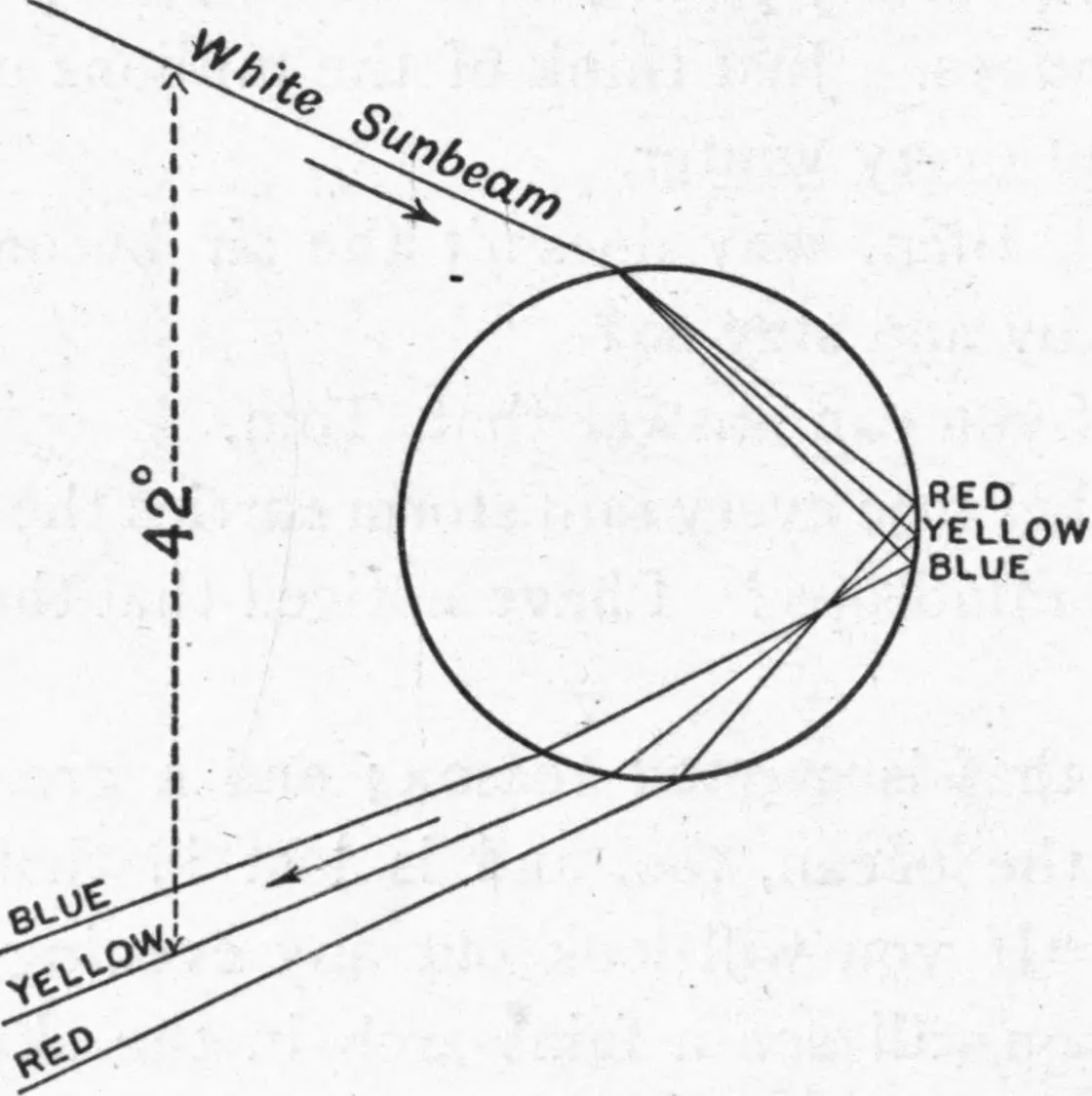
The white light from the sun is split up into colors by each raindrop much as it would be by a glass prism, and then the light is scattered by the different drops as light is scattered
FIG. 145. WHITE LIGHT ENTERING A RAINDROP is SPLIT UP INTO COLORED LIGHTS
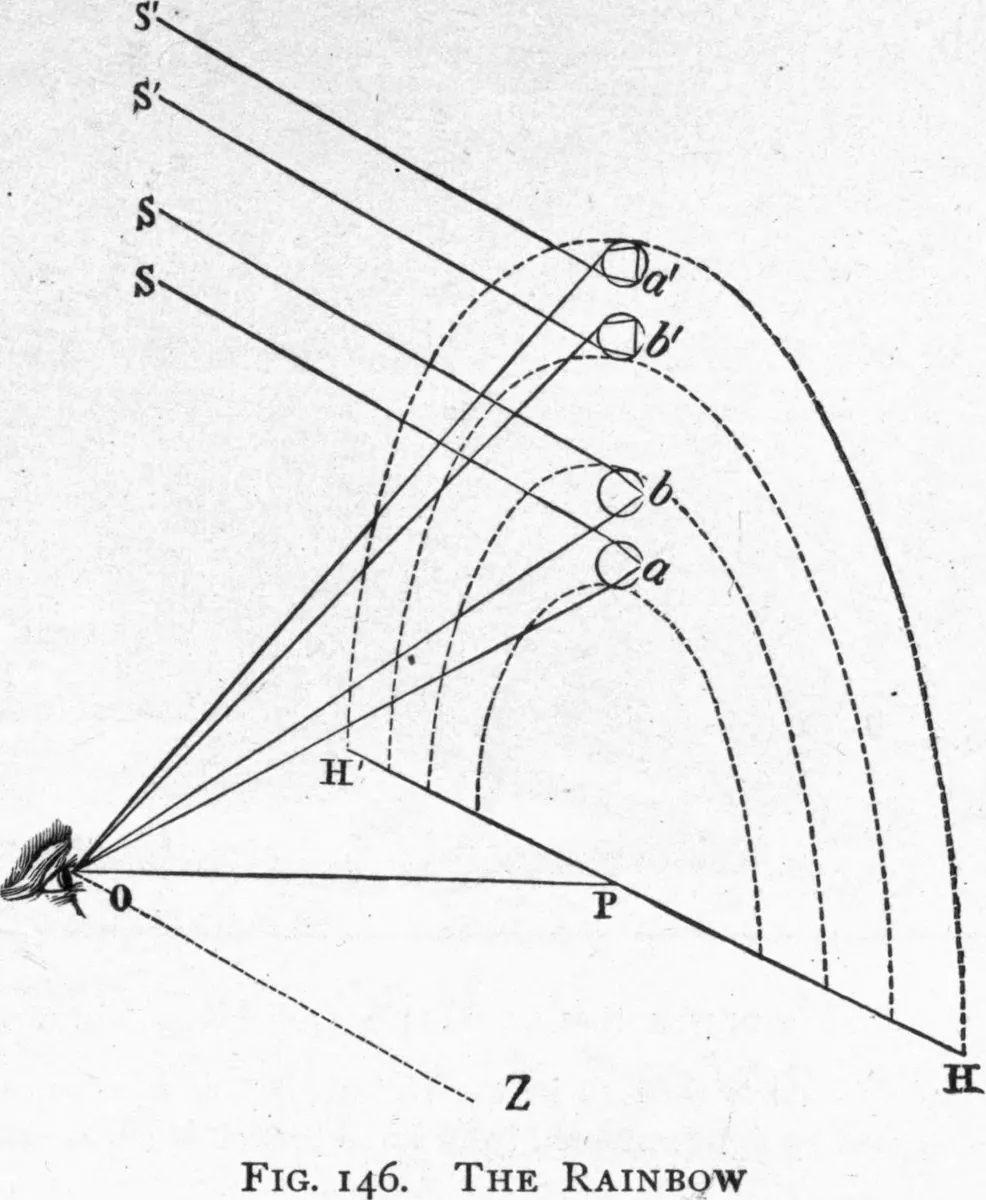
A white sunbeam enters a hollow raindrop, and its different colors are separated by the water of the drop as they would be by a prism of glass. The white color is separated into red, yellow, blue, and so forth, and is refracted by the drop down to the ground where you are standing. (See Fig. 146.) You see the drops by these refracted colors — red, yellow, blue — and all of these colors show in the rainbow.
Original page 165
from mother-of-pearl shells. It is not very easy to explain in simple words, but that is the main cause.
Halos. — "You have seen rainbows round the moon, haven't you? and halos — bright circles — round the moon? They are
Sometimes two bows are seen. Both are formed in much the same way. The ordinary bow is formed by sunlight that enters the top of the raindrops and is refracted to the eye. The secondary bow is formed by sunlight that enters the bottom of the raindrops. (Examine the picture carefully.) SSS'S' are rays from the sun; HH' is the horizon. The center of the bow is always exactly opposite to the sun from where you stand.
caused by little prisms of ice floating high up in the atmosphere, which scatter the moonlight in a regular way."
Fog and Clouds. — "The air is full of dust that we can see," said Jack, " and it is full of the vapor of water that we cannot
Original page 166
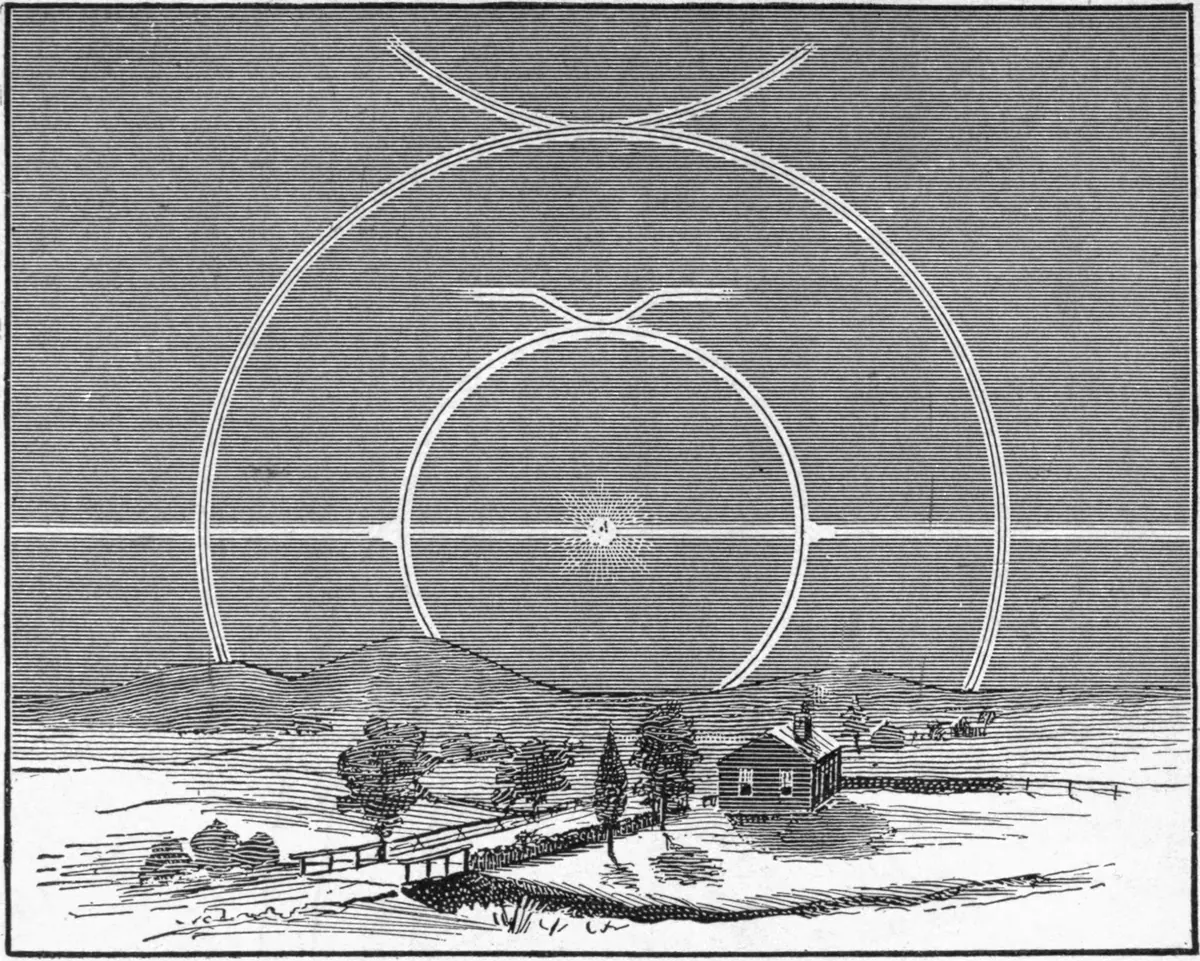
FIG. 147. A COMPLETE SOLAR HALO (parhelion, sundog)
Sometimes the complete halo is seen as in the picture, but more often only parts of it. These halos are caused by light refracted from small prisms of ice in our atmosphere.
see, too. When I put a pan of water out of doors, Agnes, what becomes of the water? "
Agnes. It disappears somehow, if there is not much of it. I don't know where it goes.
Tom. It evaporates; it rises up into the air like a gas. I suppose it is a gas.
Jack. Yes, it is a gas, like invisible steam. Real steam is invisible, and water vapor is invisible. When the water vapor in the air turns into visible water what do you see?
Original page 167
Agnes. Fogs and clouds and mist.
Mary. Yes, and rain and dew.
Jack. Mist and fog are made of millions and millions of little drops of water.
Agnes. Why don't they fall down in rain, then, Jack? Water is heavy.
Jack. The drops are hollow, and they are very small and they float in the air just as soap bubbles do.
Dew. — " When you breathe on a cold windowpane the invisible water vapor in your breath," said Jack, " condenses on the pane and makes a mist which is just like the dew that falls at night. Take a tumbler of ice water and set it in a warm room and you will see dew form on the outside of the tumbler. The cold tumbler condenses the invisible water vapor just as the cold water of a pond condenses the vapor of the air above it into a fog or mist. The reason is because a cubic foot of warm air can hold more water vapor than a cubic foot of cold air. When you cool air, no matter how you do it, you squeeze some of its water vapor out of it."
Tom. When the sun rises the fogs over ponds vanish. Is that because all the air gets warmer and can hold more vapor?
Jack. Exactly so, and when all the air is warm you have no clouds either. Clouds are a sure sign that the air where they are is colder than the other air in the neighborhood.
Agnes. How high are the clouds, Jack?
Jack. Oh, they are at very different heights. Why, don't you know, Agnes, that you are sometimes in the very midst of a rain cloud? The cirrus clouds (see Fig. 143) are sometimes ten miles high, but usually less. They are probably made of little ice crystals, for the air at that height is very cold indeed.
Original page 168
The cumulus clouds are a mile high, or so. The stratus clouds are the lowest.
Tom. If clouds are made of hollow water drops like soap bubbles floating in the air, how is it that we ever have rain? Why don't the bubbles always float?
Jack. You have seen two soap bubbles come together and burst? They become nothing but two heavy drops of water, or even one drop, and the water falls. That is rain.
Rain. — " A little sphere of water that is not hollow is a good deal heavier than the air, and a hollow sphere of water is often lighter than air. There are millions of drops in a cloud, and when they are blown about by winds they come into collision and fall in rain.
Size of Raindrops. — "The next time it rains try to measure the diameter of the raindrops. It is not very easy, but you can find some way to do it. I leave it to you boys to invent a way. The raindrops of a heavy pattering summer shower are large — about a tenth of an inch in diameter. Fine rain is made of drops one twentieth to one fiftieth of an inch in size."
Hail and Snow and Sleet. — "I suppose hail is nothing but frozen rain," said Mary.
Agnes. And snow and sleet, too, for that matter.
Tom. Sleet is nothing but snow that is driven about by the wind. In calm weather you get the little snow crystals; but when the wind blows, a dozen of them are blown into one and they come down in little lumps of ice; sleet, that is.
Jack. Or else the snow falls through a layer of rather warmer air and is partly melted.
The Snow Line. — "The higher up you go," said Jack, "the colder is the air, and by and by you come to a height above which there is never rain, only snow. That is the line of
Original page 169
perpetual snow. In our Rocky Mountains the snow line is about 1 3,000 feet or so. Above that height the snow never melts at all, and you have snow mountains. In Alaska the snow line is nearly at the level of the sea. That is one reason why Alaska scenery is so impressive. A low snow line makes fine mountains. Uses of Snow. — " If no snow fell in the winter time, seeds would have a hard time to grow, as the ground would be frozen
FIG. 148. SNOW CRYSTALS Notice that all snow crystals are six sided.
stiff; but the snow fall covers it up like a blanket. The ground is not frozen so very deep, and the seeds have a chance.
Irrigation. — " Snow has another great use. When it melts in the spring the water can be used for irrigating arid lands. We in the United States let our snow go mostly to waste. We ought to save it in great reservoirs in the western and southwestern states and let it out during the summer when it is sadly needed. Nevada and Arizona and other states could be made into gardens if people would take a little trouble."
Tom. That is something for the government to do. The government must build the reservoirs, and the people will do the rest.
Original page 170
Frost. — " I suppose frost is nothing but frozen dew," said Mary.
Jack. It is not quite that, Mary, though it looks so. The dew does not fall first as water and then freeze; but it really is
water vapor frozen in the air, and it falls in fine spikelets of ice and covers everything.
Rainfall. — " How much rain falls in a year, Jack?" said Fred.
Jack. Fred, that is like asking how long the nose of a man is. Why, in some parts of the world almost no rain falls — on the deserts of Sahara and of Arizona, for instance. The average rainfall of the whole world is about thirtythree inches in each year; the water would be about a yard deep at the end of a year if all of it
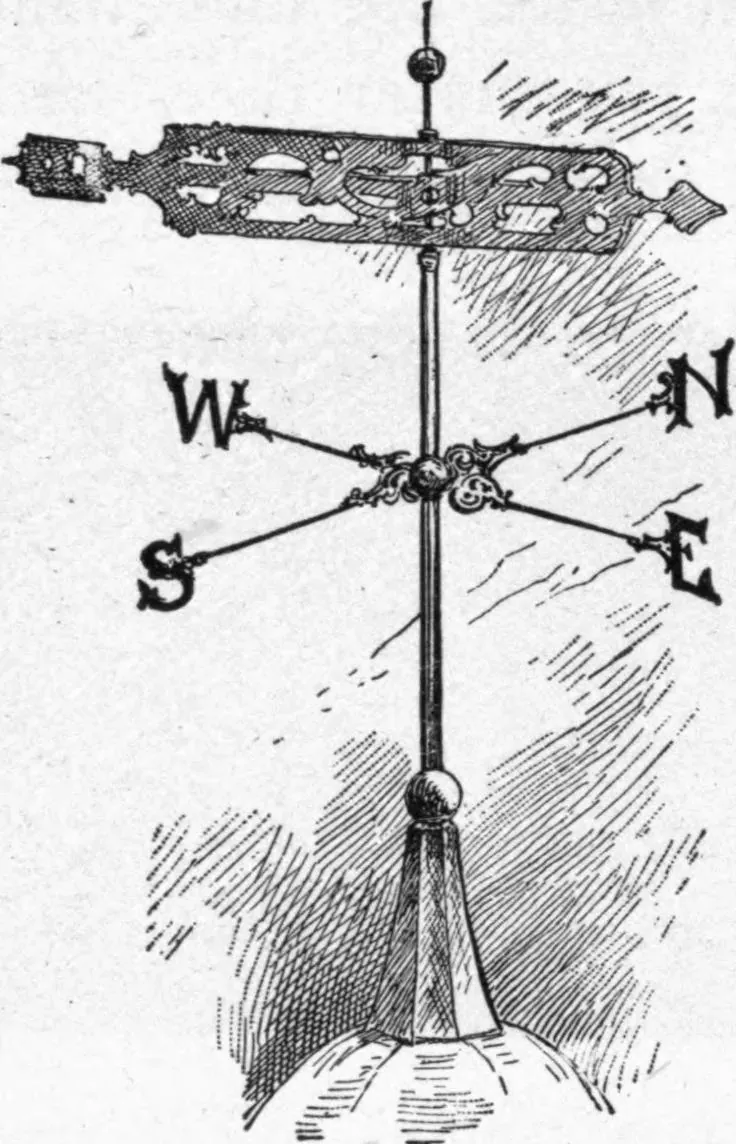
The arrow points to the direction from were Saved if it did not get into
the soil. But there is an enormous difference in rainfall at different places. On the arid plains of Arizona there are often less than two inches a year. In some parts of the Himalaya Mountains forty once for all, so as to point north, feet of rain fall in a year, east, south, west. Rainfall and Crops. — " Wheat
will not grow by itself where the rainfall is less than about eighteen inches a year, unless there are plenty of fogs. In the arid (dry) regions the farmers have to irrigate their crops."
FIG. 149. ONE FORM OF WIND VANE
which the wind is coming. If you should move the arrow so as to point in any other direction and then let go of it, you can see that the pressure of the wind on the tail of the vane would soon bring it back. A wind vane put into a rapid stream of water
Original page 171
Winds. — "A wind," said Jack, "is a current of air moving
near the surface of the earth. How can you tell which way
the. wind blows? "
Mary. A wind vane will do that. (See Fig. 149.)
Force of the Wind. — "Here is a table," said Jack, "that
scientific men and sailors use to express the velocity of the
wind, or else its pressure on a square foot.
SCALE
DESCRIPTION
VELOCITY IN MILES PER HOUR
PRESSURE IN POUNDS PER SQUARE FOOT
O
Calm
O
Very light breeze
Gentle breeze
7 or less
T2ijV or less
Fresh breeze
T6o4o
Strong wind
1 8 or more
IT^ or more
High wind
3i6oV
Gale
Strong gale
Violent gale
Hurricane
Most violent hurricane
" You can describe a wind by using this little table. A wind that blows about eighteen miles an hour — one that would carry a feather or a little toy balloon about eighteen miles in sixty minutes — is called/<?z/r (4). (See the first column of the table.) Such a wind presses on every square foot of a -house nearly two pounds. Hurricanes travel at the rate of seventy-six miles an hour — faster than express trains — and press on every square foot of houses nearly thirty pounds."
Agnes. And the houses are often blown down, too.
Original page 172
Jack. They are n't built to resist such winds. We very seldom have them in our part of the world, I 'm thankful to say.
Causes of the Winds. — " Whenever the surface of the earth is warm," said Jack, "the air over that part rises and other air
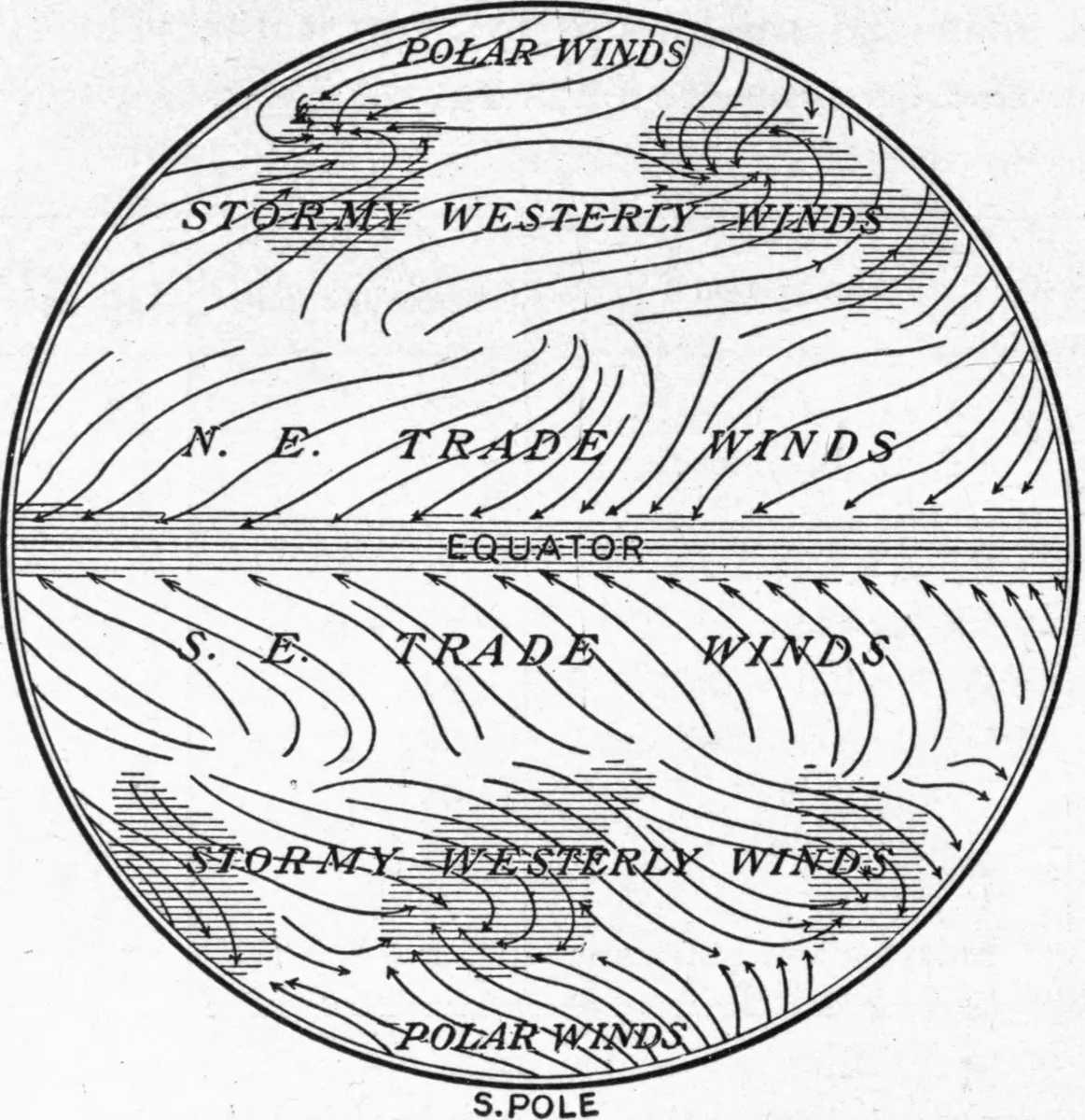
N.POLE
FIG. 150. A MAP OF THE GENERAL WINDS OF THE EARTH
The arrows show their general direction. The dark spots mark places where there is much rain. These winds blow over large regions of the earth. There are particular winds over smaller regions; but these are, of course, not shown on the map.
from a coWer place flows in to take its place. If you boys build a bonfire, the air rises and the smoke rises with it. Other air comes in to take its place, and if your fire was big enough — if a city were burning — it would create a really
Original page 173
FIG. 151. DIAGRAM TO SHOW HOW WINDS ARISE
If any region (D) is warmer than near-by regions (C,C), the air over D is warmed and rises. As it rises it cools, and the air near B,B moves downwards and inwards to take its place. The air over a bonfire moves in this way, and we have a little local wind. The air over a large part of the Mississippi valley may move in the same way for like reasons, and then we have winds covering several states.
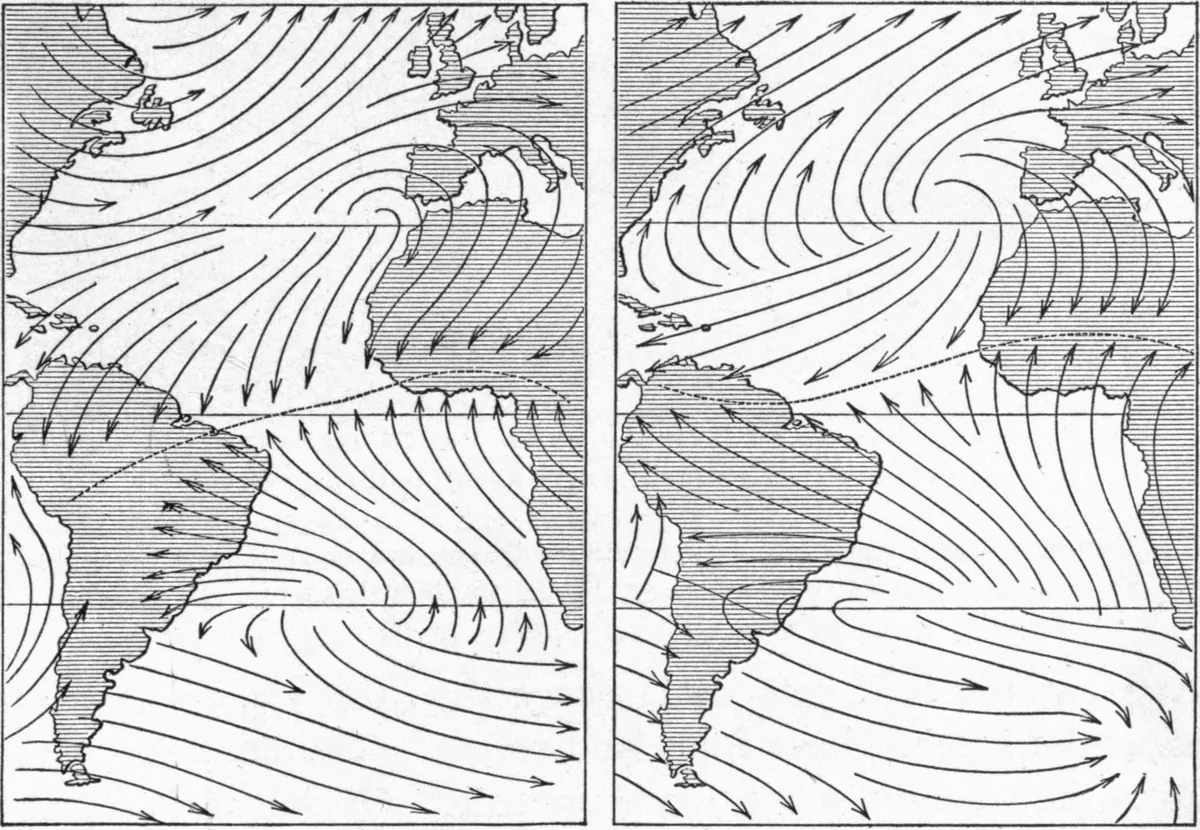
I. In January
II. In July
FIG 152. WINDS OF THE ATLANTIC OCEAN
The arrows show which way the winds blow. Charts like these are made for every ocean and for each month, and sailing ships go by tracks where the winds are favorable.
Original page 174
strong wind. The sun warms the hot regions of the earth, near the equator, more than the arctic regions; the hot air rises and the cold arctic air flows southwards to take its place."
Tom. You have to add that the earth is turning round all the time and so the winds do not flow straight to the equator but in spirals.
Jack. The sun is warming the earth all day — land and water, mountains and valleys; and all night the heat from the warmed places is rising up.
Land and Sea Breezes. — " The land gets warm more quickly than the sea, so that all day the breeze blows from sea to land.
FIG. 153. THE SUN (S) SHINING ON THE EARTH ILLUMINATING AND
HEATING THE HEMISPHERE TURNED TOWARDS HIM
It is daytime in that hemisphere. As the earth revolves on its axis (NS) every twenty-four hours both hemispheres are lighted and heated in turn.
At night the land gets cool sooner than the sea, so that all night the breeze blows from land to sea. The next time you go to the seashore see if this is not true. Of course there will be other winds, too; but every hot day you will notice the sea breeze that springs up in the morning and blows till nightfall." Weather. — " Weather depends upon a great many things," said Jack. " See if you children can tell me some of them."
Original page 175
Agnes. Well, we have warm days and cooler nights because the earth turns round. We are in the sun's rays in the daytime and out of them at night. (See Fig. 153.)
Mary. And we have cold winters and warm summers because — I don't believe I quite know why. Is it because the earth is nearer to the sun in summer?
Jack. No, the earth is a little nearer to the sun in December and January than it is in June and July — a little, though
FIG. 154. THE EARTH IN ITS PATH ROUND THE SUN
The earth is at A in December, at B in March, at C in June, at D in September. NS is the earth's axis, and N is the earth's north pole (in all four positions). At A (December) the arctic regions are dark. As the earth turns round on its axis a person at N is not brought into the light. In the northern hemisphere in March the days are shorter than the nights. As the earth turns a person anywhere in the northern hemisphere is in the lighted half of the earth for a shorter time than in the dark. But in June (C) a person in the northern hemisphere is longer in the light than in the dark — longer in the region heated by the sun.
not much; there is a different reason, Mary. (See Fig. 1 54.)
Storms. — " Our weather depends on the earth's turning on
its axis then," said Jack, " and on its motion round the sun.
Those causes are working all the time. Then there are storms that

Original page 176
travel over the whole country from west to east l and others that come up from the Gulf of Mexico along the Gulf Stream. These storms reach us, and our weather on Thursday, we may say, depends upon the weather some one else had on Monday. The Weather Bureau in Washington gets reports of all the storms in the whole country by telegraph several times a day and makes up a prediction about the weather we are going to have. You see the Weather Bureau predictions in the newspaper every day.2
Storm and Other Signals. — "Whenever you see a red flag with a black center expect a storm. The triangular pennants tell which way the wind will blow. (See the titles to the cuts.) A
N.E.
S.E.
N.W.
s.w.
FIG. 155. UNITED STATES WEATHER BUREAU STORM SIGNALS
square white flag predicts fair weather; a square blue flag predicts rain or snow; a flag half white and half blue predicts local rain or snow storms. A square white flag with a black center indicates that a cold wave is to arrive. If the black pennant (No. 4) is hoisted above any flag, it means that the weather is going to be warmer. If it is hoisted below any flag, it means that the weather is going to be colder.3
1 See Book II (Physics), page 87. 2 Ibid., page 88.
3 These flags are displayed in all towns where there is an observing station of the United States Weather Bureau, and children who live in such towns should learn them by heart.
Original page 177
FIG. 156. HURRICANE SIGNAL
Great Lakes
On the coast
Easterly winds Westerly winds
FIG. 157. INFORMATION SIGNALS
On the Great Lakes a red pennant denotes easterly, a white pennant westerly, winds. A red pennant at seacoast stations indicates a storm.
No. i, a square white flag
Fair weather
No. 2, a square blue flag
Rain or snow
No. 3, a square flag, half white, half blue
Local rain or snow
No. 4, a triangular black pennant
No. 5, a white flag with a black center
Temperature Cold wave
FIG. 158. WEATHER SIGNALS
By a cold wave is meant a fall of temperature of at least 20° in twenty-four hours. N.B. — In all the foregoing pictures a red flag is marked by vertical lines; a blue flag by horizontal lines.
Original page 178
" In some regions the Weather Bureau signals are given by steam whistles. A long blast is sounded to attract attention, then follow the signals for weather, and next those for temperature. The signals for weather are long blasts; those for temperature are shorter.
" One long blast means ' expect fair weather.' Two long blasts mean ' expect rain or snow.' Three long blasts mean « expect local rains or snows.'
" One short blast means ' expect lower temperature.' Two short blasts mean ' expect higher temperature.' Three short blasts mean « expect a cold wave.'
" You have no idea how useful these weather predictions are nor how many people read them and follow their indications. Think, about it a moment. Suppose there is a cold wave far up in Winnipeg moving eastward. Often it makes cold north winds in Texas — a * norther ' — and northers are destructive to crops and to cattle. The whole of the United States from the Mississippi River eastward to Maine and southward to Florida is going to feel it, and every one is warned to get ready. The railway people are all ready with snowplows; stock raisers herd their cattle into shelters and provide food for them; people who are shipping fruit, etc., on trains take warning and wait; orange growers in Florida light fires to protect their trees; ice companies prepare to get in their crop of ice; householders see that there is plenty of coal for their furnaces; firemen take extra precautions about their hydrants. There are millions of people who are affected in thousands of ways. The government Weather Bureau warns them all, and every man must look out for himself and for his business. That is the way a government like ours should be, I think. It ought to do
Original page 179
friijffUfl [pf*|ilr
r -w HE.?! --
i||i
Original page 180
i8o
the things that no single man can do — like this weather prediction — and leave every man to take care of his own affairs afterwards."
Lightning. — " The clouds in storms are electrified," said Jack, "and lightning is electric sparks on a large scale exchanged
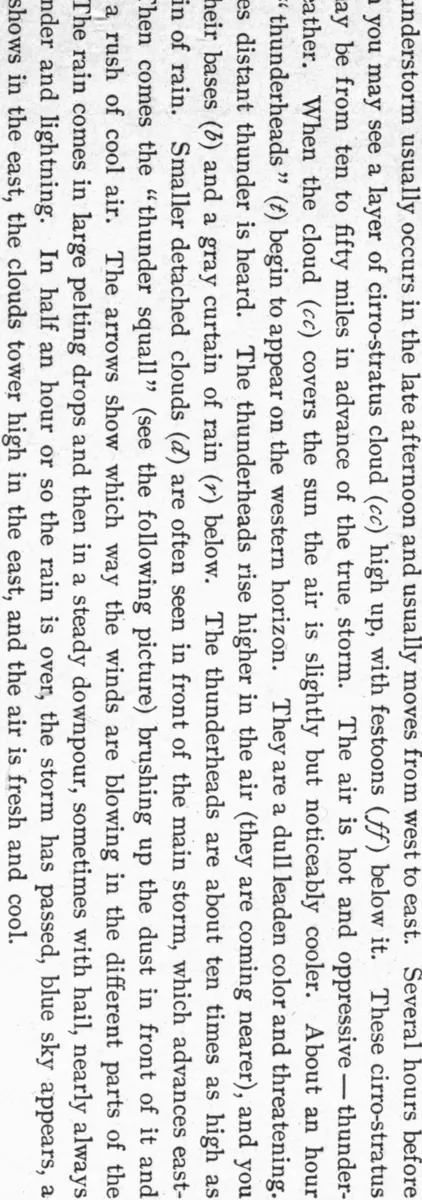
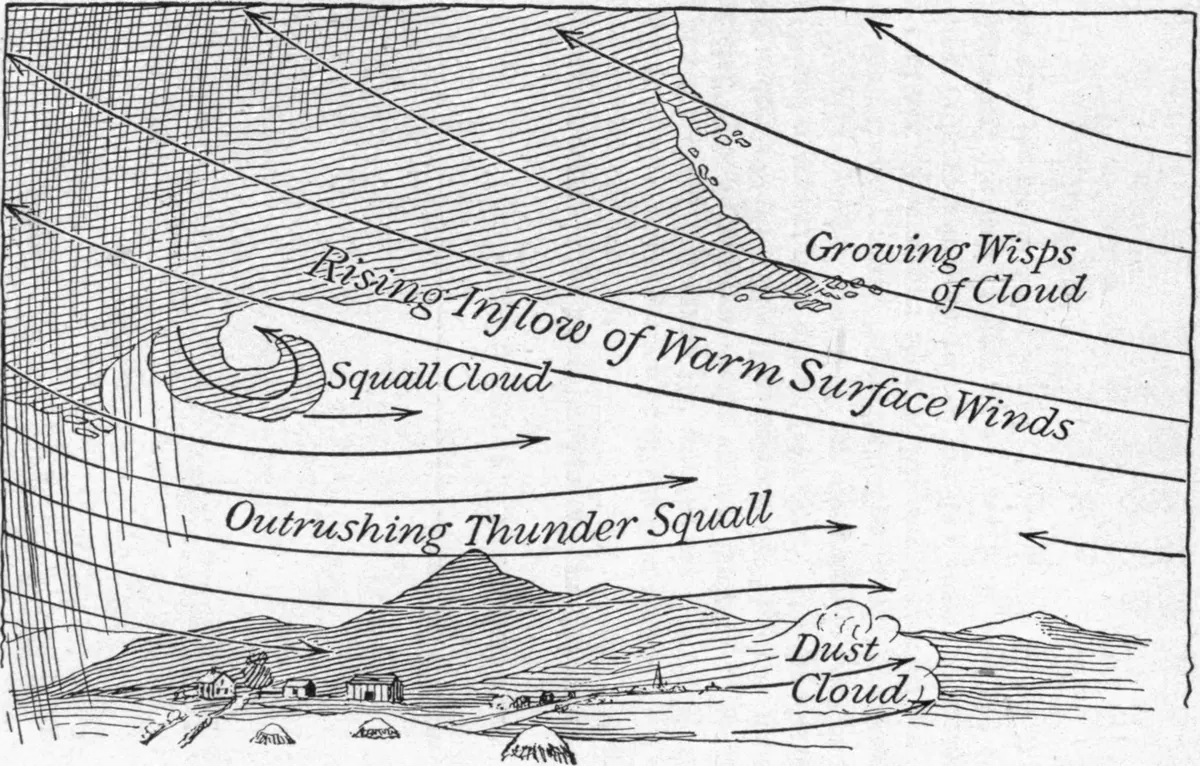
FIG. 160. THUNDER SQUALLS
A part of the preceding picture (within the space marked d b q in Fig. 159) is drawn on a larger scale here. The first picture shows the thunderstorm as it moves across the country at the rate of twenty to fifty miles an hour. This picture shows the thunder squall as it reaches any particular place. The arrows indicate how the different winds are blowing. If the two pictures are carefully studied, and especially if the reader will compare them with the summer thunderstorms seen at his own home, they will explain most of the appearances he sees.
between one cloud and another. Thunder is the crackle of the spark echoed among the clouds and mountains. Sheet lightning is usually the reflection of distant forked lightning from the surface of high clouds."
Original page 181
Agnes. Thunder is the echo that we hear, and sheet lightning is a kind of echo that we see.
Tom. How fast does lightning travel, Jack?
Jack. Exactly as fast as light does — at the rate of 186,000 miles in a second — so that the duration of a lightning flash is only a very small fraction of a second. After the flash comes the thunder. Do you know how to tell how far away a thunderstorm is?
Distance of a Thunderstorm from the Observer. -- Tom. You notice the flash of lightning and then count the number of seconds till you hear the thunder; I know that much, but I forget the rest.
Jack. It 's like this. The lightning flash and the thunder occur in the storm at exactly the same moment.
You are far off from it. You see the flash the moment it occurs because light travels so fast; but as sound travels only 1 100 feet in a second, it takes time for the sound of the thunder to reach you. You have to multiply the number of seconds between the time of the flash and the time of the thunder by noo, and you '11 have the distance of the storm in feet.
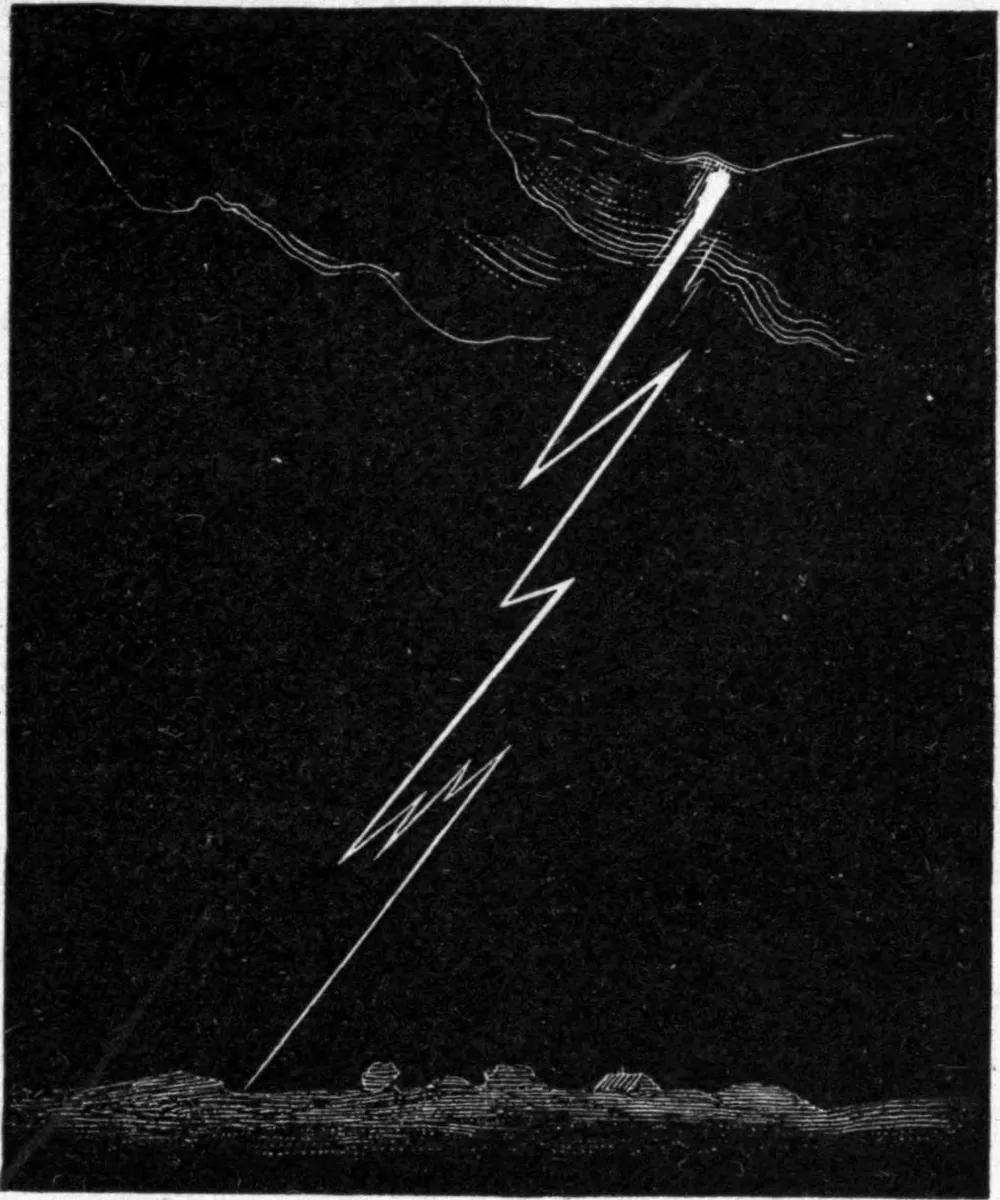
FIG. 161. LIGHTNING FLASHES
The sound of the thunder is The storm is heard after the flash by: distant:
Two seconds. Three "
The sound of the thunder is heard after the flash by:
Four seconds. Five "
The storm is distant:
4400 feet.
5500 " (about a mile).
It takes sound about five seconds to travel a mile.
Original page 182
Lightning Rods. — " Some people say," said Fred, "that lightning rods aren't of any use. How is it, Jack?"
Jack. Well, no lightning rods are so good that you can be certain your house will not be struck. The government takes the greatest pains to protect its powder magazines, but once in a while they are struck. Still, a lightning rod really does protect. It should be a good-sized copper rod that goes deep down into the ground — far enough to reach moist earth— and it should extend ten or twelve feet above the roof, and end in a sharp point. Three or four good rods will protect an ordinary house almost always. It is better to have them; you are safer.
Original page 183
Original page 184