
Book II · Physics
Heat, Light, Sound, Electricity, and Magnetism
Original page 73
Solids and Liquids. — "What is the difference between a solid and a liquid? " said Tom one hot afternoon when the children were all together on the porch, fanning themselves.
Mary. You can pick up a solid in your fingers, and you cannot pick up a liquid — that's one difference.
Agnes. You mean you can pick up a piece of ice, and you cannot pick it up when.it has melted into water?
Mary. Of course you can't.
Fred. Oh, yes, you can — and with that Fred took a lump of sugar and put it in a teaspoon partly full of water. The sugar took up the water, and Fred picked up the sugar and left the spoon quite empty, saying: " Look at that! I 've picked up a liquid in my ringers. It 's magic."
Agnes. That is just foolish, Fred.
Fred. I know it — but it is magic. You said I could n't do it.
Tom. It is n't fair, Fred; you can pick up a sponge with water in it, but you cannot pick the water up without the sponge, nor the water without the sugar, either.
Original page 74
Fred. All right. I was just playing. It is a kind of magic, though.
Mary. Well, was n't I right? A solid is a thing you can pick up in your fingers, and a liquid is something you can't pick up.
Tom. The real magic of it is that a piece of ice and a spoonful of water are just the same thing. The same thing is different at different times; sometimes it is ice, and sometimes water. I wonder why. Let us ask Jack.
Jack. I think Mary's definition is a pretty good one — a solid is a thing you can pick up in your fingers. You can change a solid into a liquid, if you want to, by heating it. You can change a piece of ice into water by letting it melt. A little heat will do it.
Fred. How does heat do it, Jack? Solids, Liquids, and Gases are made up of Millions of Small Particles. —Jack. Well, you have to begin far off if you wish to understand. The scientific men have proved that all solids — and all liquids, too — are made up of little particles crowded close together. When you heat a solid the particles are forced farther and farther apart.
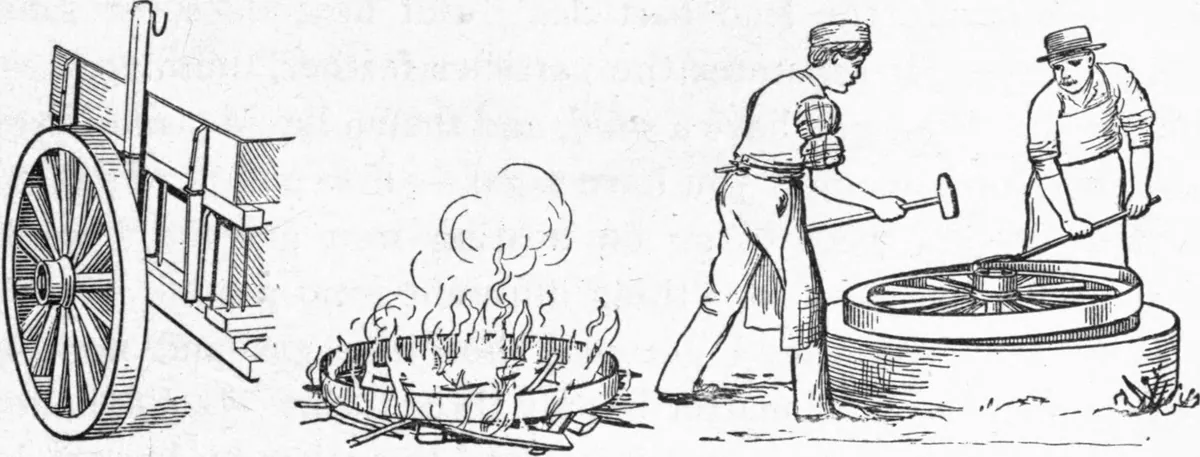
Heat makes Solids, etc., expand. — "A piece of solid iron gets larger when you heat it. When a blacksmith wants to fit a new tire on a wheel he first heats it and puts it on; then the tire, as it gets cold again, shrinks tightly on the wheel and stays where it was put."
FIG. 54
A solid, a piece of iron for instance, is made up of thousands and thousands of little particles, each one like every other one, all crowded together, like the lower part of the picture. When you heat a solid the little particles are forced farther apart, so that by and by they look like the upper part of the picture. The solid will get larger if you heat it.
Original page 75
" Every little particle of the tire has been forced apart by the heat, and by and by the whole tire, which was in the first place smaller than the wheel, grows large enough to slip over the rim. Then the blacksmith slips it on and lets it cool. As it cools, it shrinks and fits the rim tightly. The heat has loosened the particles, you might say."
Agnes. How do you know the particles are farther apart when the iron is hot?
Jack. There are just so many particles in the cold iron to begin with, Agnes — say ten millions of them, if you please. And ypu haven't put any more particles in the tire, you know;
FIG. 55
The right-hand picture shows a wheel ready to be fitted with a tire; the middle picture shows the tire heated in a fire. When the tire has expanded — grown large — enough the blacksmith fits it on the wheel and lets it shrink tight by cooling.
you have simply heated it. But the tire really has grown bigger — the proof is that it will slip over the rim of the wheel. The same ten million little particles of the cold iron fill a larger space than when they are cold; so they must have been forced farther apart somehow, you see. And the heat did it — nothing else could have done it.
Mary. Suppose you had heated the iron more and more, Jack. What then?
Original page 76
Jack. If you had put the iron in a furnace and kept on heating it, you would have had a hot solid at first; then it would have become pasty, almost like dough, and by and by it would become a liquid — it would flow like water. You cannot try the experiment with iron, but you have often seen the boys try it with lead when they are molding bullets for their guns. Lead melts more quickly than iron.
Agnes. Yes; they put the lead in a ladle and melt it, and then pour it into molds and let it cool.
Jack. Iron is made up of one kind of small particles, and lead is made up of another kind of particles; and it takes less heat to separate the lead particles. But heat does the same thing always. It separates the particles farther, the more heat you apply. First you have a solid, and then a liquid; and if you heat the liquid enough, you have a gas — iron gas, lead gas.
Tom. If you were to go on heating iron gas for a week, what would you get? something different from gas?
Jack. No; you would get very hot iron gas and nothing more. You can have matter in only three forms — solid, liquid, gas — but you can turn one form into the other by heat or by cold. Take ice, for instance.
Fred. Ice is solid. If you make it colder and colder, it is nothing but ice — the north polar regions are ice and nothing else.
Agnes. And if you heat ice, it becomes water.
Mary. And if you heat water in a teakettle, it becomes steam.
Tom. And if you heat steam, Jack, more and more, is it always steam?
Jack. It is never anything else. It is simply very hot steam. The boiler of a locomotive or of a steamship makes steam and
Original page 77
nothing else. Solid, liquid, gas — that is all you can get. If you cool a gas like steam enough, you will get a liquid; and if you cool a liquid enough, you will get a solid.
Most Gases are Invisible. — Mary. I have seen solids and liquids; but I am not sure I have ever seen gases.
Fred. Well, you have smelled them, anyway, from leaky gas fixtures in the house, or when the match went out before you could light the gas at the burner.
Mary. Oh, yes; and of course there is gas inside of the little toy balloons. But I have never seen gas.
Jack. Most gases cannot be seen. They are invisible. Air is invisible, but it is all around us. If any one asked you to prove that air was really all around us, Mary, how would you prove it?
Mary. Why, I should say that the wind was nothing but moving air.
Jack. That is a good way, my dear, was n't blowing; then what?
Mary. I should wait till it did.
Jack. You could make an experiment to prove it this way. Take an empty tumbler and hold it upside down. We call it empty, but it is really full of air — of invisible air. Then take a glass bowl half full of water and float a cork on it. Now gently press the tumbler down over the cork (see the picture) and see what you will see. If there were nothing in the tumbler
FIG. 56
A glass bowl partly filled with water, a cork, and a glass tumbler are needed to prove that the tumbler was filled with air. This experiment should be tried in the class room.
But suppose the wind
Original page 78
-if the tumbler were really empty — then the water would fill it full; but you can see that the water rises only for a certain distance, and no higher. There is air in the tumbler still.
Tom. I can prove that there is air in the tumbler now. Tip the tumbler sidewise a little while it is in the bowl
and the air will come out in bubbles.
Fred. What becomes of the air in the bubbles when they come to the surface?
Tom. Why, it just mixes with the other air all around us.
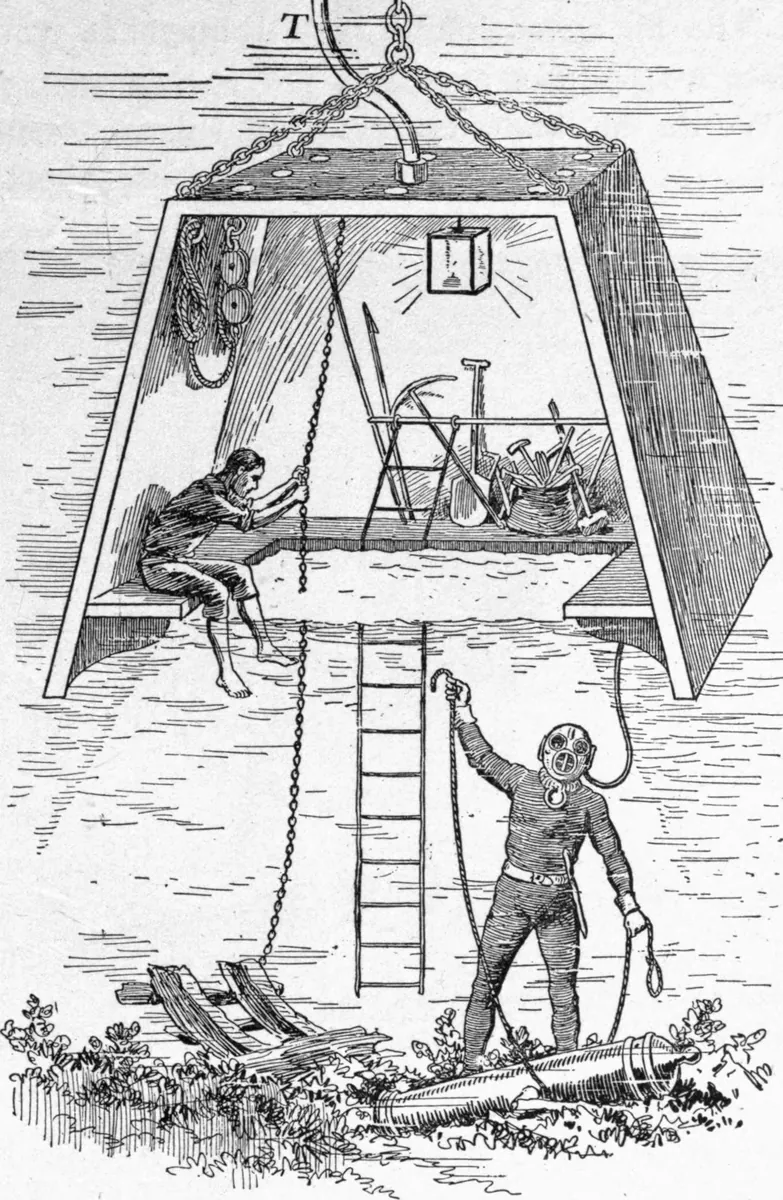
The Diving Bell. — Agnes. The diving bell that men use at the bottom of rivers is like the tumbler, is n't it?
The Earth's Atmosphere. — Jack. The air is all around us everywhere, for wherever you go you find air to breathe. Agnes. Not on the tops of mountains, Jack. Jack. There is not so much air at the tops of mountains as there is below, Agnes, but there is air. Men have climbed the very highest mountains, and as they went up they found less and less air. Birds fly nearly as high. The condor — a bird like an eagle — flies high in the Andes of South America, and balloons carrying men have gone five miles high. Balloons without men have gone as high as ten miles, but the air is so thin at that height that men could not breathe.
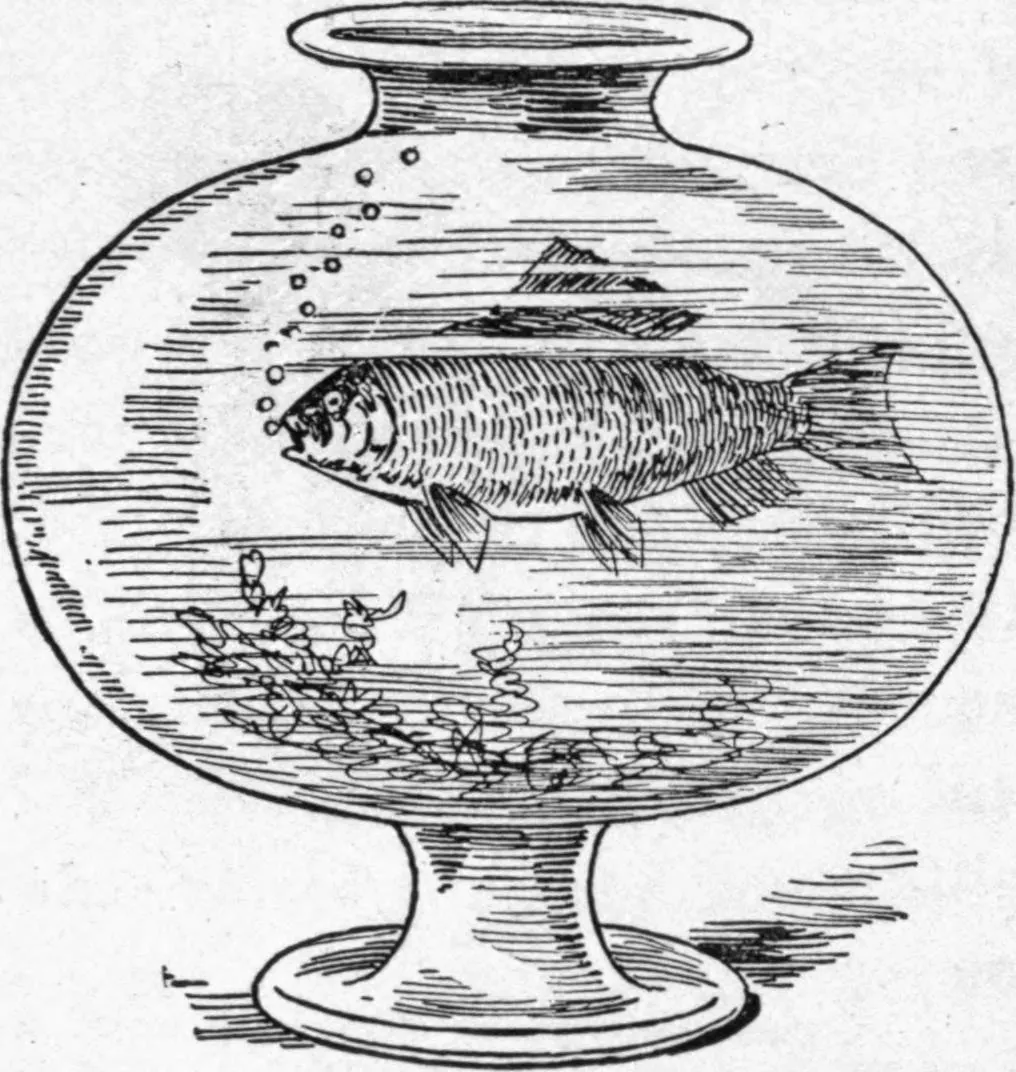
FIG. 57. BUBBLES OF AIR ESCAPING FROM THE MOUTH OF A GOLDFISH IN A GLOBE
Original page 79
FIG. 58
The diving bell is lowered by a chain from a ship, and air is pumped into it by the pipe marked T in the picture. The whole diving bell is under wa,ter, but the water rises no higher than its floor. The pressure of the air keeps it out. A diver goes down to the bottom of the harbor and fastens ropes to whatever he wants to hoist to the surface. He has a waterproof and air-proof suit of clothes, and air is pumped down for him to breathe (through the small pipe in the picture). The foundations for the piers of bridges can be laid by men working in this way.
Original page 80
Mary. The air gets thinner and thinner as you go up. Where does it stop, then?
Jack. We do not know exactly; but there is some air — a very little — as high as sixty miles, because shooting stars
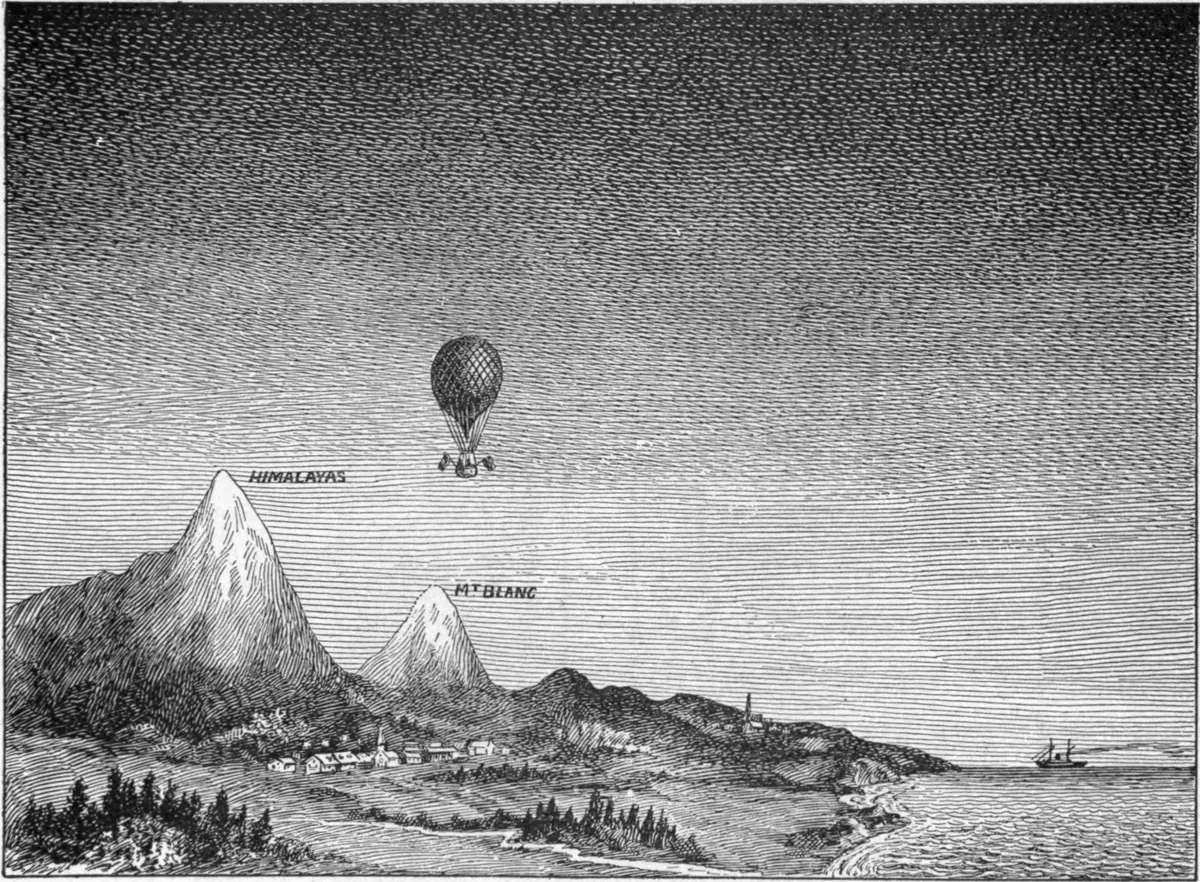
FIG. 59
The Himalaya Mountains are about five miles, and Mont Blanc, in the Alps, is about three miles above the level of the sea. A balloon carrying men has gone up five miles and very light balloons filled with gas have gone nearly ten miles above sea level.
begin to burn as high as that. They burn when they first meet the air, about sixty miles above the ground.1
Balloons. — Tom. The balloon floats in the air because it is lighter than the air, just as a chip floats on the water.
1 See Book I (Astronomy), Meteors, page 45.
Original page 81
8l
Mary. If the balloon is lighter than the air, then the air itself must be heavy; for a balloon weighs a good deal, especially when it is carrying men.
Air is Heavy. — -Jack. Yes, the air is heavy, and there is a simple way to prove it. /
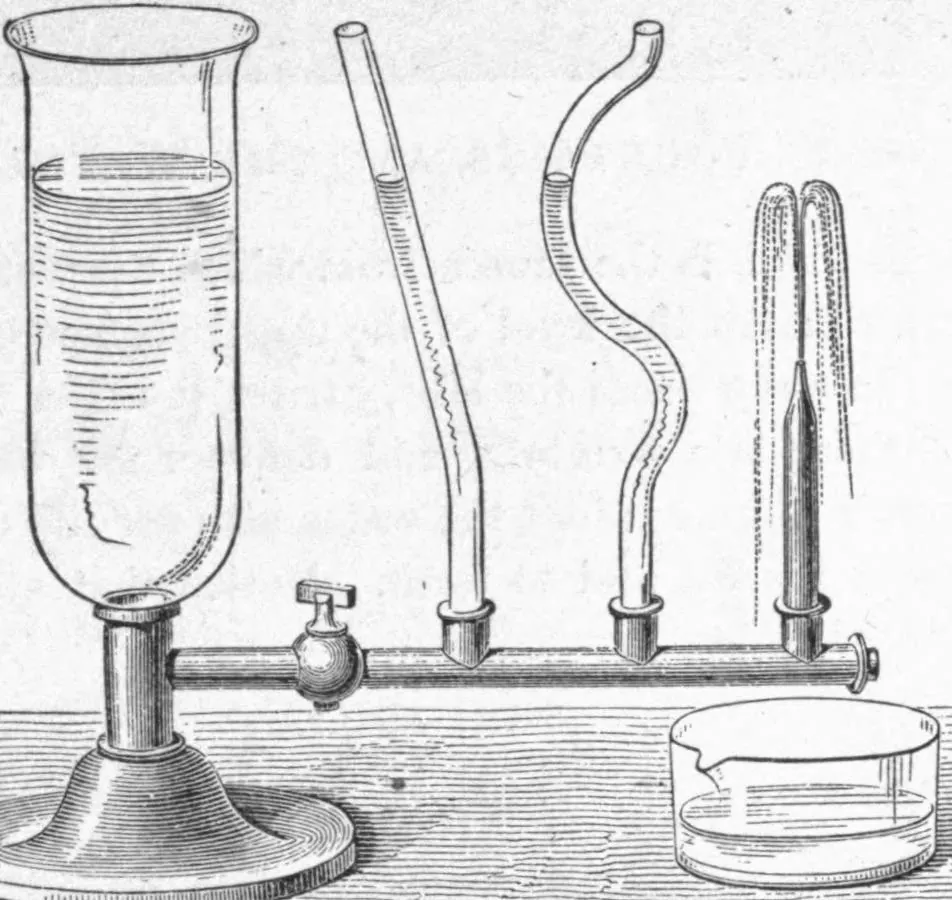
Reservoirs, Fountains, and the Water Supply of Cities. — " If you have a reservoir full of water and a fountain joined to the reservoir by a pipe, the fountain will play as soon as the
All these glass vessels are joined together by the brass tube at the bottom. If you fill the large jar at the left-hand side with water, all the other tubes will at once fill up to the same level. The air presses on the water in the large jar and forces it up into the other tubes and makes the little fountain play.
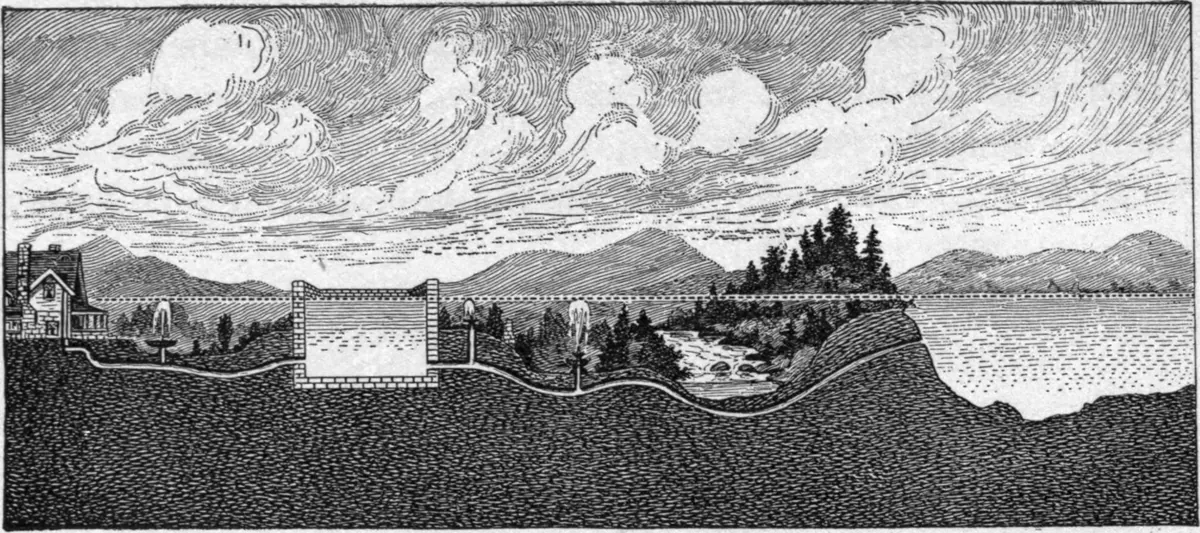
water is turned on, and the fountain will play as high l as the water in the reservoir. That is because the air above the reservoir is heavy and presses down on the water in it and forces it up in the fountain. (See Fig. 61.) Now here is an
1 Or nearly as high; the friction of the water in the pipe makes some difference.
Original page 82
FIG. 61. RESERVOIRS, FOUNTAINS, AND THE WATER SUPPLY OF CITIES
picture shows a lake which is the source from which the water is obtained. A dotted line across the picture marks the level of the upper surface of the lake. An aqueduct (water pipe) takes the water from the lake, carries it under the hill, under a pond, up another hill, where there is a fountain, and delivers the water to the city reservoir. From the city reservoir pipes conduct the water all over the city — to public fountains, to the upper stories of houses, and so forth. Notice that all the fountains send their jets to about the same height.
FIG. 62
The U-shaped tube is partly filled with water as in the right-hand picture. Air fills the rest of both branches of the tube. Now tip the tube so that one branch of the tube shall be completely filled with water — water on one side, air on the other. Then cover the water side with your finger, as in the left-hand picture. You will see that the water will stand at different heights on the two sides. There is air pressure on one side of the tube and no air pressure on the other (your finger keeps the air out). The air pressure keeps the water standing high. If you take your finger away and let the air in, the water on both sides of the tube will stand at the same level on both sides. (This experiment should be tried in the schoolroom.)
Original page 83
experiment that we can try ourselves with this bit of glass tube bent into the shape of a U.
" You see that the air must be heavy; it must press down with weight because it makes the fountain play (Fig. 61) and keeps the water standing high (Fig. 62).
The Barometer.1 — " Instead of using water in the U-shaped tubes, you can use any liquid — milk, kerosene oil, quicksilver. It is convenient to use quicksilver because it is heavy and because it is so clean.2
" You need a hollow glass tube about thirty-two inches long, closed at one end, a lot of quicksilver, and a flat basin of glass or china. Hold the long tube with its open end upwards. It is full of air. Make a paper funnel and pour quicksilver from a pitcher into the open tube, slowly and carefully, until you have quite filled it. As the quicksilver goes in it will drive out the air, and finally you will have a tube with no
,.. See the description in the text.
air in it — nothing but quicksilver.
You must handle it carefully because it is quite heavy. Now
put your finger over the open end of the long tube and turn
1 The barometer is an instrument to measure the weight — the pressure — of the air. The name comes from two Greek words, one meaning " weight," and the other " to measure."
2 Quicksilver is a poison if taken in the mouth; it is perfectly safe to handle it unless there are open cuts on the hands and fingers. If it touches a gold ring, however, it will cover the gold with a thin layer of quicksilver that will not wear off for some time.
FlG. 63. HOW TO MAKE A
BAROMETER
Original page 84
the tube swiftly upside down. (See the left-hand picture, Fig. 63.) If you should now take your finger away, all the quicksilver would fall out. There would be nothing to support it. But dip the open end of the long tube in the basin of quicksilver, take your finger away, and see what happens. The quicksilver will fall in the tube a little distance — a few inches — and then it will stop. The air is pressing on the quicksilver in the basin and is pressing some of it up into the tube. There is no air above the quicksilver in the tube; nothing is pressing downward except the weight of the quicksilver in the tube itself. The weight of the quicksilver in the tube pressing downward just balances tire pressure of the air on the quicksilver in the basin. The two pressures just balance each other." The Air presses about Fifteen Pounds on Every Square Inch. — Tom. The height of the column of quicksilver in the tube is about thirty inches.
Jack. Yes; and if the tube were an inch square, the column of quicksilver in it (thirty inches high and an inch square) would weigh fifteen pounds. The air pressing on the basin keeps that column standing. It keeps a weight of fifteen pounds standing.
FIG. 64. A QUICKSILVER BAROMETER READY FOR USE
The long glass tube has a scale of inches at the upper end; 28, 29, 30, 31 inches are marked, as well as the tenths of inches. The basin of quicksilver is at the bottom.
Original page 85
Fred. That is what is meant by saying, the air presses fifteen pounds on every square inch of your body, is n't it?
Jack. It presses fifteen pounds on every square inch of the whole world; on your body, and on the ground, and on the water — everywhere. It presses down and it presses up, too.
Tom. How does it press up? I see that it presses down.
Fred. The air must press up or else a balloon would not rise.
Jack. That is one proof, and here is another that you can try for yourself. (See Fig. 65.)
How to measure the Heights of Mountains. — "Now I want you to say what would happen if I had taken the barometer to the top of a mountain."
Mary. The air is lighter at the top of the mountain than it is here, and does not press down so much.
Tom. So the quicksilver in the tube would not stand so high; it would not have so much air pressure to balance.
Jack. Bravo! that is just right. At the level of the ocean all the air — the whole atmosphere — is above you, and it presses fifteen pounds on every square inch of the ground. The quicksilver stands thirty inches high. When you go up about 1000 feet the air above you presses less because there is less of it; you have left 1000 feet of it below you, and the column of quicksilver is about twenty-nine inches high; if you
FIG. 65
Fill (or partly fill) a tumbler with water and press a stout piece of writing paper over the top closely. Put the palm of your hand over the paper and hold it on tightly. Now quickly turn the tumbler upside down and take away your hand from the paper. (See the picture.) The pressure of the air from below is so much greater than the weight of the water, and of the small amount of air in the tumbler, that the paper will hold the water up. (This experiment should be tried in the schoolroom.)
Original page 86
go up 2000 feet, there is less air above you and the column is about twenty-eight inches high, and so on.
Tom. So you could measure the height of a mountain by noticing the height of the column of quicksilver in the tube?
On high mountains the column would be short.
Jack. That is right, and that is the way the heights of mountains are really measured. A barometer measures the weight of the air above you. The higher you go the less air above you and the less pressure on the basin of the barometer.
The Barometer is a Weatherglass. — Fred. Sometimes we see in the newspapers a notice of low barometer coming.
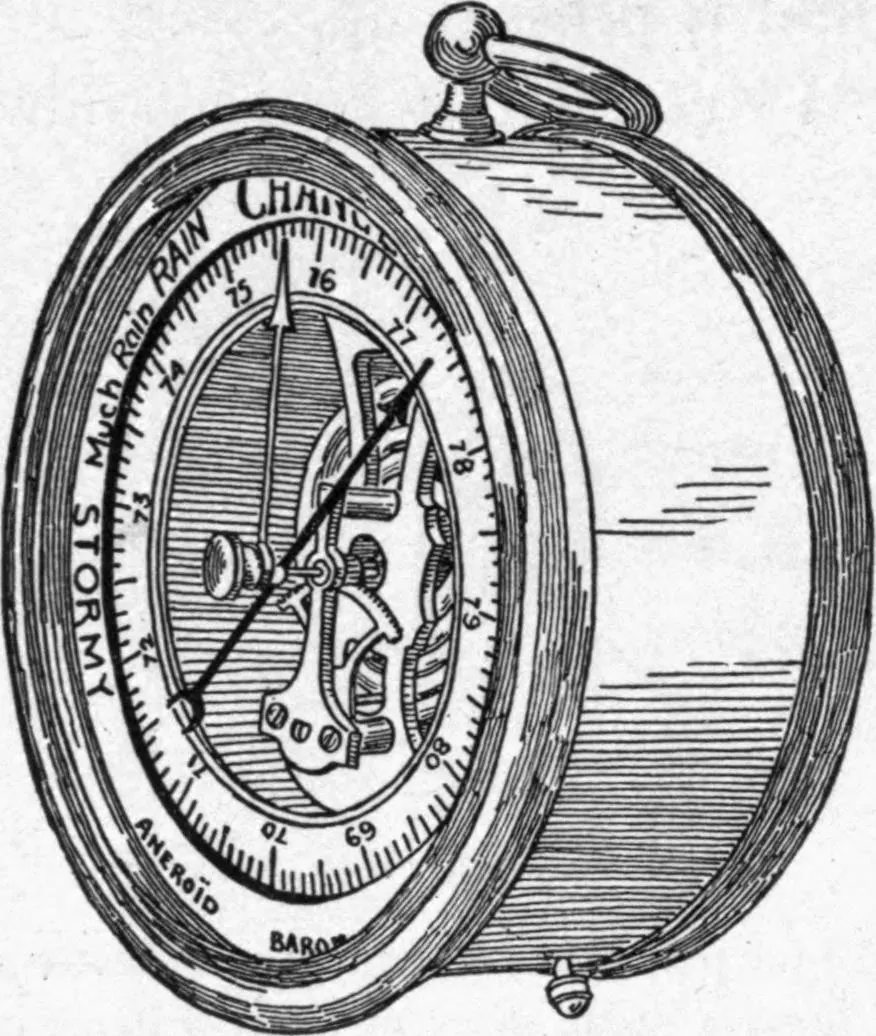
FIG. 66. AN ANEROID BAROMETER (A BAROMETER WITHOUT QUICKSILVER)
Aneroid is a Greek word that means “without any liquid.” Inside of the outer metal case is a tightly sealed box containing no air. On this box the outside air presses, sometimes more, sometimes less. The little box changes its shape under this pressure, and things are so arranged that changes of pressure make a needle pointer move around a dial. This form of barometer is very convenient for travelers and seamen.
Jack. It happens that where storms are coming the air weighs less and the barometer is low — the column of quicksilver is short. In fine weather the air is heavy and presses down more; so the barometer is high and the column of quicksilver is long. If you watch the quicksilver from day to day, you will find this is the case, generally: when fine weather is coming or is here the barometer is high; when storms are coming or are here the barometer is low. So the barometer is a kind of
Original page 87
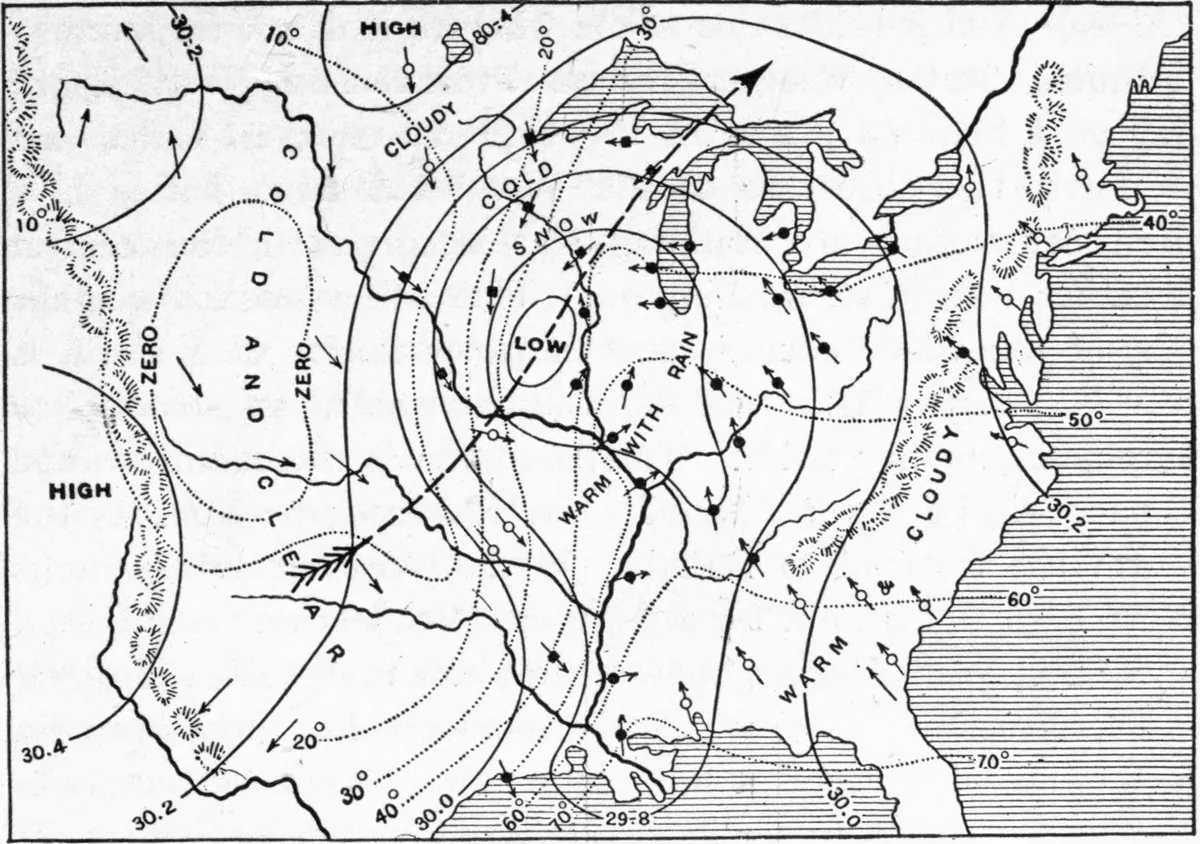
FIG. 67
A map made by the Weather Bureau one November morning. An area of low barometer was near Omaha and it was moving towards Canada (in the direction of the curved arrow). Wherever there are little dots observations had been taken and telegraphed to Washington. The arrows through the dots fly with the wind — they point in the direction of the wind's motion at each place. Where the dots are bkck it was raining; where they are square it was snowing; where they are circles with white centers it was
cloudy. The full lines () join all places where the barometer was at the same height,
the thermometer stood the same, as 70°, 60°, 50°, 40°, 30°, 20°, 10°, o°. There was zero weather near the Rocky Mountains, while it was warm and cloudy east of the Alleghenies. Northwest of the area of low barometer there was snow; southeast of it there
Original page 88
weatherglass. It tells you beforehand what kind of weather is coming.1
Fred. And it tells ships at sea when to look out for storms.
United States Weather Bureau Predictions. — Jack. Every day at a hundred places in the United States, in Cuba, and so forth, the observers of the Weather Bureau notice how their barometers are standing and telegraph to the central Weather Bureau at Washington. There they make a weather map of the whole country several times daily. If a storm is traveling eastwards, it will show on the map by an area of low barometer, as they call it. The barometer in the country round Omaha will be low on Monday, for instance; by Tuesday the storm has traveled to Buffalo; so the Weather Bureau tells New York to look out for a storm on Wednesday.
Agnes. Well, I never knew before how that was done.
Thermometers.2— Fred. A thermometer has quicksilver in it, too, but it is closed at both ends.
Tom. A thermometer is to measure how hot the air is. It is different from a barometer; that measures how heavy the air is.
Jack. Yes, a thermometer measures how hot the quicksilver in it happens to be by the height of the quicksilver in the glass tube. If the quicksilver column is long, then the temperature
2 The word thermometer is from two Greek words, and it means " an instrument to measure heat — temperature."
Original page 89
is high; if the column is short, then the temperature is low. The higher the temperature the longer is the quicksilver column.
Mary. It is like the iron tire of the cart wheel. (See Fig. 55-) The hotter the fire, the b
longer the tire is.
Agnes. ^ By just putting my hand on a thermometer I can make the quicksilver mount up in the tube.
Tom. Jack, why do they make the scale this way? 32° is marked freezing, and 212° is marked boiling.
Jack. A German named Fahrenheit l invented the thermometer we use about 200 years ago. (See the right-hand picture in Fig. 68.) He put his thermometer into melting ice and made a mark on the tube just where the quicksilver stood; and then into boiling water and made a mark on the tube where the quicksilver stood. It is too complicated to tell you why he named the first mark 32° and the second 212°, but anyhow he did so. The distance between his two fixed marks he divided into 1 80 equal parts — degrees. His thermometer was used in England; the Pilgrims brought it over to America; and we use it to-day. But there is another scale of degrees — the centigrade2 (see the left-hand picture in Fig. 68) — which was invented in France
1 Pronounced far'en-hlt. 2 Pronounced sen'ti-grad.
FIG. 68. THE GLASS TUBES OF Two THERMOMETERS
The tubes are closed at both ends, are entirely empty of air, and are partly filled with quicksilver.
Original page 90
about a hundred years ago, that is used nearly everywhere in Europe. On the centigrade thermometer the freezing point is marked zero degrees (o°), and the boiling point of water one hundred (100°); and the scale between o and 100 is divided into equal parts. Zero of Fahrenheit's scale is 17^5- degrees below zero of the centigrade scale. (See Fig. 68.)
Mary. Was Centigrade a man?
Tom. Of course not; don't you see that centi means "one hundred," and grade " degree "?
Mary. Why, certainly; I thought he might be a Frenchman though.
Jack. If you put one of our thermometers into melting ice, it will always mark 32°; if you put it in boiling water, it will always mark 212°; and if you put the bulb of it in your mouth, it will always mark about 98° — that is, unless you have a fever.
Fred. The doctor always takes my temperature with a little thermometer when I am ill.
Tom. And if your temperature goes as high as 104°, he looks very serious. The sign of being well is to have a temperature of 98°, they say.
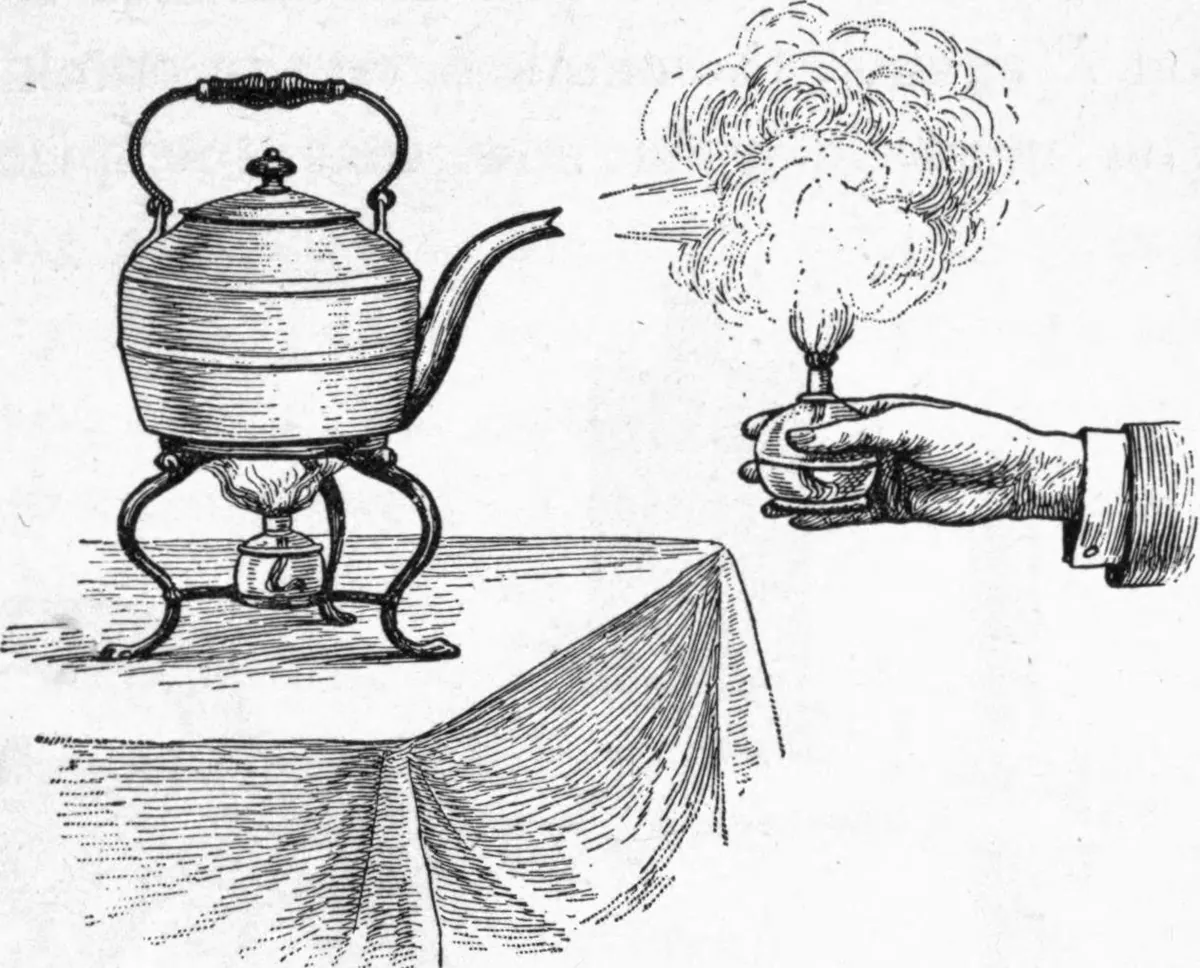
Steam. — Jack. If you took a teakettle and boiled the water in it, the temperature of the boiling water would be 212°. Inside the kettle there is water at the bottom, and above the water there is steam. If we had a glass kettle, you could look through the sides and you would see nothing at all above the water. True steam is invisible; but there is steam there all the while. How do we know?
Mary. We see the steam lift the lid of the kettle every now and then.
Fred. I thought steam was visible. What is that cloud coming out of the nozzle of the kettle?
Original page 91
Jack. That is water; cooled steam; water in small drops like fog or clouds. The real invisible steam is inside, trying to lift the lid and escape. If we fastened the lid down and closed the nozzle, we should have a little steam engine.
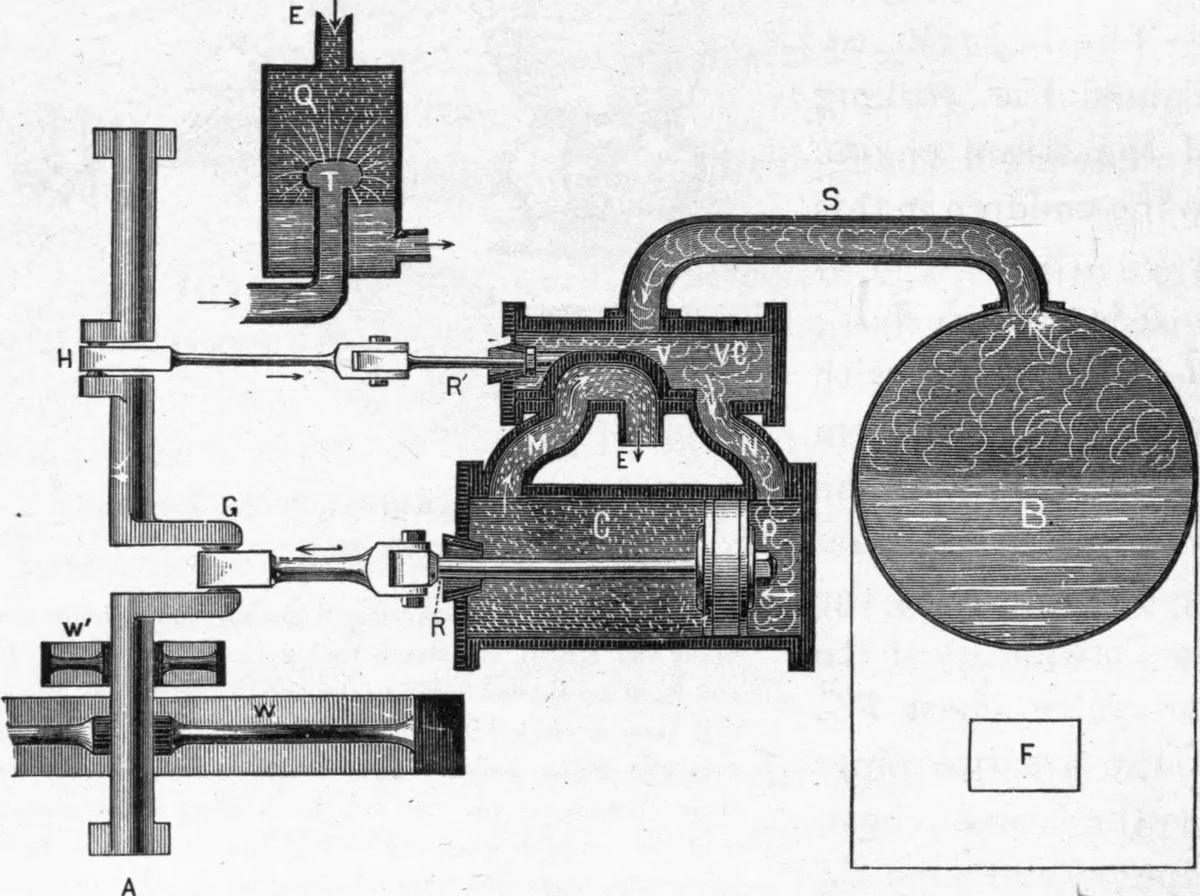
The Steam Engine. — Then Jack explained the working of the steam engine to the children in this way. (See Fig. 70.)
F is the fire box; B is the boiler with water in the bottom of it, and steam at the top; S is the steam pipe that carries the live steam over to the valve chest VC. There are two pipes in the valve chest, pipe M and pipe N, and both pipes open
FIG. 69.
A TEAKETTLE WITH BOILING WATER IN IT
It gives out clouds of what we call steam. The clouds are really not steam, but steam cooled back into water. If you hold an alcohol lamp under the cloud, the hot flame will turn it back into steam and you will see no cloud over the flame, because true steam is invisible. It is there though, as you can tell by holding a cold spoon over the invisible spot. The invisible steam will turn into visible water (like fog or cloud) and gather in drops on the spoon. (This experiment should be tried in the schoolroom.)
from the valve chest and run to the cylinder C. But things are so arranged that both pipes M and N cannot be open at the same time. If N is open, Mis shut (as in the picture). If Mis open, N must be shut.
The picture is drawn with the pipe N open. The live steam rushes into the pipe N, fills it, and rushes into the right-hand end of the cylinder C and presses against the piston
Original page 92
head P. (The piston head is a large iron disk that fills up the whole of the diameter of the cylinder.) The pressure of the live steam moves the piston head P (to the left in the picture) to the other end of the cylinder C and pushes the piston rod R against the crank G on the crank shaft A, and turns it. You must imagine now that the piston head P is at the
FIG. 70 Drawing of part of a steam engine.
left-hand end of the cylinder C and that the live steam fills the whole of the cylinder. Find the letter Rf in the picture. R1 is fastened to a slide valve Fat one end and to the crank shaft at //", and things are so arranged that now the rod R' closes the pipe N by which the steam came in and at the same time opens the pipe M. The live steam is filling the valve chest VC all
Original page 93
this time. It cannot get into the pipe A7" (which is now closed), and so it rushes into the pipe M (which is now open) and presses against the left-hand side of the piston head P (which is now at the left-hand end of the cylinder C}. The piston is now pushed back by the steam to where it started from (just as in the picture), and the crank shaft A is turned still more. When the piston gets back to where it started the pipe M is closed and the pipe N is opened again (by the rod R') and the piston head is moved to the left again, then to the right, then to the left, and so on as long as the engine is running. Every time the piston head P travels the length of the cylinder C the crank G makes half a turn, and in this way the crank shaft GA keeps on turning. W is a little pulley wheel fastened to the crank shaft; and if you put a leather belt on this pulley wheel, you can carry the power of the engine wherever you like. You can carry it as far as the belt goes and drive any other machine — a lathe, a saw, a drill. W is a heavy fly wheel fastened to the shaft A to keep the motion steady.
All this description of how an engine works is perfectly easy to understand if you take one thing at a time and pay attention; but it is rather long, and you had better read it over again carefully with a pin in your hand to point with. The live steam starts from the boiler B (put your pointer there); fills the valve chest VC (put your pointer there); rushes through the pipe N (point at it); presses against the piston head P (point at it); drives the piston head to the left-hand end of the cylinder (point at it); moves the stiff piston rod R so as to turn the crank G (point at R and G). At this time the pipe N is closed and the pipe M is open (point at A7" and M); the live steam is all the while filling the valve chest VC (point there) and cannot escape through the pipe N (which is closed) and
Original page 94
now rushes through the pipe M (which is now open), and so on. You must go through the whole description again and again till you understand it.
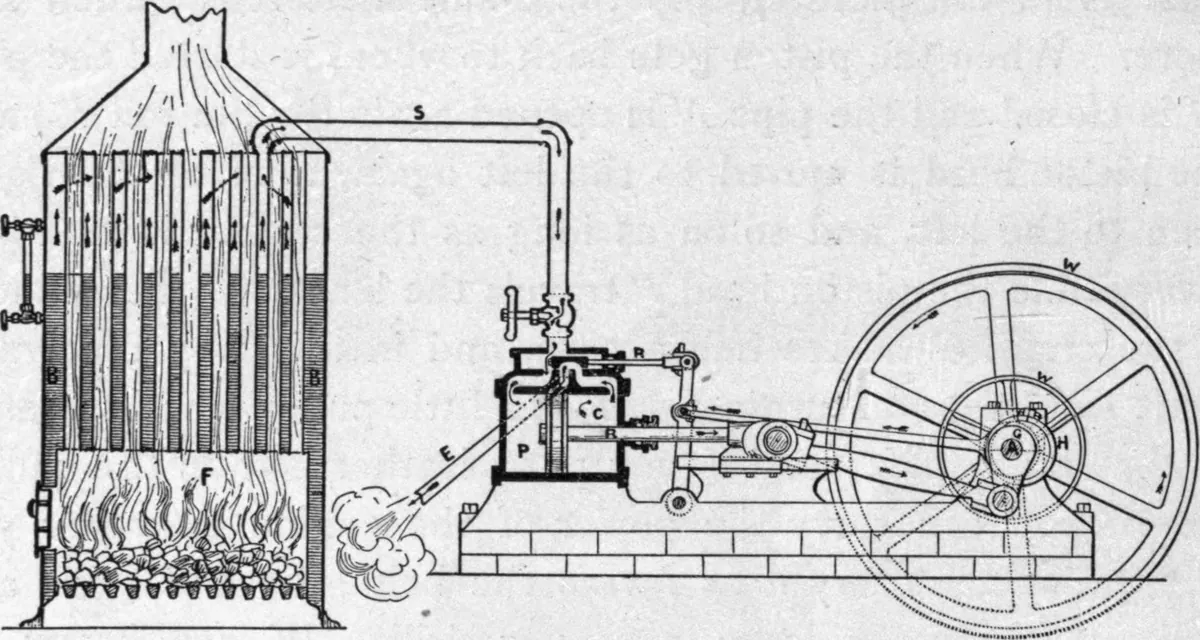
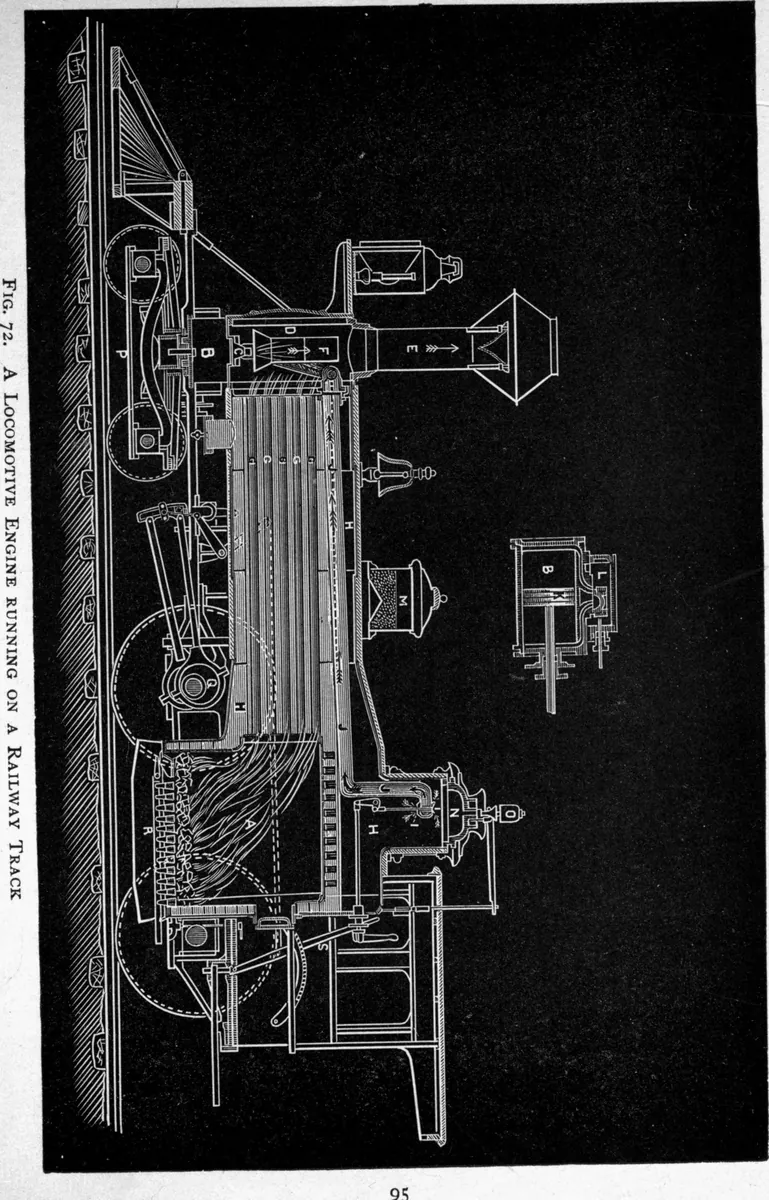
The Locomotive. — Figs. 70 and 71 show just how steam from a boiler can be made to turn a crank shaft (G in both
FIG. 71. A STATIONARY STEAM ENGINE
C, cylinder; P, piston; JR, piston rod. The reader should trace the course of the steam (which enters through the pipe S) throughout a complete motion of the piston.
pictures) round and round. Suppose we put wheels on this crank shaft and make the engine into a locomotive.
In Fig. 72 you should put your pointer on the sleepers, the rail, the front wheels P, the front driving wheel, the fire box A, the fuel grate R, the boiler G, the valve chest C, the cylinder B (there is a separate picture of the cylinder above the main picture), the smokestack E, the cowcatcher, the headlight, the bell, the sand box M (the sand box is used to hold sand to sprinkle on the rails when they are wet and slippery, so that the driving wheels may not slide on the track), the whistle O, and the cab. The to-and-f ro motion of the piston in the cylinder
Original page 95
Original page 96
moves the driving wheels round; the engine moves forward as they move round, and the train follows the engine.
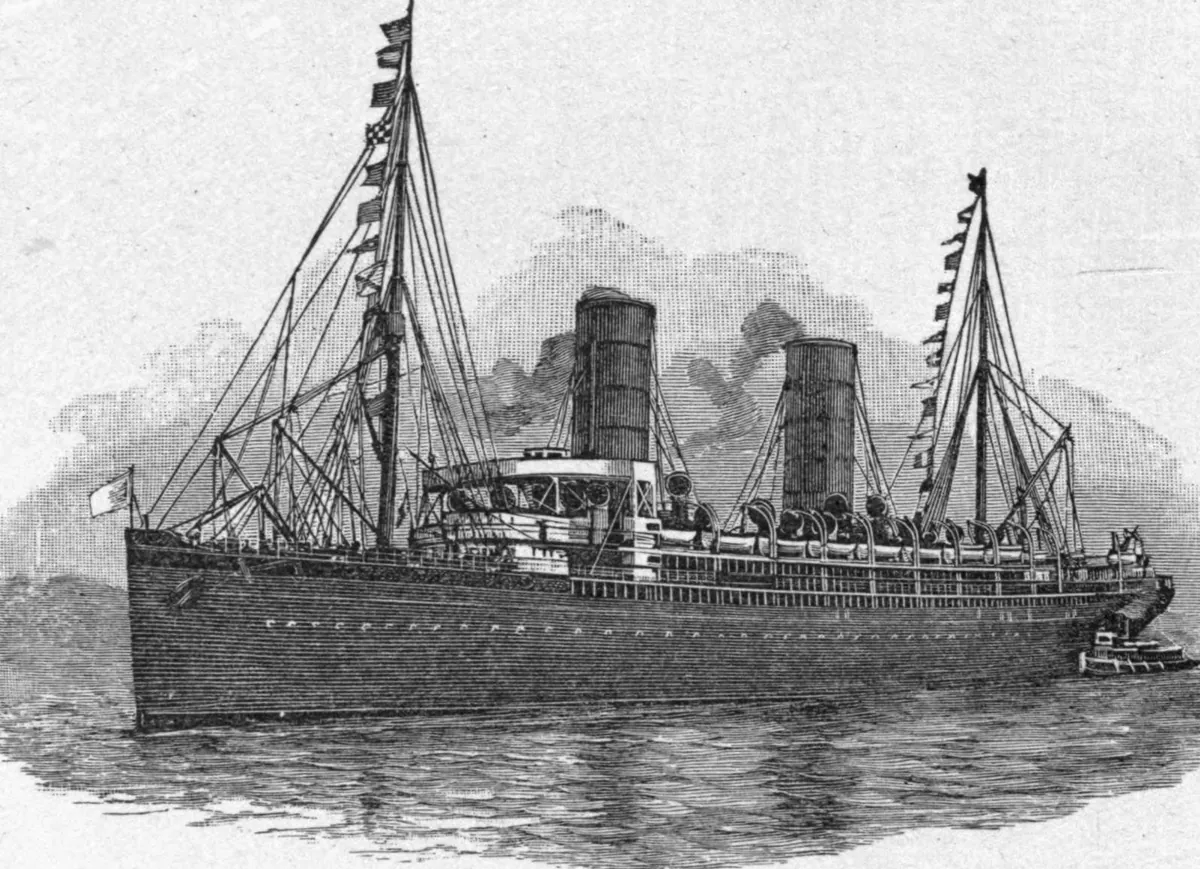
All steam engines work very much like the ones shown in the pictures. You can see them at work in factories, on ships, in locomotives, in automobiles — everywhere. With a machine like this you can take a little water and a little coal and turn
FIG. 73. AN OCEAN STEAMSHIP
them into a power that will drive a locomotive sixty miles an hour, or a great ship twenty-five miles an hour from New York to Liverpool.
Light. — Jack. The very first thing to know about light is that it travels in straight lines. You cannot see round a corner, you know, though you can hear round a corner.
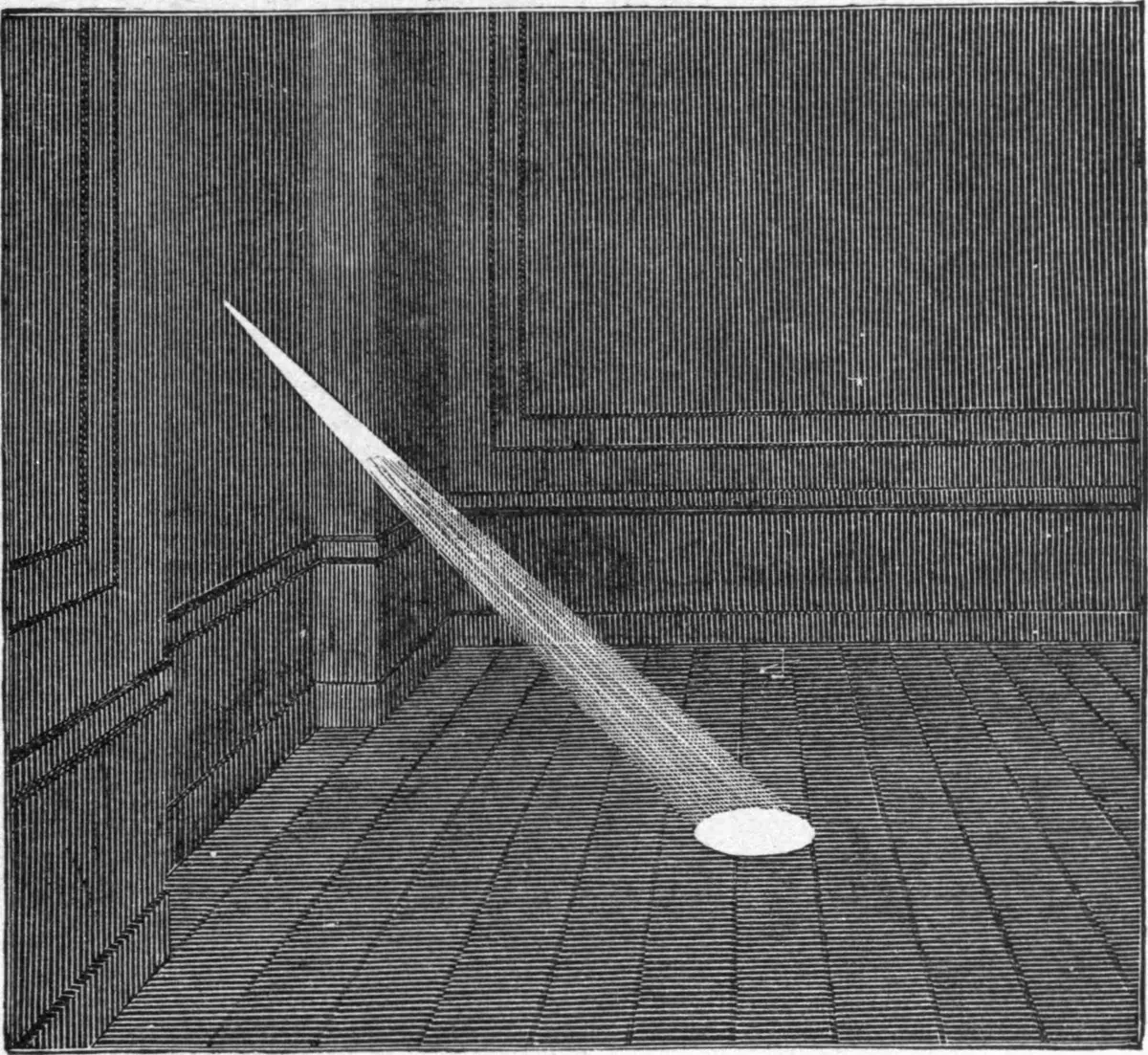
The room was darkened, and the sun's rays were let in through a very small hole in a card and made an oval spot on the floor. Tom took a newspaper, crumpled it up, and set it on fire in
Original page 97
a coal hod, so that the room was partly filled with smoke and dust. This made it easy to trace each little sunbeam along its whole course, as the picture shows.
Fred. That spot on the floor looks like a picture of the sun.
Jack. It is a picture — an image — of the sun. It is oval because the sunlight falls slanting on the floor. But take this
FIG. 74
The sun's rays travel in straight lines. (This experiment should be tried in the schoolroom.)
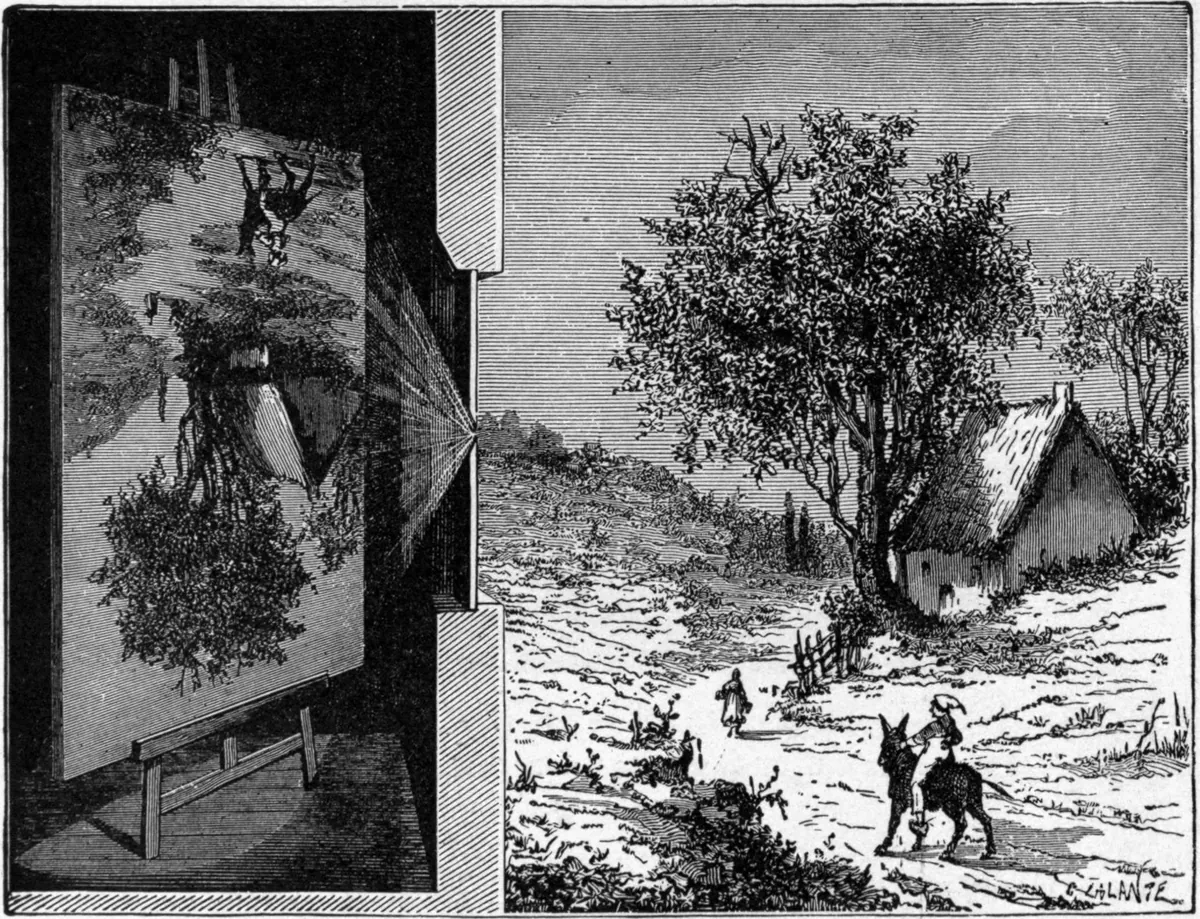
large sheet of white pasteboard and hold it perpendicular to the sun's rays and you will get a round image. You can get a picture of the landscape outside by letting light in through a small hole in the same way. (See Fig. 75.)
Mary. Well, I 'm sure I don't understand how you can get a picture of out-of-doors by just letting light through a hole.
Original page 98
Jack. It is the easiest thing in the world to understand when it is explained; but it is not so easy to understand it when you see it the first time, as you have, Mary — when it is sprung on you, as the boys say.
Fred. Well, Jack, how is it? Explain it to us, now that you have sprung it on us.
Jack. It all comes from light traveling in straight lines. Let us begin with a simple case, and explain the harder one afterwards.
FIG. 75. A PICTURE OF THE LANDSCAPE FORMED INSIDE A DARK ROOM (Camera obscura) BY LIGHT THAT PASSES THROUGH A VERY SMALL HOLE
This experiment ca n be tried in the schoolroom. The room should be quite dark. The hole should be pierced in a sheet of cardboard or, better, a neat hole should be drilled in a sheet of tin.
Original page 99
FIG. 76
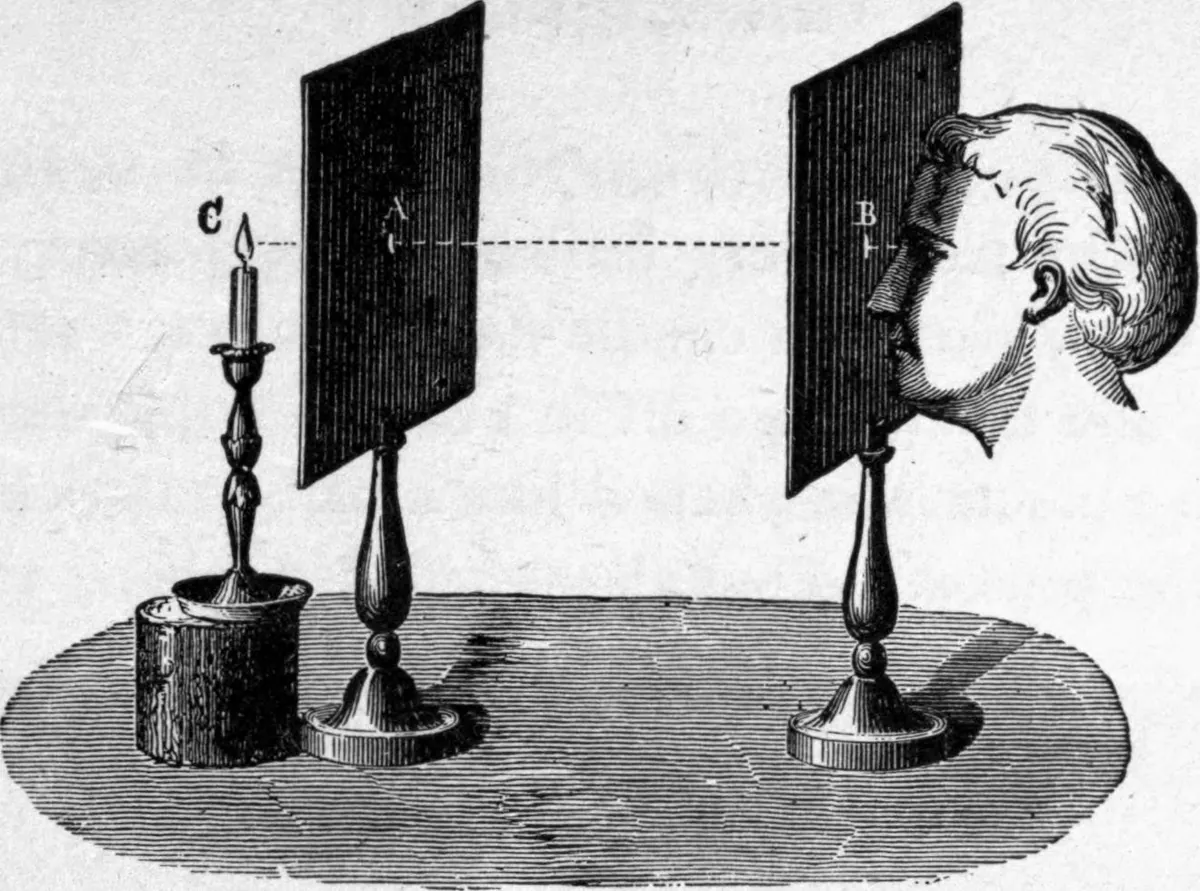
The light of a candle travels in straight lines. Until you have the candle (C) and the two holes (A and B} in the same straight line you cannot see the flame. (This experiment should be tried in the schoolroom.)
FIG. 77
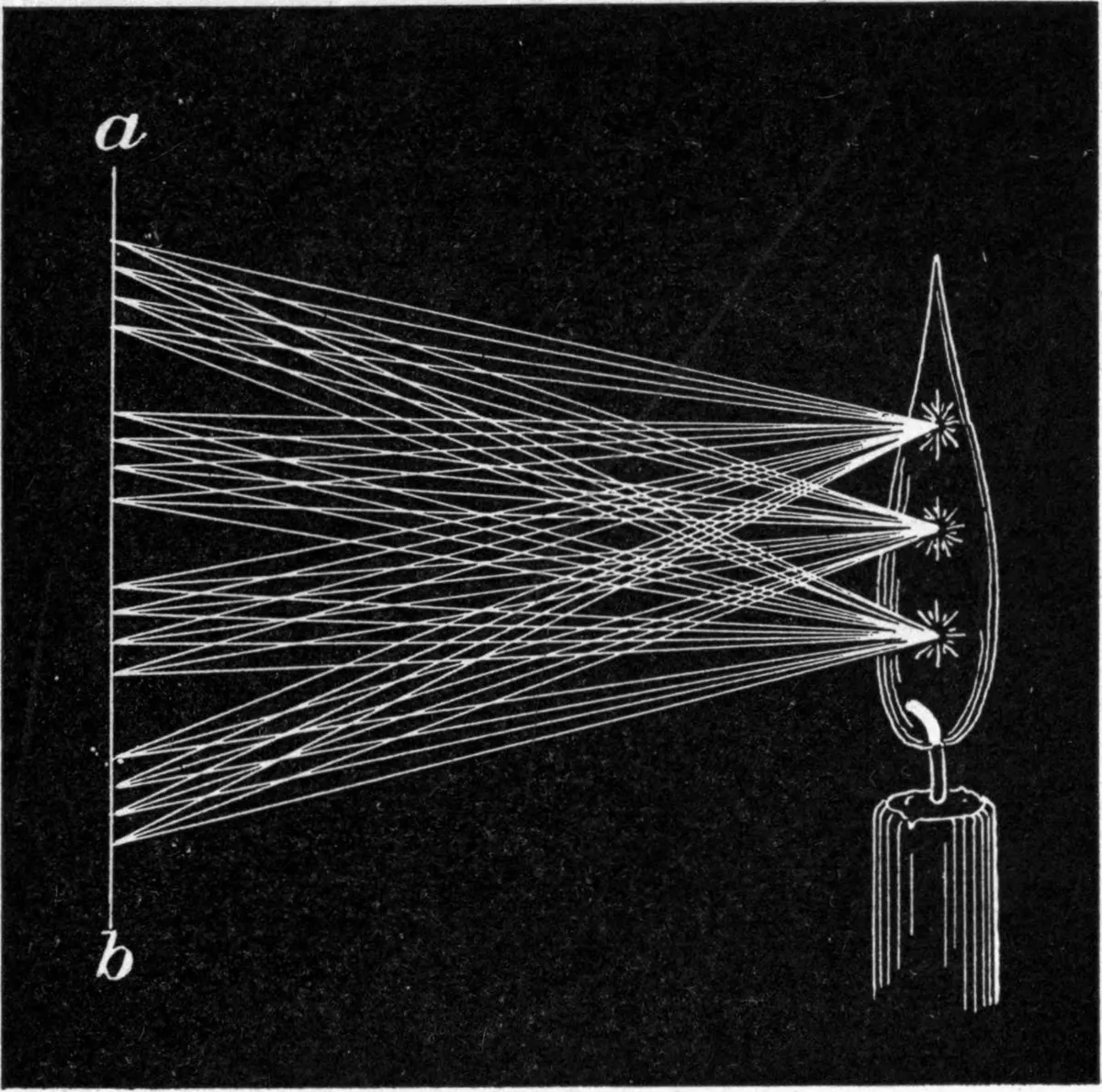
Some of the rays from three points of a candle flame are 'drawn in this picture. They fall on a screen (a&) and make it bright. From every point of the flame there are such rays. And there are many more than are drawn in the picture.
Original page 100
The light of the candle (Fig. 76) travels in straight lines. So does the light from every brilliant thing. Every point of the sun and every part of a candle flame is always sending out rays of light, and the rays go off in every possible direction.
If you take a pincushion shaped like a ball and stick it full of pins so that the pins stand out all over it everywhere, that might
FIG: 78
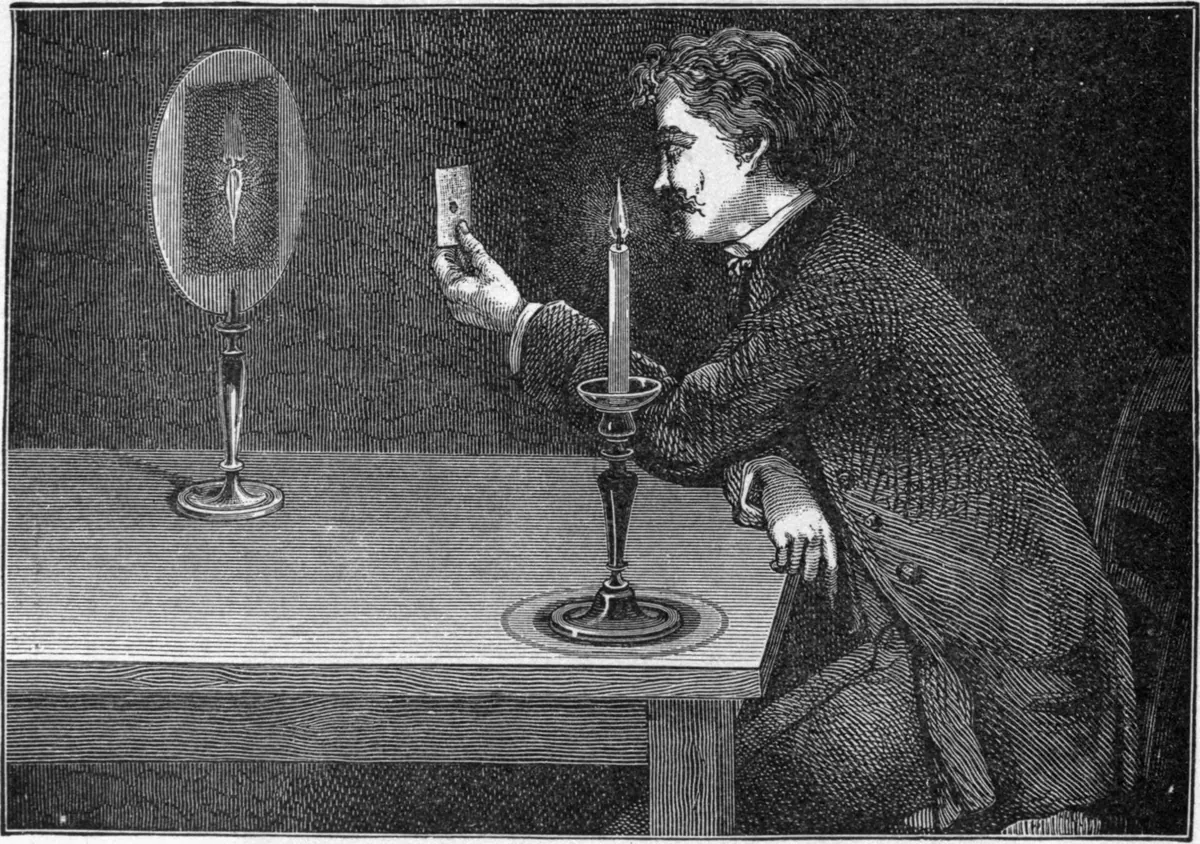
In a dark room a candle shining through a pin hole will form its own image on a screen.
serve as a model of a brilliant point of a candle flame. Every such point sends out rays of light in every direction — up, down, sidewise. You "see " by the rays that happen to come your way. Rays of light from the candle flame go out in every possible direction. How do you know that, Tom?
Original page 101
Tom. Because you can see the candle flame no matter what part of the room you are in. If you see it, you must get rays from it.
Jack. Exactly; now most of the rays from the flame light up the card and the table and the walls of the room; a few of them — only a few — get through the hole in the card (Fig. 78). Some ray from the top of the flame gets to the hole, goes through it, and goes on till it meets the screen of white pasteboard. There it stops, and there you have an image of the top of the flame. Some ray from the candle wick gets through the hole and goes on to meet the screen and, when it meets it, forms an image of the wick. Some rays from each of the other parts of the flame get through the hole and make images, so that finally an image of the whole flame is shown on the screen. The image of the flame is built up of hundreds of little separate images, FlG
The image of candle shining through a pin hole is formed upside down on a screen, and this drawing shows why.
you see.1
Agnes. The image of the candle on the screen is upside down, and so was the picture of the landscape (Figs. 75 and 78).
Jack. You can see why it was so from this drawing, Agnes.
Shadows. — "The shadow of any square or cube is bounded by straight lines (Fig. 78), and this is another proof that
1 The reader should lay a straight edge (the edge of a card will do) on Fig. 78. He will see that the wick, the hole, and the image of the wick are in one straight line. Again, the top of the flame, the hole, and the image of the top of the flame are in one straight line, and so on.
Original page 102
light travels in straight lines. When the point of light is really a point, or when it is only a small spot (as in the electric street lamp) the edges of the shadow are sharp; but when the
light comes from a large body like the sun the true shadow (the umbra) is bordered by a less dark shadow (the penumbra). If you hold a piece FlG- 8o of cardboard in front of a lighted
A point of light at A lights half of a candle in a dark room, you can see globe at B, and B casts a shadow. the shadow of the cardboard on the
The electric street lamp casts a
shadow with sharp edges as in the wall. The shadow is made up of two picture, because the light of an parts — tne ^ark center (\ht-umbra)
electric street lamp comes from a
very small spot -a point of light, and a less dark part (fat penumbra).
Move the cardboard till it is quite
near the wall and you will see the umbra get dark and sharp and the penumbra almost disappear." l
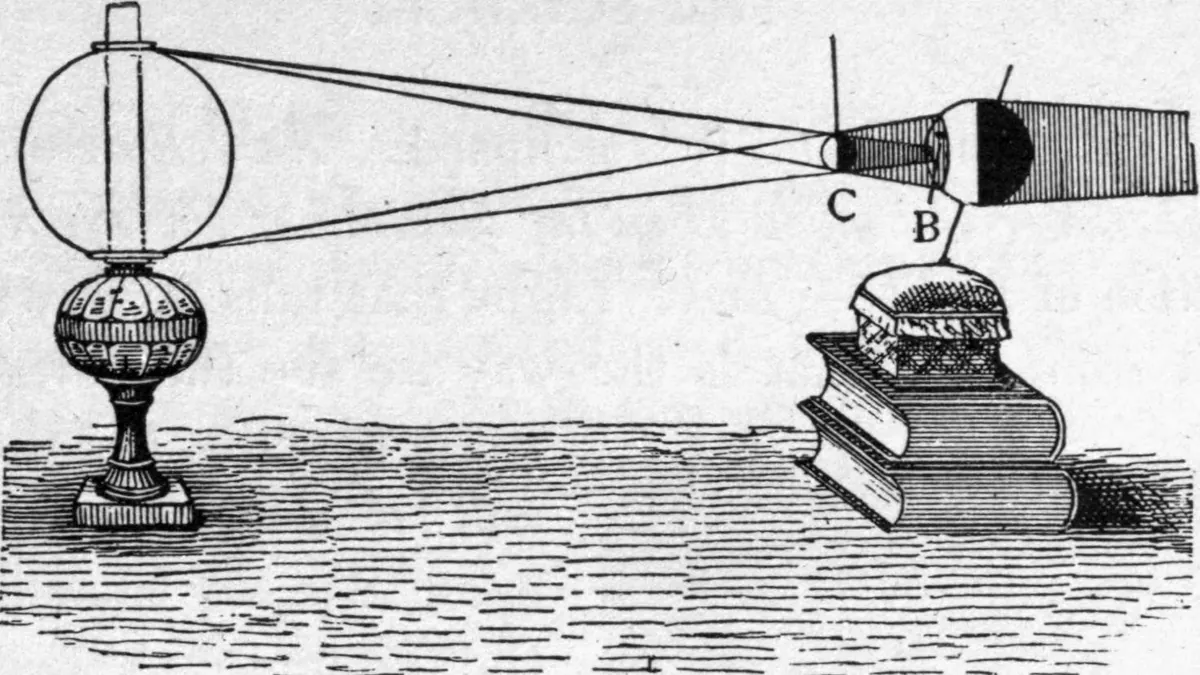
Eclipses of the Sun and Moon. — Eclipses of the sun and moon can be explained by Fig. 8 1. The globe of the lamp stands for the sun, the ball B for the earth, the ball C for the moon.
Suppose you were on the earth (B) inside the shadow of the moon. (Take a pin and point out the place.) The sun would be hidden from you if you were there; the sun would be eclipsed to you. An eclipse of the sun occurs for any place on the earth when that place is in the moons shadow. (See Fig. 51.)
The moon revolves around the earth, you know. Take the little ball C and suspend it on that side of the ball B which is farthest from the lamp. It will be in the shadow of the ball B. When the moon is in the shadow of the earth no light from
1 This experiment should be tried in the darkened schoolroom. When the appearances are thoroughly understood a second candle should be lighted and the shadows of the two made to overlap.
Original page 103
FIG. 8 1
A schoolroom experiment on shadows. The room must be dark and the lamp should have a ground-glass globe. The ball B may be an orange fastened to a pincushion by a knitting needle. The little ball C (a small ball of twine) can be suspended by a string so as to cast a shadow on the globe B. Notice that the ball C has two shadows, a dark central shadow (the umbra) and a less dark shadow around it (the penumbra). The large brilliant globe of the lamp makes two shadows to C. (By a little thinking you can see why.)
FIG. 82
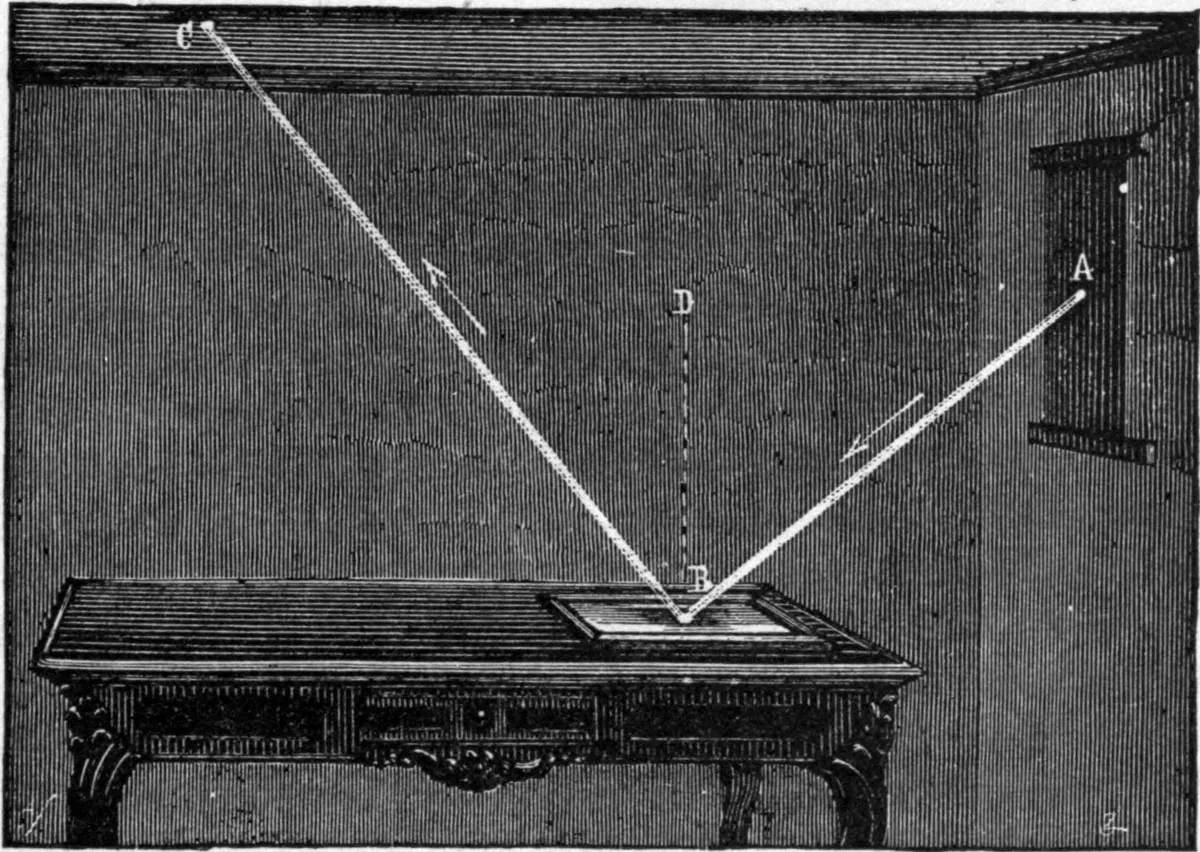
A beam of light enters a dark room through a hole in the wall (A) and falls on a mirror at B. It is reflected from the mirror upwards to form a spot on the ceiling at C. By putting a pencil vertically at B, in the line £D, you will see that the ray of light AB and the ray of light BC make the same angles with the pencil BD. That is, the angles ABD and CBD are always equal to each other, no matter where the mirror may be.
Original page 104
the sun can reach it, and it is eclipsed. An eclipse of the moon occtirs whenever the moon is in the shadow of the eartJi.
Reflection of Light. — Jack. Light that falls on any surface is reflected from it. That is the way we see the surface. The
sunlight falls on the ground and is reflected up to our
eyes,
else we should not see
FIG. 83
the ground. A feather that is floating in the air reflects light to us, else we should not see it. The moon floating in the sky reflects the sunlight to us, else we should not see it.
Fred. The sun sends us its own light though. We do not see it by reflected light.
Jack. The sun, the stars, an electric lamp, a candle, have light of their own. They send us light directly. The moon,
A ray of sunlight enters a dark room through ^ planets distant mountains a hole in the wall, and it falls on water con-
tained in a box with glass sides (a box with and clouds, near-by houses
one glass side will do). The ray is bent and rQcks anj fieJds, reflect
(refracted) as soon as it enters the water. *
sunlight to us. If you could shut off the sunlight, you would not see them.
Tom. The sunlight is shut off at night (at least it is shut off from everything on the earth) and you do not see the mountains and the houses then.1
1 The reasons why you see the moon and the planets at night are explained in Book I (Astronomy), page 33.

Original page 105
Refraction of Light. — Jack. Light always travels in straight lines; but when a ray of light that has been traveling along one straight line in the air enters something different from air — water or glass, for instance — it is bent (refracted) into another line. This second line is straight, too; but it is not the same line as the first one.
Water will bend a ray of light, and so will glass. You know what a prism is? A glass pendant to a chandelier is a prism, for instance.
If you let sunlight pass through a prism and then fall on a sheet of paper, you will get a beautiful spectrum of all the colors of the rainbow. If a plate of glass or a metal mirror is ruled with fine parallel lines equally distant, say 1000 or 10,000 to the inch, you can get a beautiful spectrum by laying it out in the sunshine. The colors of mother-of-pearl are made in this way. The inside of the oyster shell is made up of very fine parallel ridges, and the light reflected from them is scattered into a spectrum of colors. You can prove that it is the ridges that make the colors by taking an impression of the inside of the mother-of-pearl shell in wax. The wax gives just the same colors. The scattering of sunlight by raindrops in somewhat the same way has to do with forming the rainbow.
FIG. 84
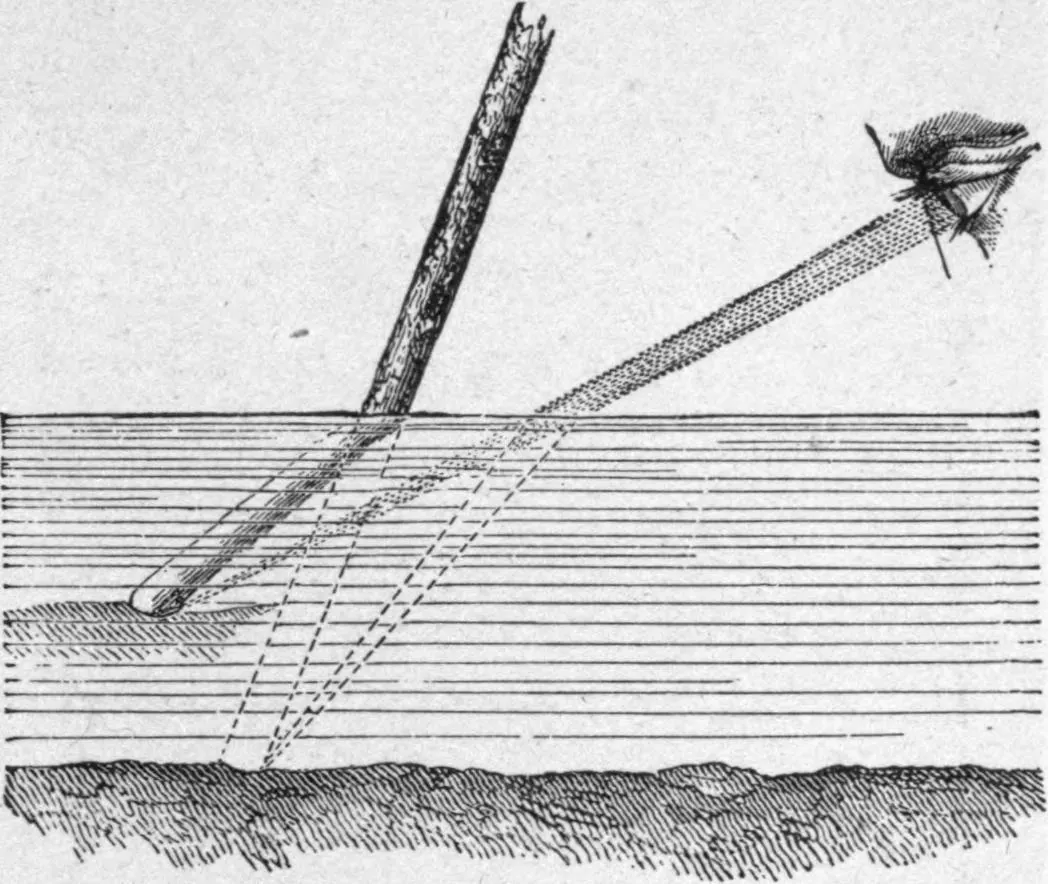
A straight stick partly out of water and partly in the water looks as if it were bent just where it enters the water. Of course it is not really bent, but it looks so. Try the experiment with a pencil in a shallow basin full of water.
Original page 106
Lenses. — "Pieces of glass of certain shapes are called lenses. We use them to make magnifying glasses, spectacles, microscopes, telescopes. You children had better get some old spectacle glasses and try experiments with them. (See Figs. 45, 88-90.)
FIG. 85
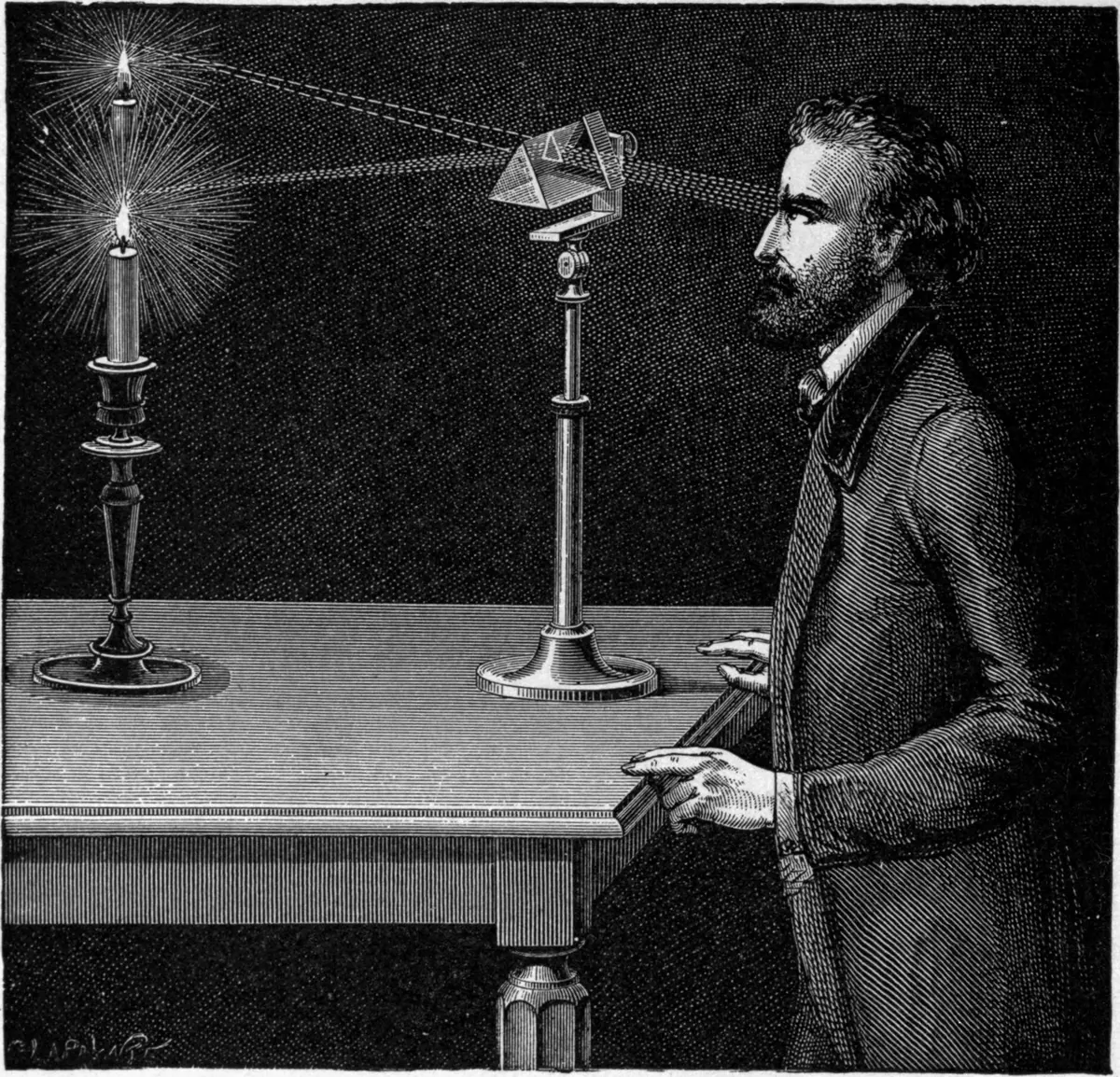
A glass prism is mounted, for convenience, on a stand; but the experiment can be tried by a prism held in the hand. The candle flame seen through the prism seems to be in a different place from the real candle flame, because the rays of light sent out by the flame are bent by the prism and when they come to the eye they seem to come from a place where the real candle is not.
Original page 107
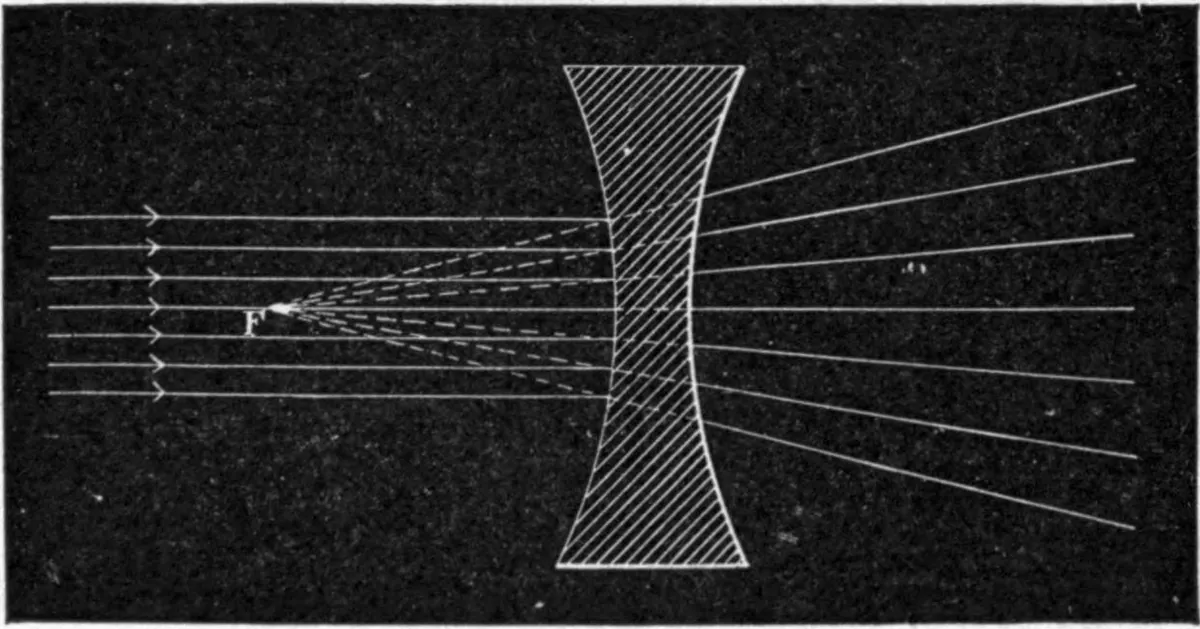
" Two (or more) lenses used together make a telescope, you know.1 Convex lenses concentrate the light that falls on them (Fig. 89), and concave lenses disperse the light that falls on
FIG. 86
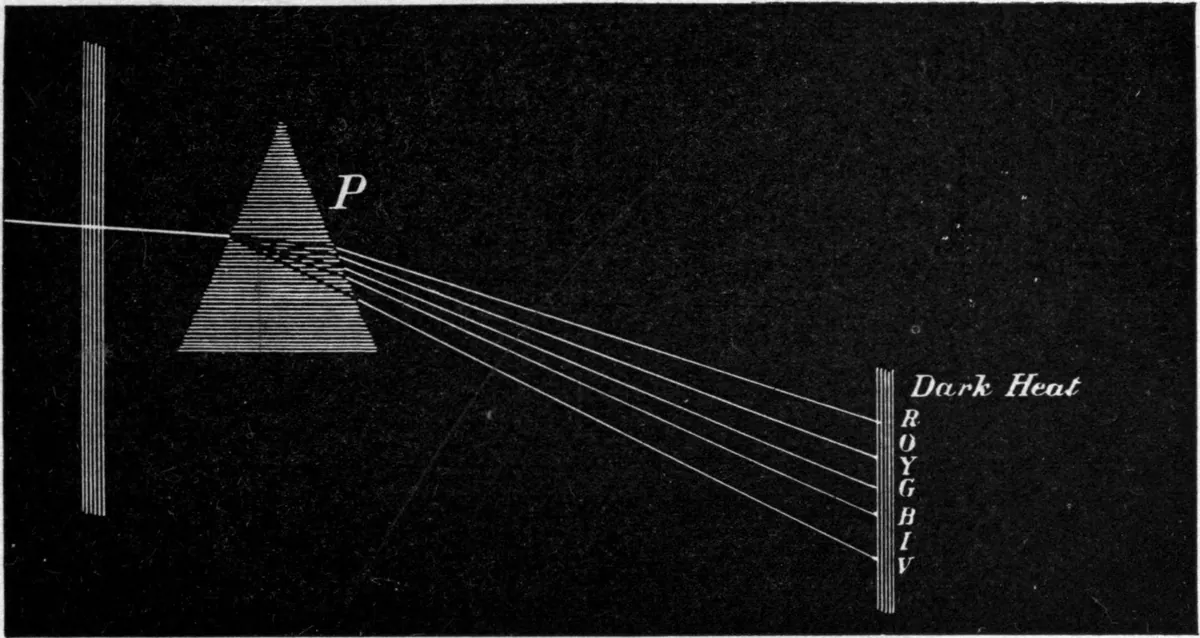
A beam of sunlight (white light) is separated by a prism into rays of violet, indigo, blue, green, yellow, orange, and red, and most of the heat in the beam falls near the red end of the spectrum. The heat rays are invisible.
FIG. 87. GLASS LENSES OF DIFFERENT SHAPES
The three to the left of the middle of the picture are convex lenses; the other three are concave lenses.
them. Persons who are nearsighted use concave lenses in their spectacles, and persons who are farsighted use convex lenses."
1 See Book I (Astronomy), page 58.
Original page 108
FIG. 88
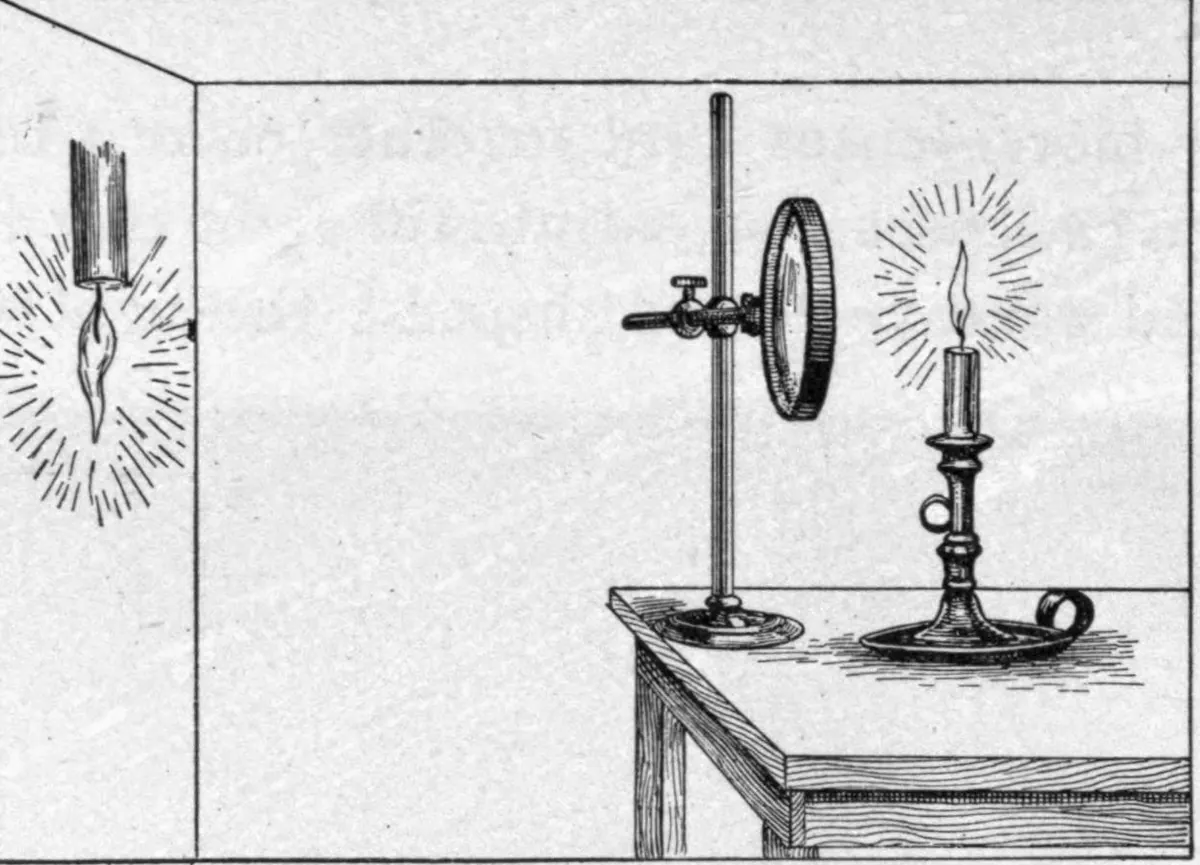
A convex lens in a dark room will make a sharp image of a candle flame on the wall if the lens is at the right distance. (The distance to the wall must be different for different lenses and can be found by trial.)
FIG. 89 A convex lens concentrates light falling on it to a focus (at F in the picture).
FIG. 90
A concave lens disperses light falling on it. (The light comes from F in the picture and is dispersed by the lens.)
Original page 109
FIG. 91. A POWERFUL MICROSCOPE
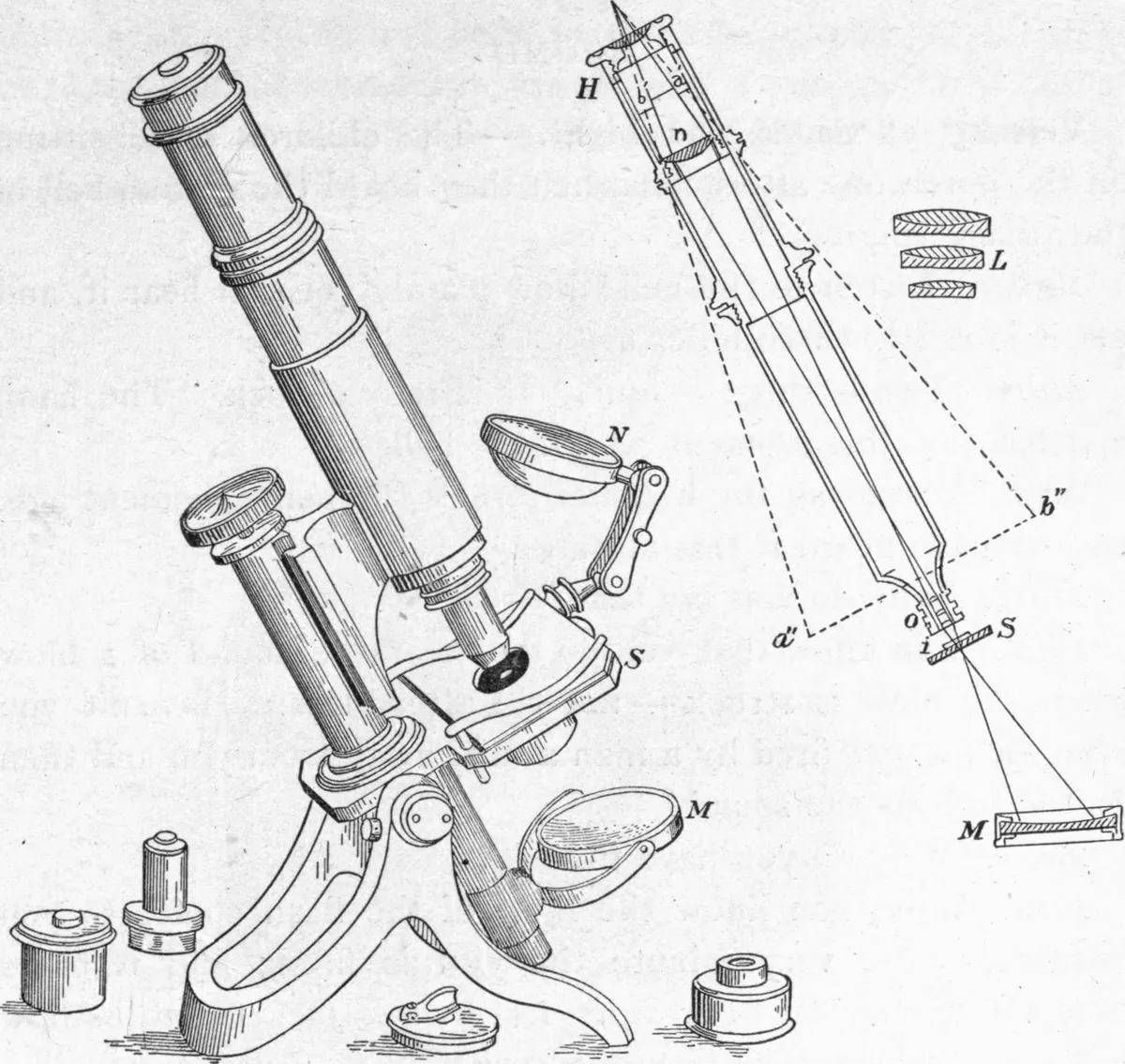
The object to be examined is placed on the stand S and looked at through the long tube. Light can be thrown on the object by the lens N or by the mirror M. The righthand picture shows the way the lenses are arranged in the tube. The eye is placed near //, and there is one lens there, another at «, and three others at O (an enlarged picture of these three is given at Z.). Such a microscope as this can be arranged so as to magnify about 2000 times — to make things seem 2000 times larger.
Original page 110
HO THE SCIENCES
SOUND
Velocity of Sound and Light. — The children were sitting on the porch one afternoon when they heard the church bell in the village ringing.
Agnes. Listen to the bell! how plainly you can hear it, and yet it is nearly three miles away.
Mary. Two — three — four. It is four o'clock. The hammer has just this moment struck the bell.
Fred. You mean the hammer struck the bell a moment ago, and we have heard it this minute.
Mary. Why do you say that, Fred?,
Fred. You know that you do not hear the sound of a blow when the blow is struck — not till afterwards. Have n't you ever seen a gun fired by a man a mile away from you and then waited to hear the sound?
Mary. Why do you have to wait?
Fred. Why, you know the light of the flash comes to you instantly — the very minute the gun is fired; and it takes time for the sound to travel. Let us ask Jack to tell us how fast sound travels; he is sure to know.
Jack. Light travels almost infinitely fast j1 but sound moves much slower — about noo feet in a second. It takes sound nearly five seconds to go a mile.
Mary. Do you mean, Jack, that we did n't hear the village clock strike till fifteen seconds after it had really struck?
Jack. Yes; the hammer struck the bell first and set it vibrating; then the air round the bell began to vibrate, and the sound began to travel off in every direction — north, east,
1 The velocity of light is 186,330 miles in a second of time. Light travels from the sun to the earth in 500 seconds, a little more than eight minutes.
Original page 111
south, west. If you had been in the village, you would have heard the bell the moment it was struck; if you had been a mile away, you would have heard it five seconds late; and as we are three miles away, we all heard it about fifteen seconds later.
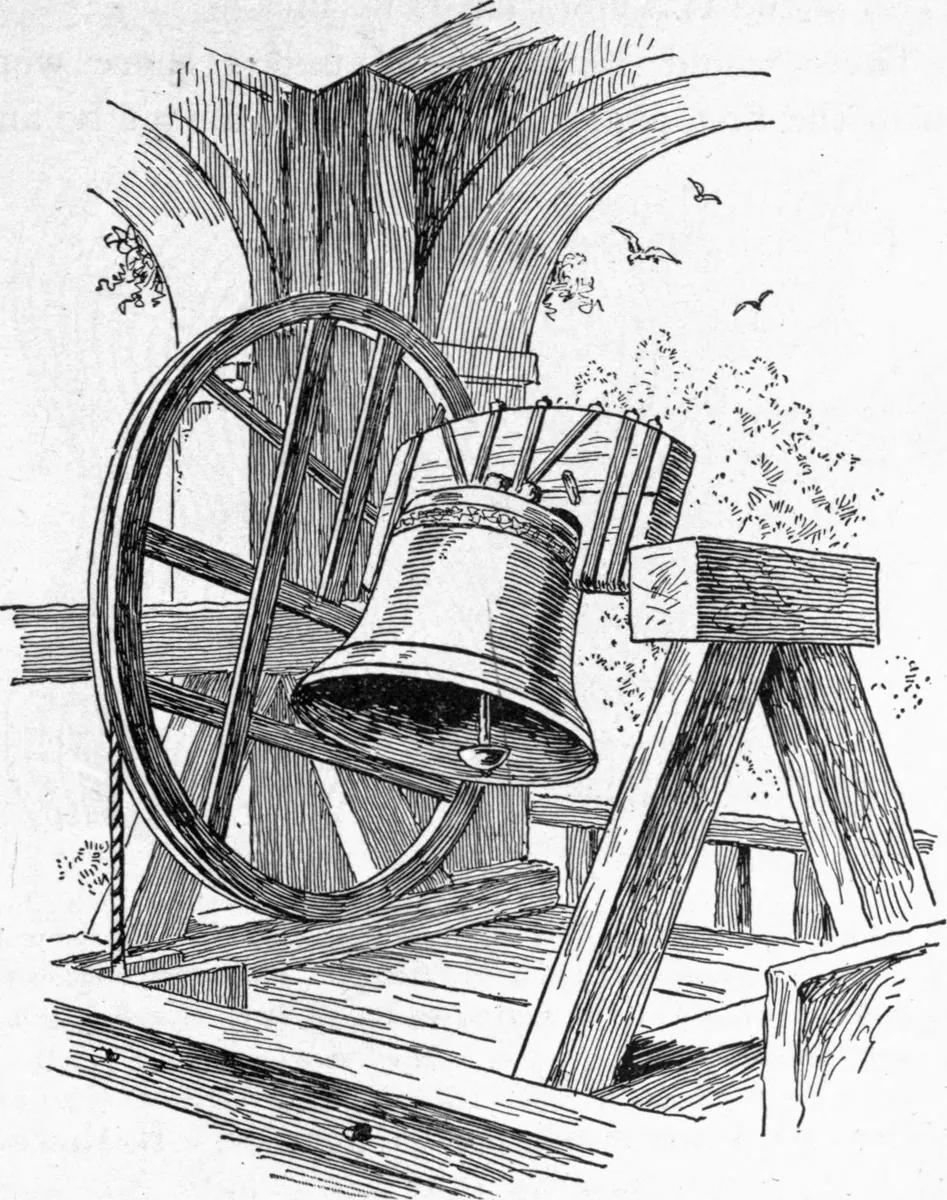
FIG. 92. A CHURCH BELL It is rung by the rope that you see on the left-hand side of the picture.
Tom. It is something like throwing a stone into a pond of water. Little waves travel in every direction from the place where the stone went into the pond.
Original page 112
Jack. Yes; and you remember that the waves get smaller and smaller the farther they go. Sound is like that. The vibrations of the air are powerful near the sounding bell, but they get weaker and weaker as you go away from it. Tom. So sound is a vibration is it, Jack?
Jack. There would be no sound unless there were some vibration in the first place. But there wouldn't be any sound
FIG. 93
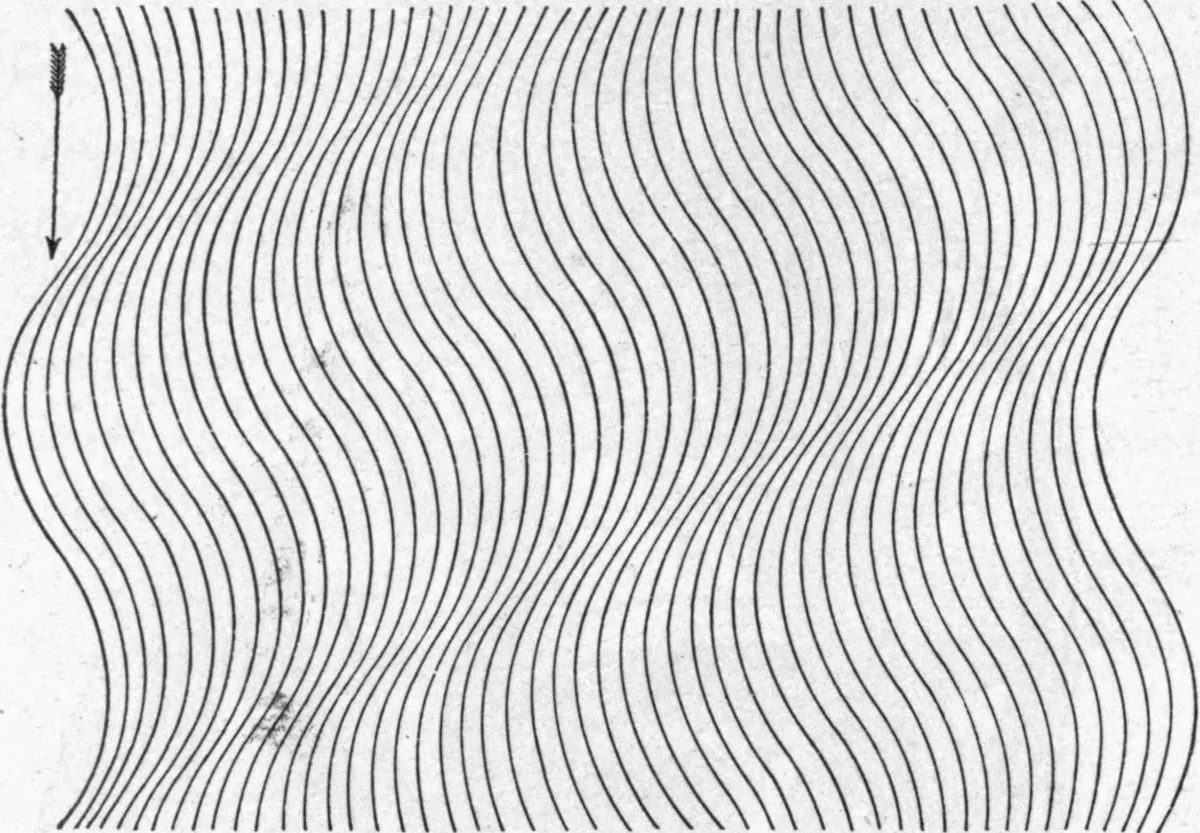
A wave of sound if it were visible, as it is not, would look something like the picture. Such waves go out from a sounding bell in every direction. When they come to your ear you hear the bell, but not before. Sound waves travel about noo feet in a second — a mile in about five seconds.
unless there were some person to hear it. If there were a mechanical piano playing at the north pole, by machinery, there would be vibration of the strings — and of the air, too; but unless there were some one to hear it there would be no sound, only vibration.
Tom. Well, usually there are persons to hear in our part of the world. Are all the sounds we hear caused by vibrations?
Original page 113
Musical Instruments. — Jack. Yes; let us take some sounds we know about and see what makes them. In the first place there is the bell. The hammer strikes it and makes it vibrate. It is just the same with a piano; the wire is struck and made to vibrate. A violin string vibrates. In an organ pipe or in a
FIG. 94
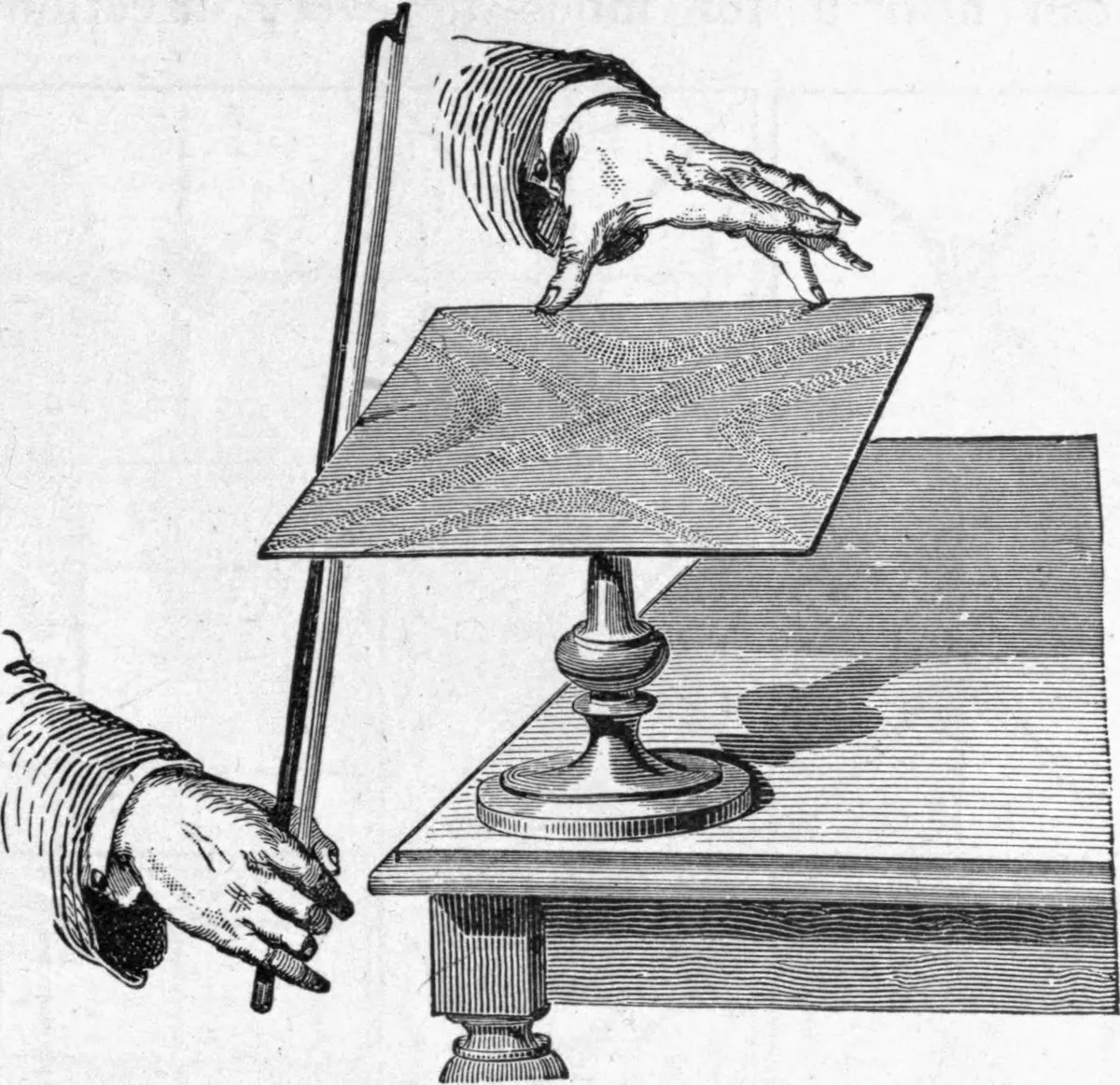
A glass plate vibrates when a fiddle bow is drawn across its edge so that the plate makes a sound. If you put a little clean dry sand on the plate, the sand will move so as to make patterns (as in the cut). By drawing the bow at different places you can get different patterns, especially if you lightly touch the plate with a lead pencil while the bow is moving. Some of the patterns are shown in the next picture.
trumpet the air vibrates. When you speak or sing a couple of elastic muscles in your throat vibrate. In a drum the parchment vibrates when the drumsticks strike. Something always vibrates first; that, whatever it is, sets the air to vibrating, and the vibration travels to where we happen to be and we hear a sound.
Original page 114
Tom. How do you know that the bell vibrates? Jack. The next time you are in the village go up in the clock tower when the clock is going to strike and hold a lead pencil against the bell. You can/^/ the bell vibrate.
Here is a curious thing to think of. First the bell vibrates and you can hear it for miles in every direction. Every
\
FIG. 95. PATTERNS MADE BY LOOSE SAND ON A VIBRATING PLATE. (SEE FIG. 94.)
After the patterns have been made they can be preserved by carefully pouring varnish on the plate and letting it dry.
particle in a very large sphere of air is set in motion. We hear the sound at our house, miles away from the village. Now the air that is set in motion weighs hundreds of tons, and it is all moved by one stroke of the hammer on the bell.
Original page 115
Tom. You can hear a locust chirping a quarter of a mile off. I suppose he sets the whole air in motion, too.
Jack. That is a very good example. A small insect moves tons and tons of air; and a violin string, vibrating so little that you can hardly see it move, stirs all the air in a great concert hall.
FIG. 96
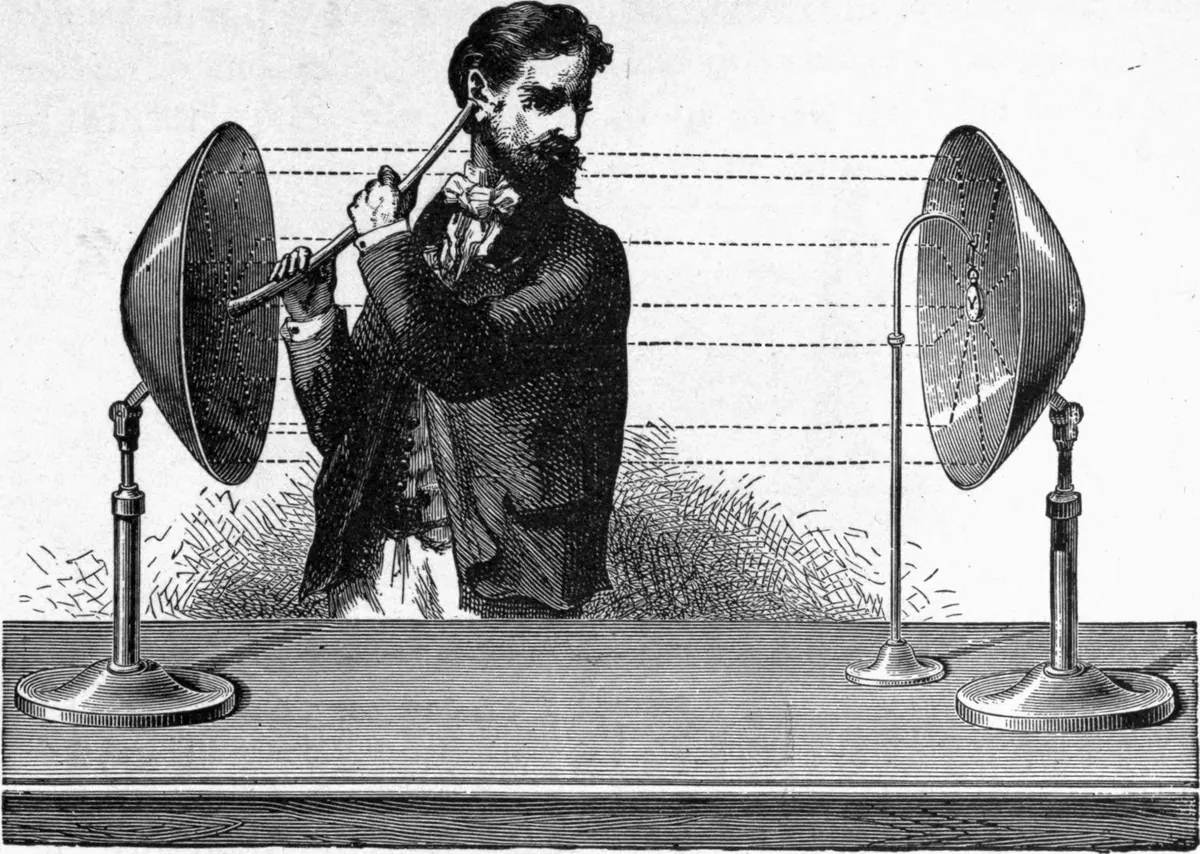
A watch ticking in front of one mirror can be plainly heard through a tube placed in front of another. If you take the second mirror away, you cannot hear it at all. The first mirror acts as a speaking trumpet (a megaphone), and the second mirror acts as an ear trumpet.
Sometimes when the organ is playing a low note in church you can actually hear the air flutter and vibrate. The organ makes a noise then, not music.
Mary. What is the difference between noise and music, Jack?
Original page 116
Il6 THE SCIENCES
Jack. If the vibrations of a bell, a violin string, an organ pipe — anything — come at even intervals, then they make a musical note. If they come irregularly, the sound is usually a
FIG. 97. ECHOES
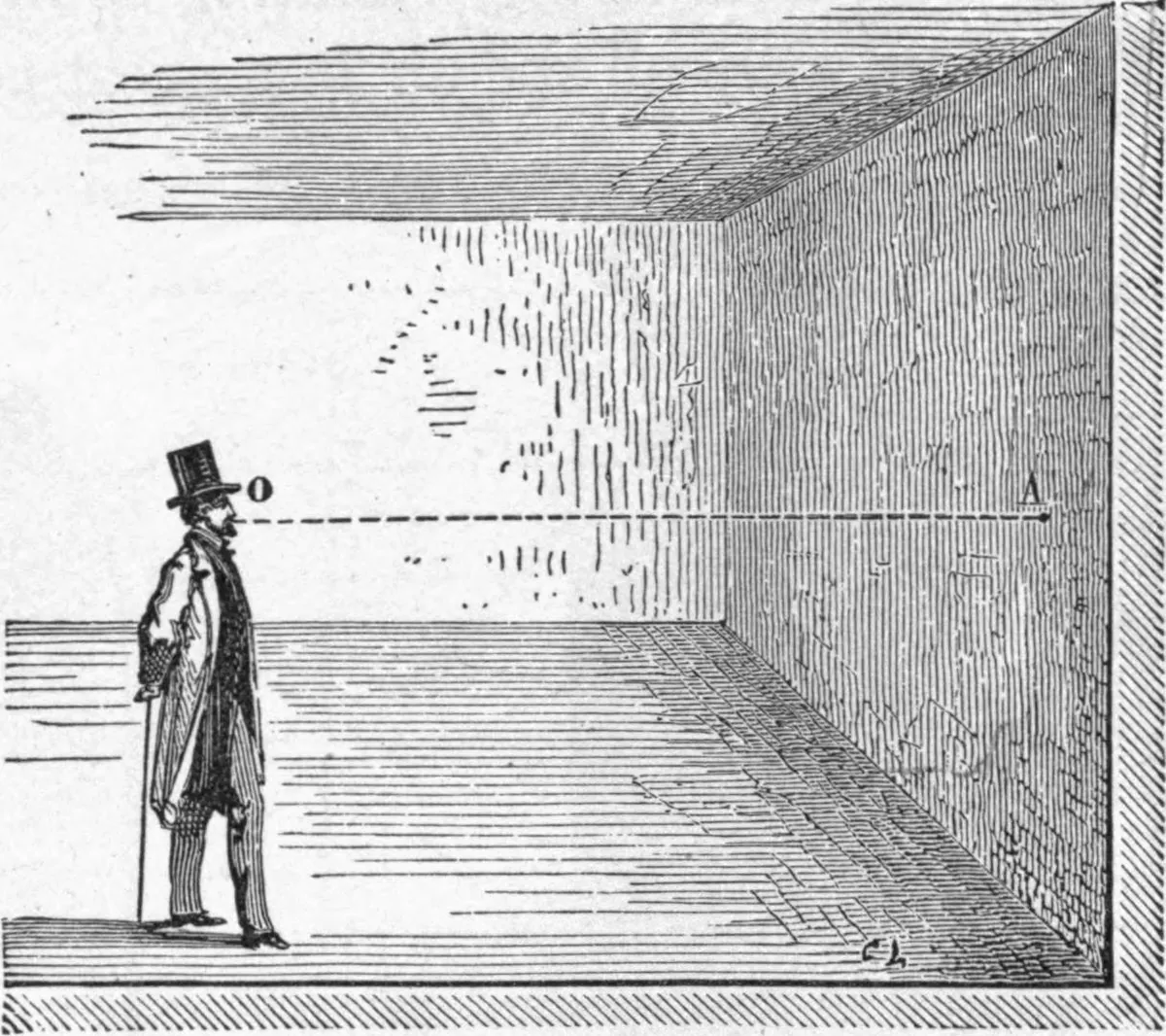
An echo is made by the reflection of sound from a wall, a rock, etc. The person who speaks must be at least 100 feet away from the wall to get a good echo.
mere noise. Music is pleasant to hear, and noise is not. That is the real difference.
Reflection of Sound. — Sound can be reflected somewhat as light is, as the following experiment shows. Musical Notes. — Mary. Are the sounds from my piano regular? Jack. Yes; perfectly regular. Each string vibrates regularly just so many times in a second, no more and no less. The middle C of your piano is a wire just long enough to vibrate 261 times every second, and all of its vibrations are alike. The shorter a string is the quicker it vibrates, and you will notice that the highest notes of your piano come from the
Original page 117
shortest strings. It is the same with drums; the small drums give the highest notes, the large drums the lowest.
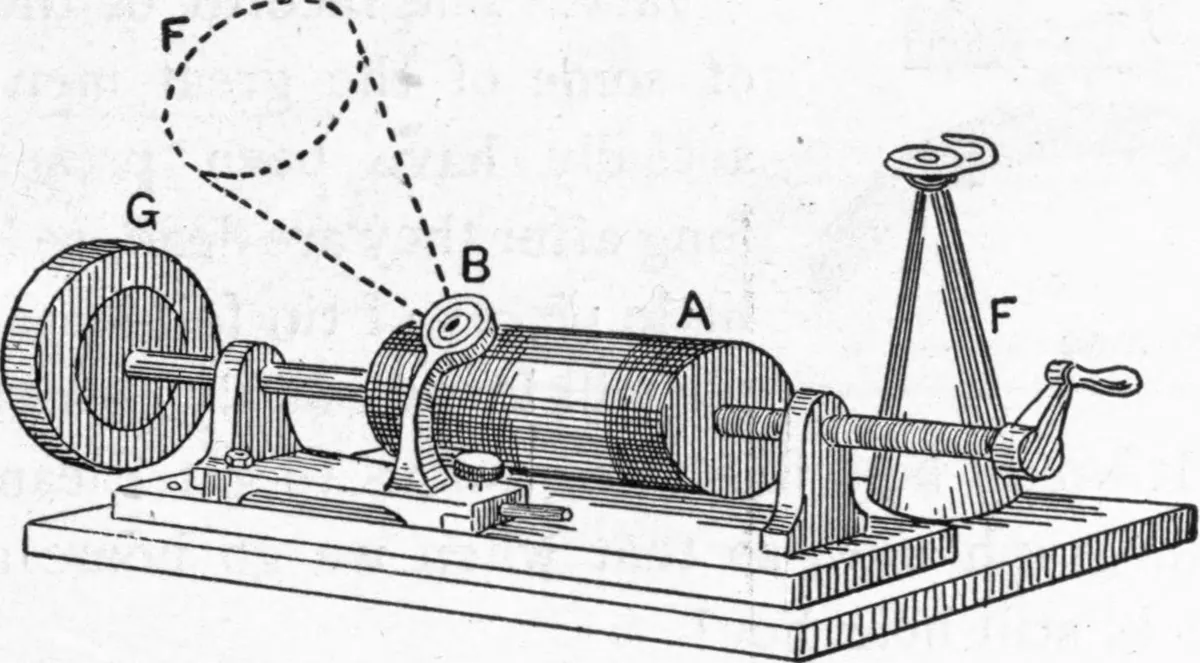
The phonograph is a machine for recording the vibrations of the air that are made when a person speaks. He speaks into a tube (F in Fig. 98) and sets the air into vibration. At the small end of the tube is a little round thin metal plate that moves up and down (slightly) as the air vibrates. The motions of this little plate copy the vibrations of the air. On the lower side of this thin plate is a sharp needle point. (See Fig. 99.)
FIG. 98. THE PHONOGRAPH
While the person is speaking the barrel (A), which is covered with tin foil, is turned by the crank, and the little needle makes marks on the tin foil. These marks are the record of the human voice. Every vibration of the voice has left its mark on the tin foil. If now we put a piece of tin foil so marked into the machine and turn the barrel, what will happen? As each one of the marks in the tin foil passes underneath the small needle the needle will move a little (if the mark in the tin foil is shallow) or moves a little more (if the mark in the tin foil is deep). The needle will move up and down for the tin foil just as it formerly moved up and down for the voice. As the
Original page 118
Il8 THE SCIENCES
needle moves, so must the thin plate move; and as the plate moves and vibrates, so must the air above it move and vibrate, and you will hear from the machine riow the very words you spoke into it an hour ago, or a year ago, or twenty years ago, whenever the record on the tin foil was made. You can keep the tin foil and repeat the words whenever and wherever you like. Tom. If the phonograph had been invented in Julius Caesar's time, we might be able to hear his voice now, or George Washington's, or Lincoln's.
Jack. The records of the speeches of some of the great men of to-day actually have been preserved; and long after they are dead, so long as the FlG little pieces of tin foil last, other peo-
ple will know exactly how they spoke. Mary. It would be a fine thing for us to get Eleanor to sing into a phonograph now, so that when we go home after vacation we could still hear her!
Jack. A wise man in England l once suggested that there could be no worse punishment in a future life than to be forced perpetually to hear all the foolish things you had said in this life. It might not be a bad way to punish naughty boys and girls in this world to shut them up in a room with phonographs that would continually repeat the silly and foolish things they had said.
Agnes, /think it would be dreadful, Jack. Nothing could be worse.
Jack. Very well, my dear, you need not mind. The things you say are always nice to hear. I was only trying to frighten the boys.
1 Charles Babbage (born 1792, died 1871).
Original page 119
ELECTRICITY
The children made some experiments in electricity which any one of you can make too, if you like. You will need a few things, most of which you can get at home or make for yourself. A few you will have to buy (they do not cost much). The principal things to get are: a couple of toy magnets, one straight, one shaped like a horseshoe; a piece of glass tube (or a glass rod) about half an inch in diameter and eight or ten inches long; a piece of sealing wax about half an inch square
Copper
wire
Zinc
B
wire
FIG. 100
and about six inches long; a rubber comb; an old silk handkerchief; a piece of old flannel; an ounce of sulphuric acid in a bottle with a glass stopper (be careful not to get the acid on your hands, and be sure that the bottle is labeled Sulphuric Acid}; an ounce of quicksilver in a bottle (be sure that the quicksilver is labeled; it is poisonous if swallowed); about twenty feet or so of insulated copper wire (No. 18 annunciator wire is the most handy to use); a piece of sheet copper about three sixteenths of an inch thick, one and one half inches wide, and five inches long; a piece of sheet zinc of the same size as the copper. Take the copper sheet and the zinc sheet to a plumber and have him solder a piece of copper wire (each piece about twelve inches long) at A and B. After this is done
Original page 120
take a large tumbler, fill it two-thirds full of water, pour three tablespoonfuls of sulphuric acid in it (use an old kitchen spoon for this purpose), dip the zinc plate in it, and leave it there for a minute. Then take the zinc plate out, hold it over a china plate, pour quicksilver on it, and rub the quicksilver on to the surface of the zinc until it is all covered and shining. (Do not empty the water and acid from the tumbler; you will need it by and by; save it.) Now you have all the
things you need for your experiments, but it is convenient to get two dottble connectors (so called) FIG. ioi like Fig. 101.
A double connector (so called) is a cylinder Jack. Before WC begin Our
of brass with two holes in it and with experiments with the things you
two screws. It is used to connect the ° J
ends of two wires and saves the trouble have Collected, tell me what yOU
of twisting the ends together, it is already know about electricity.
convenient, though not necessary.
You have heard it talked about. Tell me what you have seen on your own account.
Agnes. Well, lightning is electricity, they say.
Mary. And electric bells ring by electricity, and some street railways go by electricity.
Fred. And then there is the electric telegraph.
Tom. Yes, and the telephone, and the electric light.
Jack. All these things have to do with electricity. Let us begin by making some lightning.
Agnes. Oh, Jack! make lightning? It would be dangerous.
Tom. Agnes thinks Jack can make anything — even a thunderstorm if he wants to.
Jack. Well, Agnes, the lightning we are going to make will not be dangerous; but I will put off making it for a little while and begin with something else.
Original page 121
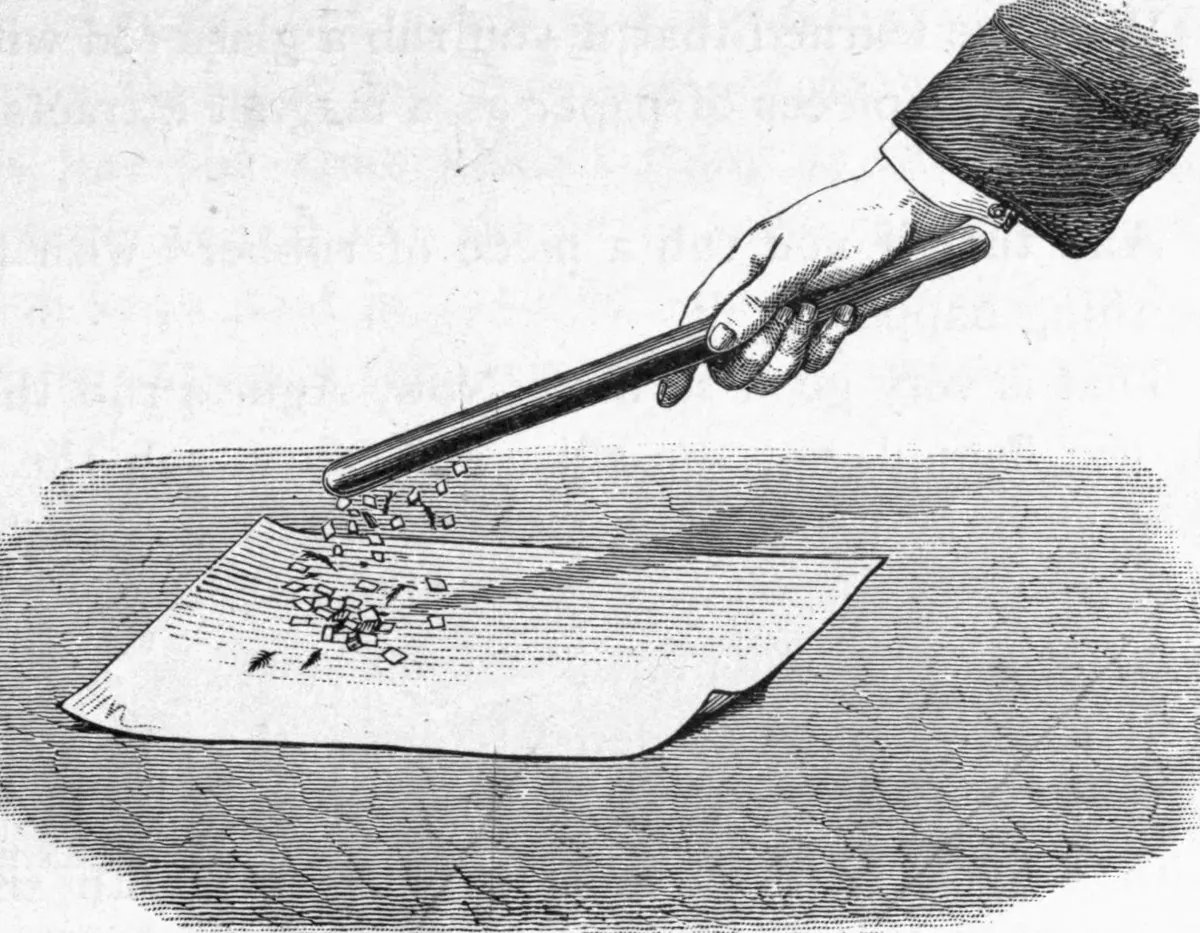
Here is a lot of small pieces of tissue paper — they are very light, you see — laid on the table. Now take the glass rod, Agnes, and hold it over them. What happens?
FIG. 102
Little pieces of tissue paper (or light grains of sawdust) are attracted by a glass rod rubbed with. a silk handkerchief (or by a piece of sealing wax or a rubber comb rubbed with flannel).
Agnes. Nothing happens at all.
Jack. Try the rubber comb, Mary.
Mary. Well, nothing happens.
Jack. Now, Agnes, rub the glass rod briskly with the silk handkerchief; and you, Mary, rub the comb with the flannel; and try again; Agnes first.
Agnes. Why, Jack! the little pieces of paper rise up to meet the glass. (See Fig. 102.)
Jack. Take the glass rod away, Agnes; and now, Mary, try with your comb.
Original page 122
Mary. It is just the same thing; the little pieces of paper rise up to meet the comb — it is like magic.
Jack. We have learned something, anyway. What have we learned, Fred, so far?
Fred. We have learned that if you rub a glass rod with silk, the rod will attract pieces of paper as a magnet attracts pieces of iron.
Tom. And that if you rub a piece of rubber1 with flannel, the same thing happens.
Jack. That is very good so far. Now, Agnes, rub the glass rod with the flannel, not the silk; and Mary, rub the comb 2 with the silk, and both of you try once more. What happens?
Agnes. Nothing happens now.
Mary. Nothing happens when I try with the comb either.
Jack. Well, we have learned that to lift the little pieces of paper with a glass rod you must rub the rod with silk, not flannel; and the comb with flannel, not silk. Glass rubbed with silk is made electric — electrified, as they call it; and rubber (or sealing wax) rubbed with flannel is electrified. When either glass or rubber is so electrified it will attract little pieces of paper, or light grains of sawdust.
I want you all to try this experiment, too. Electrify the glass rod and the comb and then hold them near your face. What happens?
Agnes. Why it tickles! it feels as if there were a cobweb on my cheek.
1 A piece of sealing wax rubbed with flannel will act just as the rubber comb acts. Try it.
2 A piece of amber does the same thing. The Greek name for amber is elektron, and we get the name " electricity " that way.
Original page 123
Jack. Tom, take the glass rod and rub it smartly with the silk. Now hold your knuckle close down to the tube. See there is a little spark.
Tom. I felt it and I heard it, too.
Jack. Agnes, that spark was lightning and the crackling noise was thunder, only they are not dangerous. Real lightning is just the same kind of thing as that little spark, -and real thunder is just like the little noise the spark made. Perhaps you know that in 1752 Benjamin Franklin sent a kite up in the air during a thunderstorm and brought down some of
FIG. 103. A LONG ELECTRIC SPARK BETWEEN Two ELECTRIFIED BALLS
Lightning takes the shape of this spark. It is never a zigzag bolt made up of straight lines, as it often seems to be.
the electricity that was in the clouds and proved that the lightning in the sky was exactly the same thing as the spark you have just seen.
Now you children have seen the kind of electricity that makes thunder and lightning. Let us make some of the kind that they use in the telegraph. I want to make a current of electricity that I can use to carry a message from New York to San Francisco.
Now we shall need our tumbler of water with the acid in it and the strips of copper and zinc. (See page 119.) Stand the
Original page 124
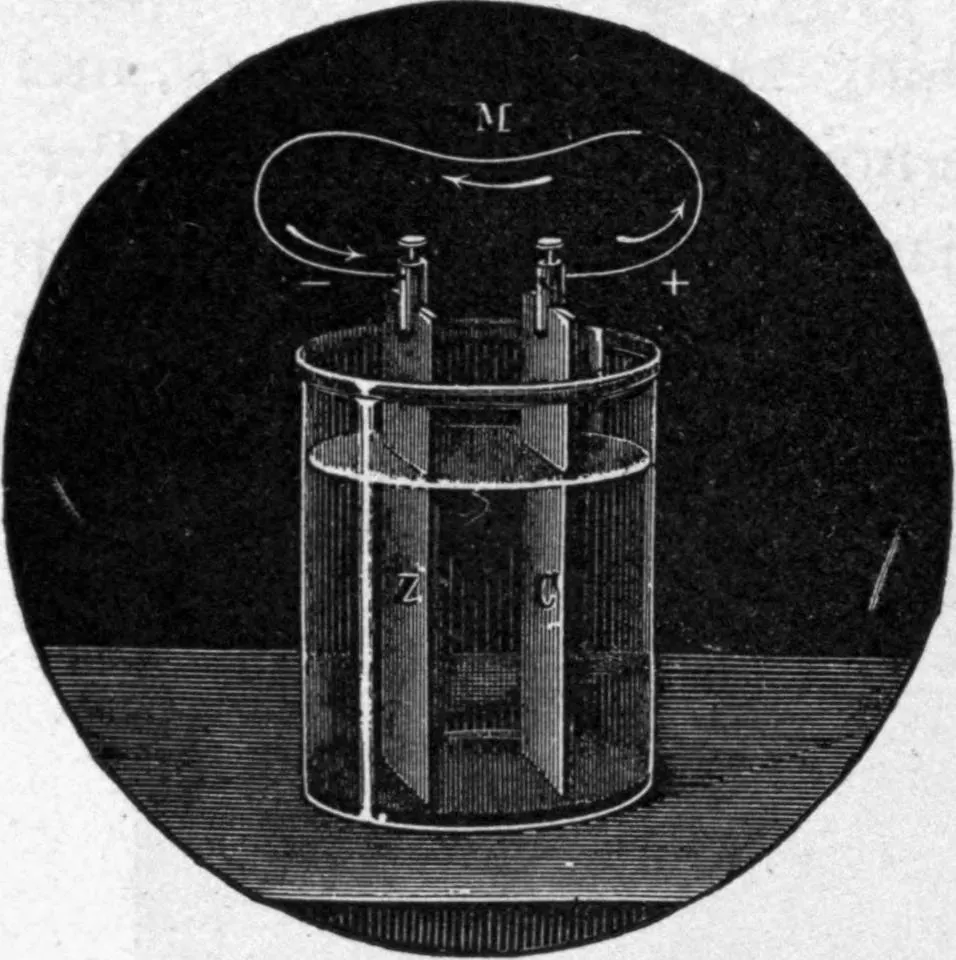
two strips upright in the tumbler and put some strips of wood across the top of the tumbler to keep the zinc and copper apart. They must not touch anywhere. When you have arranged this all right so that everything will stay in place you have got a battery, and if you join the two wires (see the picture, Fig. 104)
a current of electricity will flow from the copper plate to the zinc. I am going to prove it to you.
Take the end of the wire from the copper and put it on one side of your tongue and put the wire from the zinc on the other side, and you '11 feel a little current passing. The current goes from the copper through the wire, and through
A glass jar containing dilute sulphuric acid with a plate of zinc and a plate of copper
your tongue to the zinc. Your tongue connects the two wires.
in it (they must not touch each other) is Jf vou actually join the two
called an electric battery. If you join
the coppar (C) and the zinc (Z) plates by
a wire (Af), a current of electricity will
flow from C to Z through the wire; no
matter how long the wire is, the current
will still flow. It would flow (with a
wires, the current will be there just the same. Feeling it with your tongue proves that it is there, and that is what I wanted
strong current) from New York to Boston. j.Q prove Jf yOU
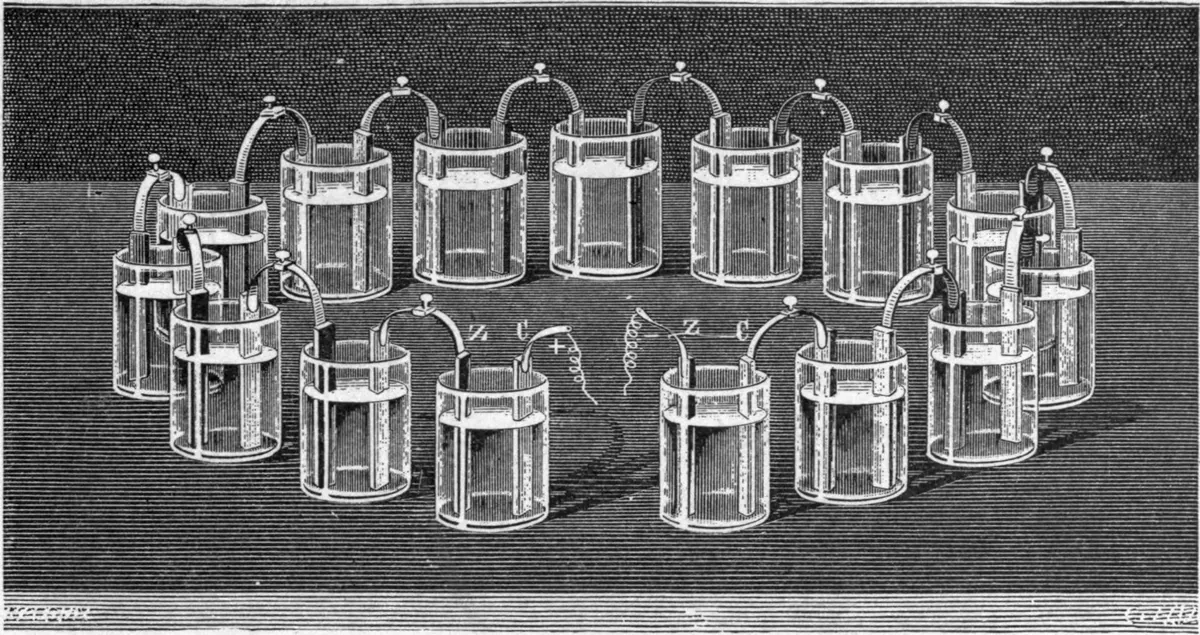
batteries joined together,1 you would have a current twice as strong. With many batteries joined together you would have a current strong enough to travel over a wire as long as from New York to Boston; and that is the kind of electricity they use in telegraphing.
1 The zinc of one battery to the zinc of the next one.
Original page 125
The Telegraph. — "I understand how you send a current of electricity from New York to Boston," said Tom; "you have a
FIG. 105. A BATTERY OF FIFTEEN CUPS
Notice that the zinc qf one cup is connected to the copper of the next one, and so on. At the ends there are two short wires marked + and —. If you join these to two telegraph wires reaching to a distant town, a current of electricity will flow from + to the distant town and back from the town to —. There would be a continuous circuit of wire from + to the town, and back again to —. If you cut the circuit of wire anywhere and put the two ends of the wire to your tongue, you will feel the current. That is a proof that the current is always there, in the wire. It is always flowing so long as the battery is joined to the long loop, or circuit of wire.
battery at New York and a loop of wire — what you call a circuit — going to Boston and returning to New York, this way:
wire ^
Battery in New York
Boston
wire FIG. 1 06
Original page 126
But I don't see how you make the signals. The current flows through the wires quietly; it makes no noise."
Fred. You have to put telegraph instruments — a key and so forth — on the wire, don't you?
Jack. Yes; we can improve Tom's drawing by putting them in, this way:
wire
Battery in New, York
Telegraph Instrument
Telegraph Instrument in Boston
in New York
< wire
FIG. 107
The battery in New York is all the while sending a current of electricity along the wire. It fills the whole of the wire from New York to Boston and back again. It flows along the wire and through the telegraph instruments at both places. When you wish to talk to Boston you move your New York key up and down, and the receiving instrument in Boston makes little sounds, one sound for each motion of the New York key. You can arrange an alphabet that way. For instance, three dots
() might be C, one dot (-) might be E, and two dots (- -) might
be /. You could spell.ice, for example, this way: - -,, -.
Fred. And Boston could talk to New York by dotting with the Boston key, and New York would hear it.
Jack. That is exactly the way it is done. Go into a telegraph office sometime and listen, and you will hear the instruments clicking away. Sometimes they make dots and
Original page 127
FIG. 108
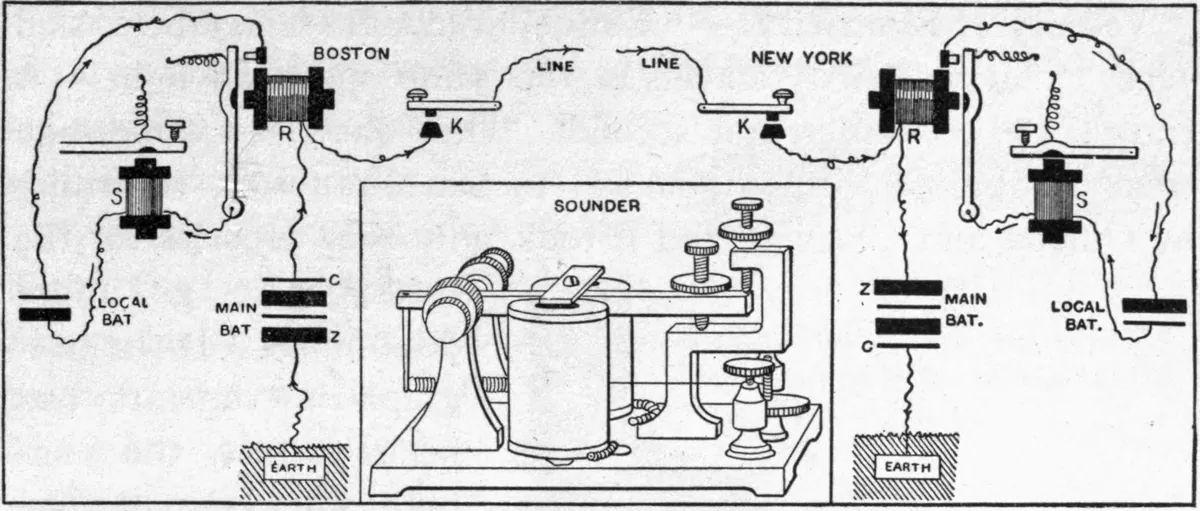
This figure shows the way in which New York and Boston are connected by telegraph. It is more complicated than the way described before, but the idea is the same. The key at New York is marked K (the Kon the right-hand side). If this key is tapped, a signal goes over the wire to Boston and is received on a sounder there. (See the picture of the sounder at the bottom of the cut.) In the same way signals made with the Boston key are heard on the New York sounder.
sometimes longer sounds called dashes, and sometimes very long dashes. The alphabet they use is:
TELEGRAPHIC ALPHABET
A
B
E
F
G
H
J
K
N
O
P
Q
R
S
T
u
W
Y
Z
&
t
p
TELEGRAPHIC
FIGURES
(
FIG. 109
Original page 128
Velocity of Electricity. — " You children must remember," said Jack, "that electricity travels at the same speed as light — it travels 186,000 miles in a second. They once sent a message from Cambridge through Canada to San Francisco, returning by Omaha and Chicago, and it took only four seconds for the
message to go those 7000 miles. If the telegraph instruments had been perfect, the message would have gone instantaneously. As it was it did not take long."
MAGNETISM
Jack. Suppose we stop talking about electricity for a while and learn something about magnets. There is a magnet in every telegraph sounder, in every telephone, and in every dynamo, and I want you
to understand how they are used. But we will begin far off
and come to these complicated machines by and by. In the
first place, Fred, what is a magnet?
Fred. A magnet is a piece of iron or steel that attracts other
pieces of iron.
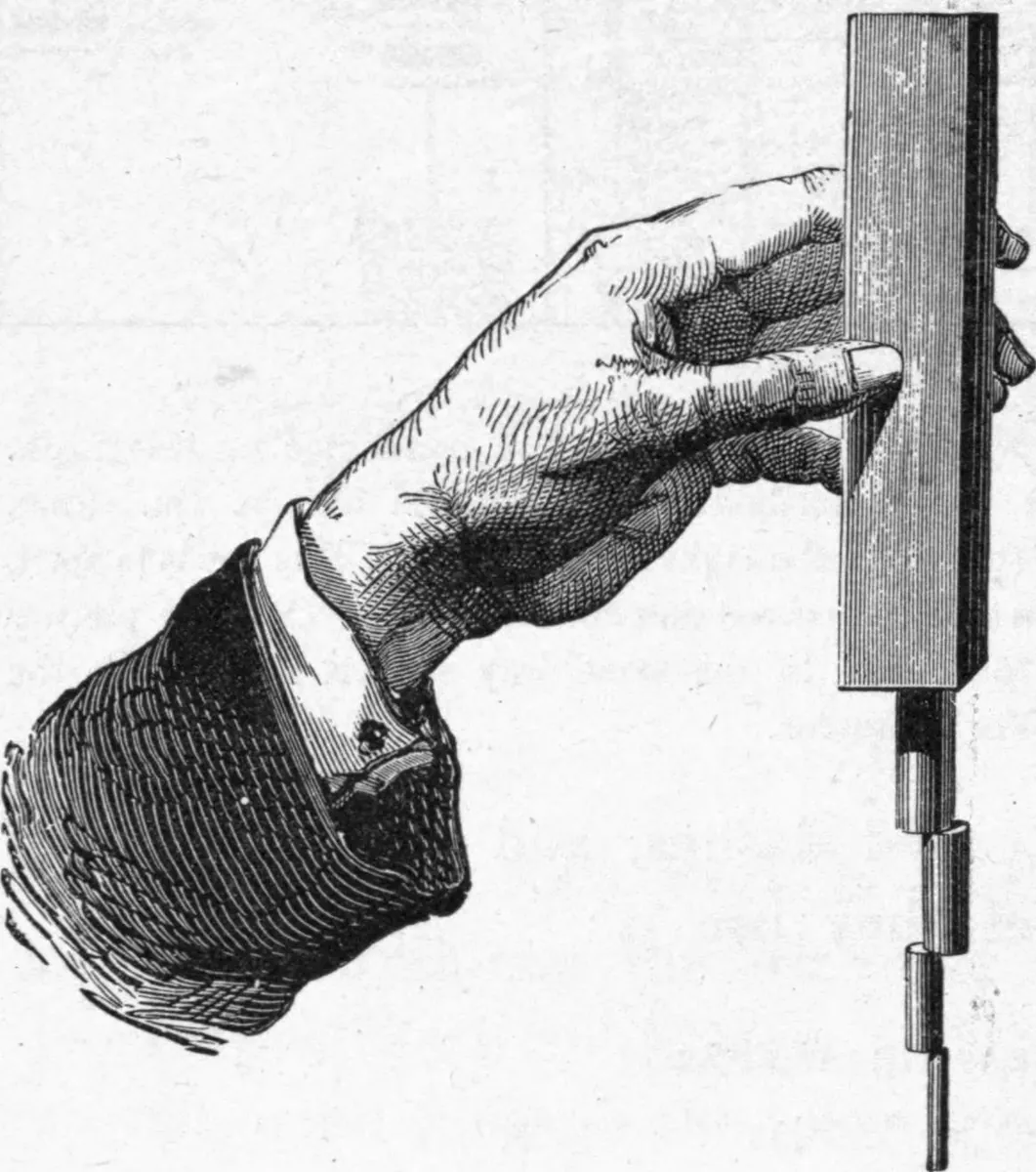
Tom. Try your straight magnet on these iron filings,
Fred.
FIG. no
A straight magnet held in the hand will attract little pieces of iron and will make each of them into magnets, so that they will hold up other small pieces.
Original page 129
Jack. There is a special thing to notice. A bar magnet attracts iron filings, tacks, and so forth, at its ends, but not at its middle. It is just the same with a horseshoe magnet. Try it.
We have learned one thing. Magnets of all shapes attract iron
filings, tacks, needles, and SO forth, A straight magnet — a bar me
to their ends, not to their centers. attracts iron filinss to its ends> but
,,,....,, not to its middle part.
Here are four little piles of sawdust, of copper filings, of sand, and of coal dust. Try to pick
them up with your magnets.
Agnes. They do not move; magnets do not attract such things as sand. Jack. No;
FIG. in
FIG. 112
magnets attract iron and steel
nothing else.
you take a
A horseshoe magnet attracts iron filings to its ends; but if you try the curved part of the mag-
net on a needle, there is almost pile of CODDer no attraction.
filings and iron
filings mixed together, the magnet will pick up the iron filings and leave the copper. Try the experiment and see for yourself.
Tom. So it does. That is a way of FlG- "3- A HORSESHOE
,r MAGNET WITH AN IRON
sorting iron out of a pile. If some one BAR (AN ARMATURE) told me to pick the iron filings out of ACROSS ITS ENDS this pile by hand, it would take all day
to do it; but with a magnet I can do it in five minutes.
Jack. See what the magnet will do through a pane of
glass. Lay a needle on a pane of glass held horizontally and
Original page 130
put the magnet under the glass. You will see that the needle moves over the glass as you move the magnet around. Tom. So it does; glass does not stop the attraction. Jack. Try putting the needle on a sheet of writing paper or on a piece of silk.
Tom. It is just the same; the needle moves when I move the magnet.
Jack. So much is clear; a magnet is made of iron; it attracts iron and nothing else; it attracts it through silk, or paper,
or glass — through anything.
These magnets that you have been using are manufactured. They were made. Let us make some more. Agnes, have you got any needles?
Agnes. Here are some. Jack laid the needles on the table and rubbed them with the horseshoe magnet, as if he were stroking them with it.1 He tried each needle on the pile of iron filings, and every one was able to lift up some filings just as the horseshoe magnet did. Then he took two of the needles and tied a bit of silk about each, near its middle, and hung the silk from
1 Make all the strokes on all the needles in one direction, so as to have the needle magnets all alike. Stroke all of them from eye end to point, or all from point to eye.
FIG. 114
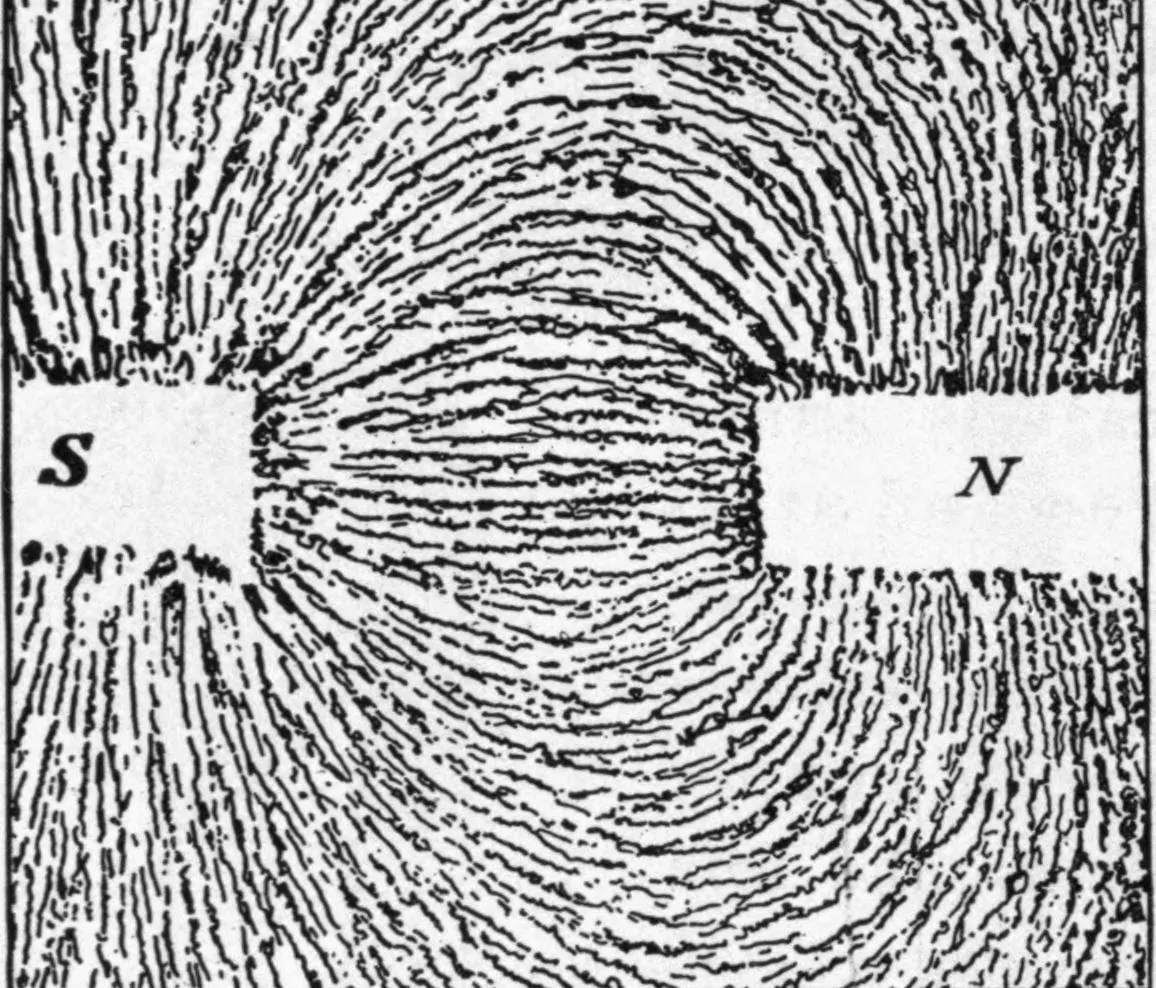
Iron filings on a horizontal pane of glass will move into a certain set of curves when yon hold a horseshoe magnet underneath the glass. (You must tap the glass very gently with your finger tip.)
Original page 131
two pencils (see Fig. 115), so that he had two little magnets, like pendulums. Next he took the bar magnet — a straight magnet — and tried some experiments with needle No. i (the other needle was laid aside for the moment). The bar magnet
silk
needle no. i
silk
needle no. 2
FIG. 115
had two ends of course; one was the point, and the other happened to be painted red.
point
red
FIG. 116
By trials with needle No. i he found:
1. That the point of the bar magnet attracted the point end of needle No. i.
2. That the point of the bar magnet repelled the eye end of needle No. i.
3. That the red end of the bar magnet repelled the point end of needle No. i.
4. That the red end of the bar magnet attracted the eye end of needle No. i.
Then he tried needle No. 2 and found just the same things for it also.
Original page 132
5. The point of the bar magnet attracted the point end of needle No. 2;
6. — and repelled the eye end of No. 2.
7. The red end of the bar magnet repelled the point end of No. 2;
8. • —and attracted the eye end of No. 2.
The next thing was to put aside the bar magnet and to try the two needles together. He found:
9. That the two points of the needles repelled each other.
10. That their two eye ends repelled each other.
11. and 12. That the point end of either needle attracted the eye end of the other.1
Tom. What is the explanation of all these experiments, Jack?
Jack. It is like this: just suppose there were two kinds of magnetism in the bar magnet. We might call them point-end magnetism and red-end magnetism, for want of better names. Now when we made magnets out of these needles we put the two kinds of magnetism into them. We put one kind into the point ends of both needles and another kind into their eye ends. Suppose we say that point-end magnetism, whereever it is found, will repel point-end magnetism; and that red-end magnetism, wherever found, will repel red-end magnetism; and that point-end magnetism will attract red-end magnetism, and vice versa, wherever they are found. Would not that explain all that we have seen?
Taking all the twelve cases one by one, the children found that the explanation was right. Magnetism of the same name repels; magnetism of different name attracts. It is not easy
1 These experiments take some space to describe, but they are so interesting that they should be tried in the schoolroom.
Original page 133
to explain in simple words why this is so; but any child who will pay attention and make these simple experiments can prove it.
Natural Magnets. — "These magnets were artificial; they were manufactured," said Jack; "but there are stones that are magnetic to begin with. They were first found in Magnesia, a town of Asia Minor, long ago, and the ancients therefore called them magnets."
Mary. In the Arabian Nights, in " Sindbad the Sailor," there is a story of a whole mountain made of magnets, so that when a ship came that way the mountain pulled all its iron nails out, and the ship broke to pieces and sank.
Agnes. That is n't true, is it Jack?
Jack. Certainly not, my dear; it is one of the big stories told by travelers. But don't you recollect how they got past the mountain with their ships?
Mary. They built their ships with wooden pins instead of nails and got safely past, so the story says.
Electro-Magnets. — Jack. There is another kind of magnet that I want you to know about. It is made by a current of electricity from a battery passing through a wire wrapped round a bar of soft iron. (See Fig. 1 17.)
You see now how a telegraph operator in New York can make a click on the sounder in Boston. The battery current is flowing all the time except just at the moment when the New York man lifts his key and breaks the circuit.
FIG. 117
If wire be wrapped in a spiral around a bar of iron, and if a current of electricity flow through the wire, the bar becomes a magnet and stays so as long as the current is flowing, and no longer.
Original page 134
The electro-magnet of the sounder in Boston is a magnet so long as the current flows, and stops being a magnet the
FIG. 118
Electro-magnets are often made of a core of soft iron bent into the shape of a horseshoe, and wound with wire. The two ends of the wire go to the copper and zinc of a battery. So long as the current flows the iron core is a magnet. When the current stops it is no longer a magnet.
instant the current stops. Whenever the New York man lifts his key the Boston sounder makes a click — a dot or a dash, just as he chooses. In that way the message is spelled out.
Key in New York
Bai
Sou ider in Boston
tery
FIG. 119
Electric Bells. — "Now," said Jack, "it is easy to understand how electric bells work. It is like a telegraph. In the first place you must have a battery. We could make a battery by using
Original page 135
several tumblers (like those described on page 124), but it is more satisfactory to buy one cell of "dry "battery, so called.
FIG. 1 20. A TELEGRAPH KEY
FIG. 121. A REPEATING SOUNDER
FIG. 122. A CELL OF DRY BATTERY
" We must run our
The coils of its magnets are vertical. Thearma- wire along the walls
tare is fastened to the horizontal ter which from one station to moves as the armature moves and clicks against
the point of the little screw above it. another like this I "
wire
Push Button
Battery
Bell
wire FIG. 123
Original page 136
FIG. 124. A PUSH BUTTON
It is like a very simple telegraph key. When you push it two ends of the wire are connected so that the current from the battery can flow to the bell and ring it. Until the button is pushed the circuit is broken and the current cannot flow. If you should take away the push button and join the ends of the wire where it now is, the battery current would flow continuously and the bell would ring all the time.
FIG. 125. AN ELECTRIC BELL
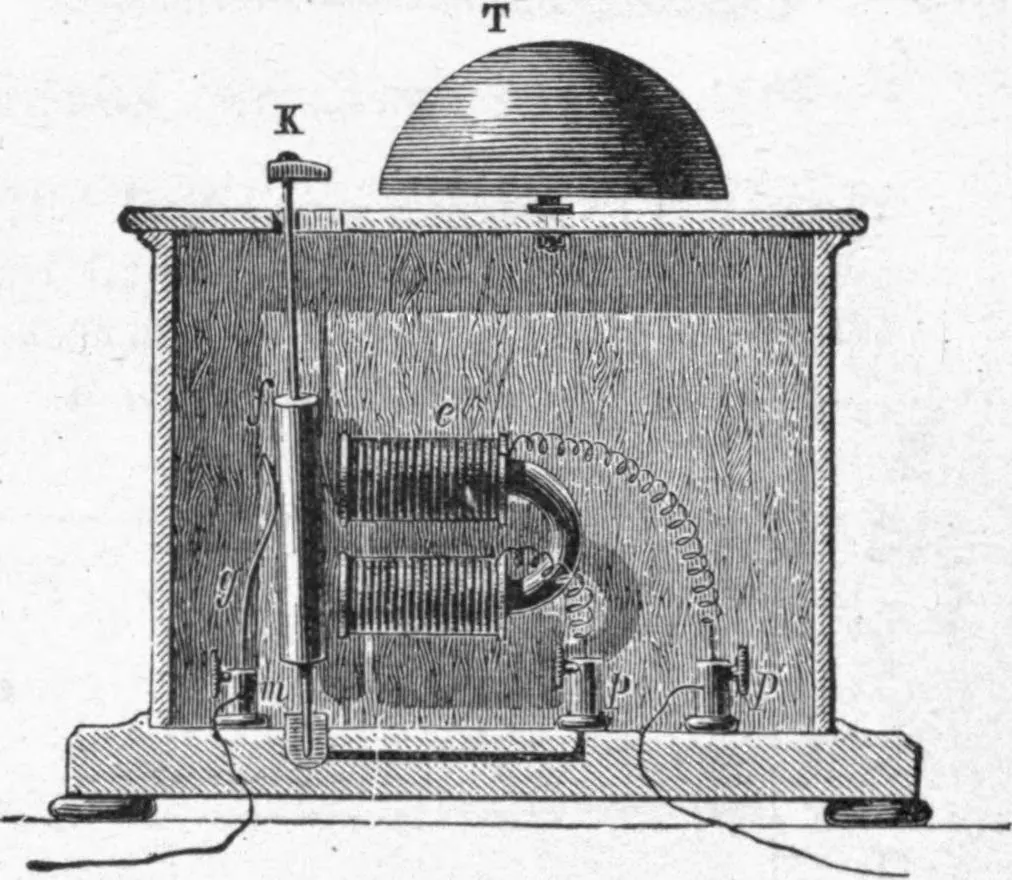
When the push button is touched the current from the battery flows along the wire into the box and round the coils shown in the picture. So long as the current is flowing the soft iron inside the coils is a magnet and attracts the piece of iron which is -the hammer (K) of the bell (T). But this piece is a vibrating spring and it keeps moving to and fro and sounding the bell. The moment that the push button is released the current stops flowing and the bell stops sounding.
Original page 137
FIG. 126. AN ELECTRIC-BELL OUTFIT COMPLETE
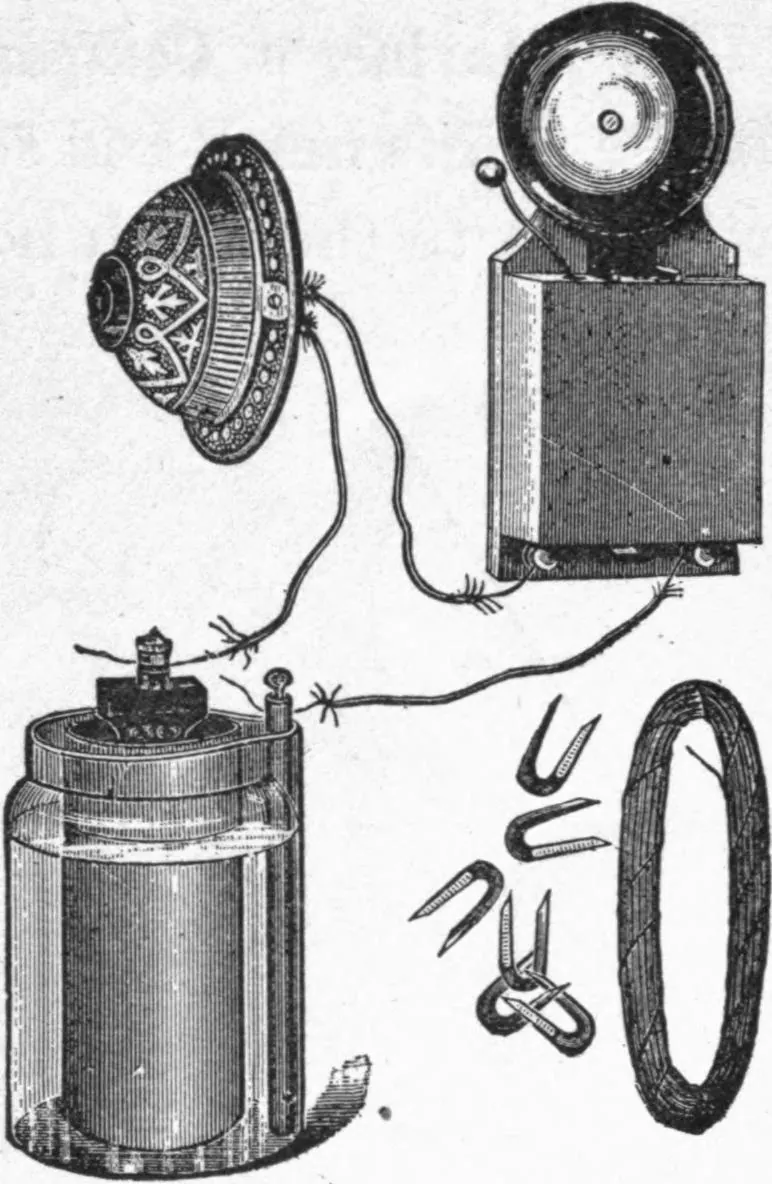
It can be bought in this form with seventy-five feet of wire and staples to fasten the wire for about $2.75.
Grou.ntL Wire,
Line Wire.
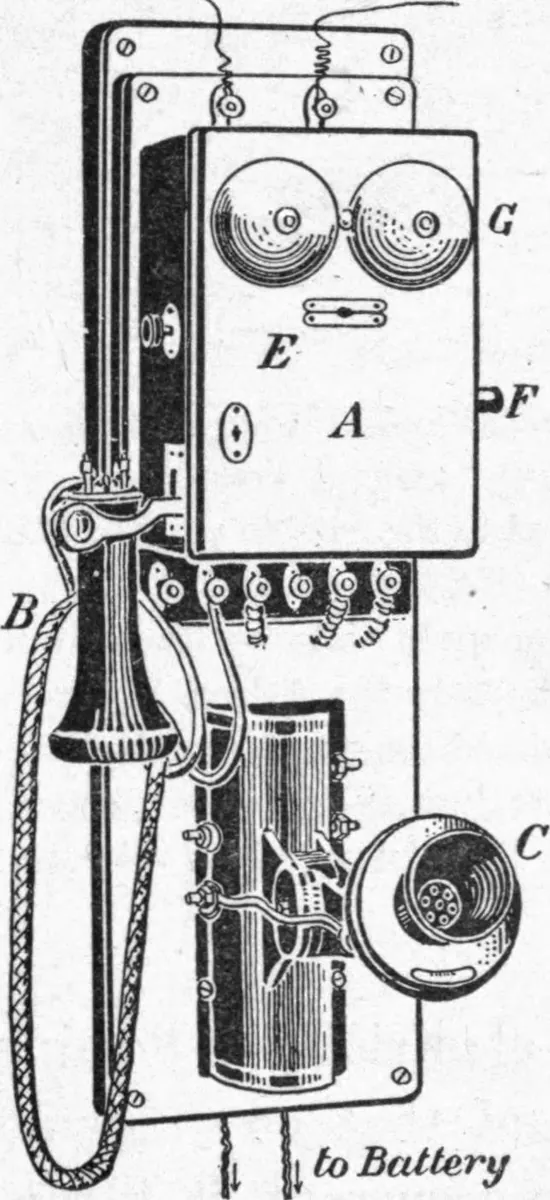
FIG. 127. THE TELEPHONE
F is a handle; turn it and the bell (G) will ring on your telephone and also at the other end of the line. The man you wish to talk to will hear it. He has another instrument just like yours. Take down your telephone (B) and put it to your ear. Speak into your transmitter (C) and he will hear you in his telephone. When he speaks into his transmitter you will hear him in your telephone.
to Battery
Original page 138
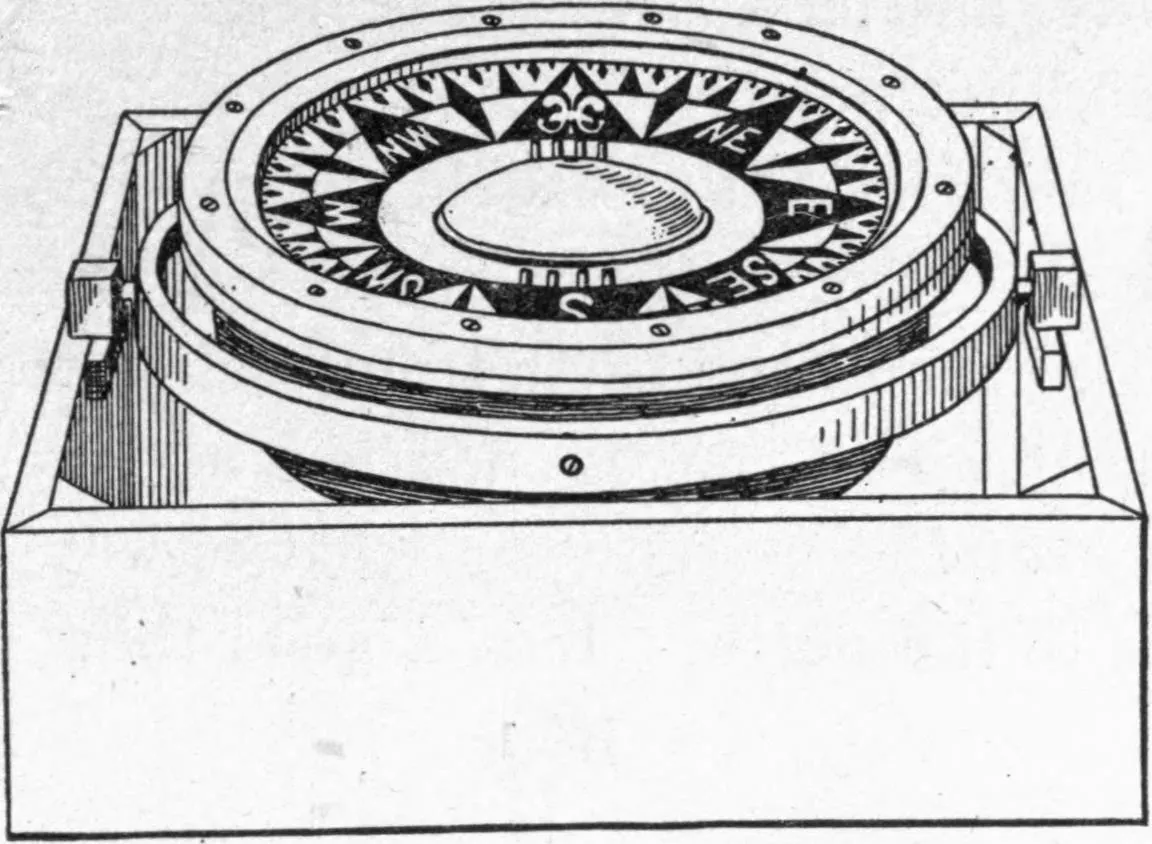
The Mariner's Compass. — "You know that a magnetized needle points north and south," said Jack. " A compass needle will point to the north no matter to what part of the earth you
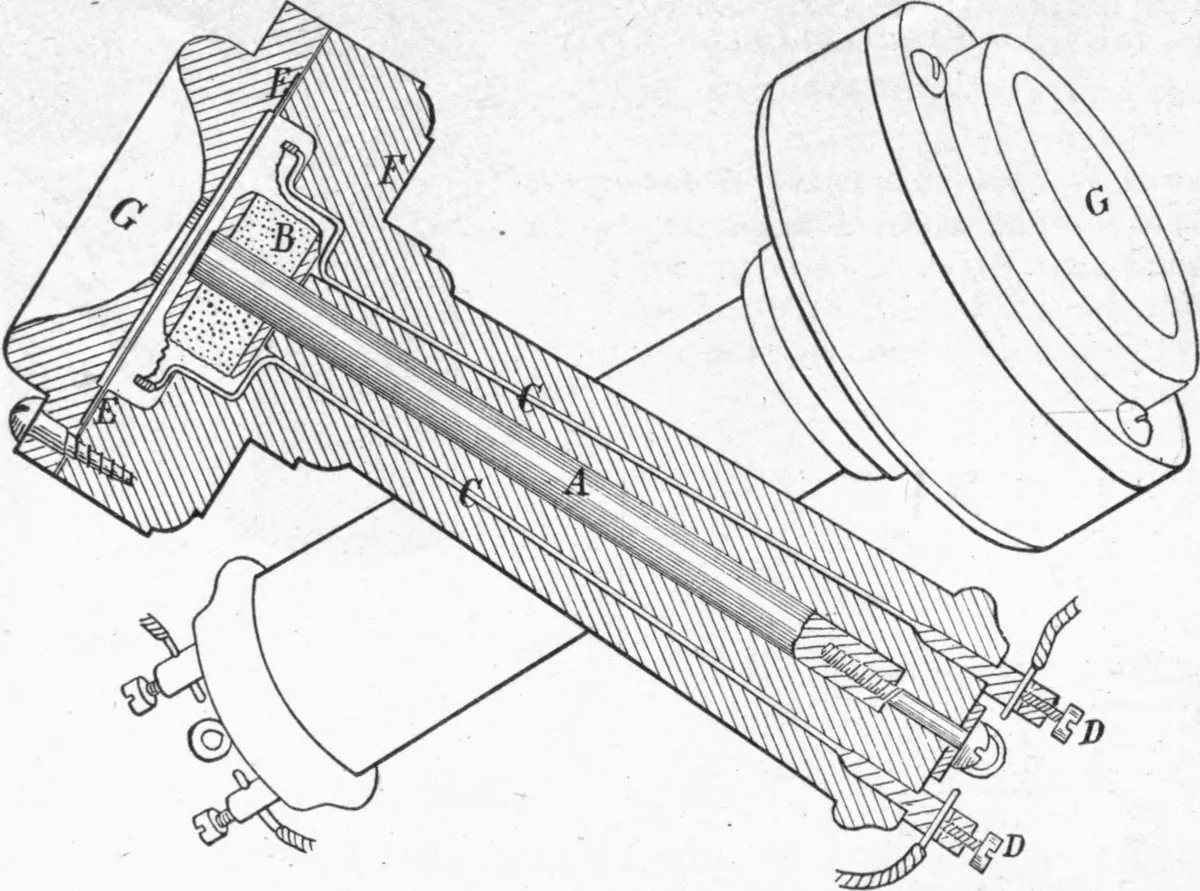
FIG. 128. THE TELEPHONE
One view shows the telephone as it really is; the other as it would look if it were split down the middle so as to show what is inside. A is a long steel magnet wound with fine wire (B). The ends of the spool of wire (B) are connected to the outside posts (D,D). Close to the magnet yi(near B) there is a thin iron plate (EE) which vibrates so as to copy the voice of the person speaking to you. That person speaks into his transmitter. (See Fig. 127.) The vibrations of his voice make vibrations in the disk of his transmitter; these vibrations are sent along the telephone wire and come to your telephone; there they make the disk (BE) of your telephone vibrate just,as his voice vibrated; the disk (EE) makes the air in your telephone vibrate like the speaker's voice, and you hear him speak.
take it. The reason is that a current of electricity is flowing round and round the earth all the time and that any magnet will always arrange itself at right angles to a current, if it can.
Original page 139
The fact is so, and I am going to prove it." So Jack took one of the little magnetized needles (Fig. 1 1 5) and let it
FIG. 129. THE MARINER'S COMPASS
swing freely. It swung so as to point to the north and rested in that direction, thus:
->• North
FIG. 130
Then Jack took the two ends of the wire from his battery and made them parallel to the needle, being careful not to touch the ends together, this way:
> North
AB
Copper
Zinc
'
Battery FIG. 131
Original page 140
No current was flowing, and the needle remained as it was before. Then he joined the ends A and B. A current flowed through the wire, and immediately the needle moved round and pointed west and not north (Fig. 132).
"You see," said Jack, "the needle moves so as to be perpendicular to the direction of the current. A current is always flowing round and round the earth from east to west. The sun makes the current. The compass needle is always perpendicular to the direction of the current, and that is why the mariner's compass points to the north. It is a good thing for us that it
West
Copp.
er Zinc
Battery FIG. 132
does so. Sailors can make long voyages and always know which way is north whether the stars are shining or not. They do not need the north star any more."
The Electric Light. — The first electric light was made about a hundred years ago by using a battery of 3000 cells. (See Fig. 105.) The wires from the ends of this immense battery were brought close together, and the spark between the ends did not come and go as lightning does, but was steady, like our electric, street lamps. The current from so many cells made a great heat as well as a brilliant light. The ends of the wires were melted off where the light was produced, and they
Original page 141
o-w
'
.
•SS'S'.SS3';
;s»*i
?!
lll'llslg^
" 0
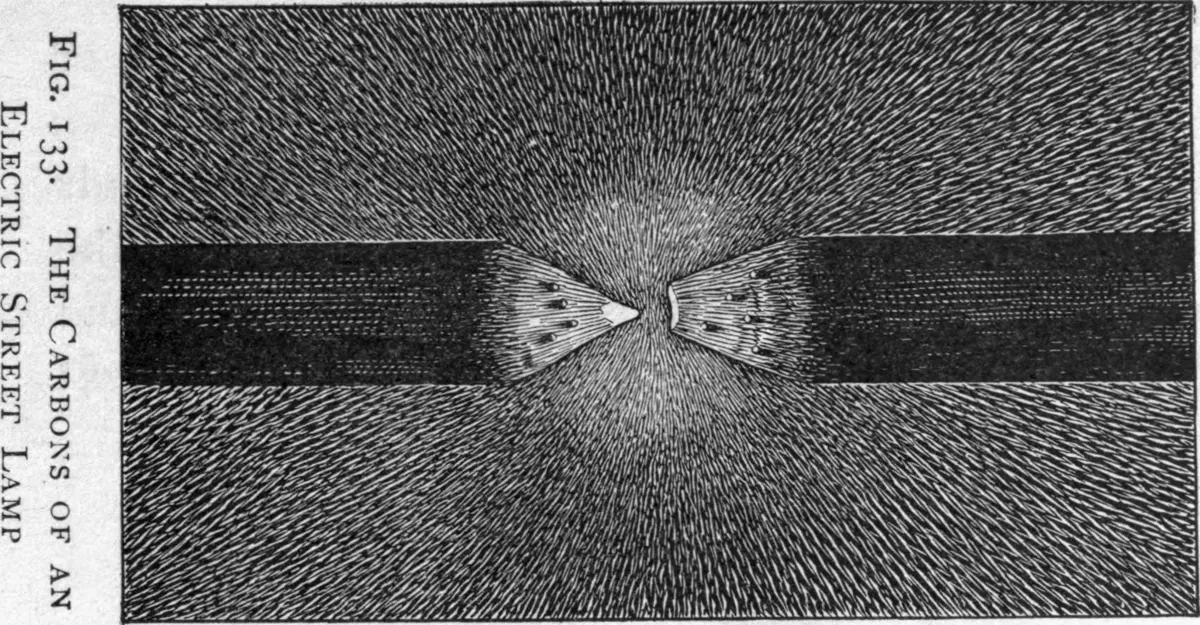
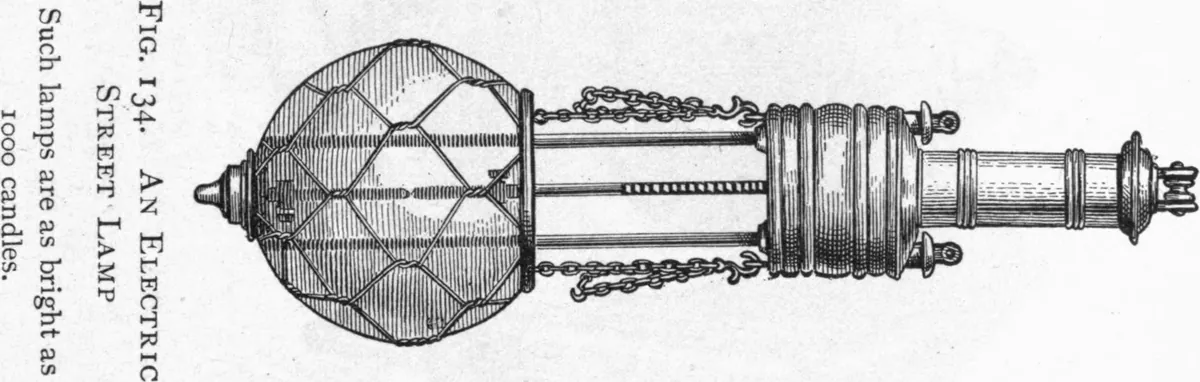
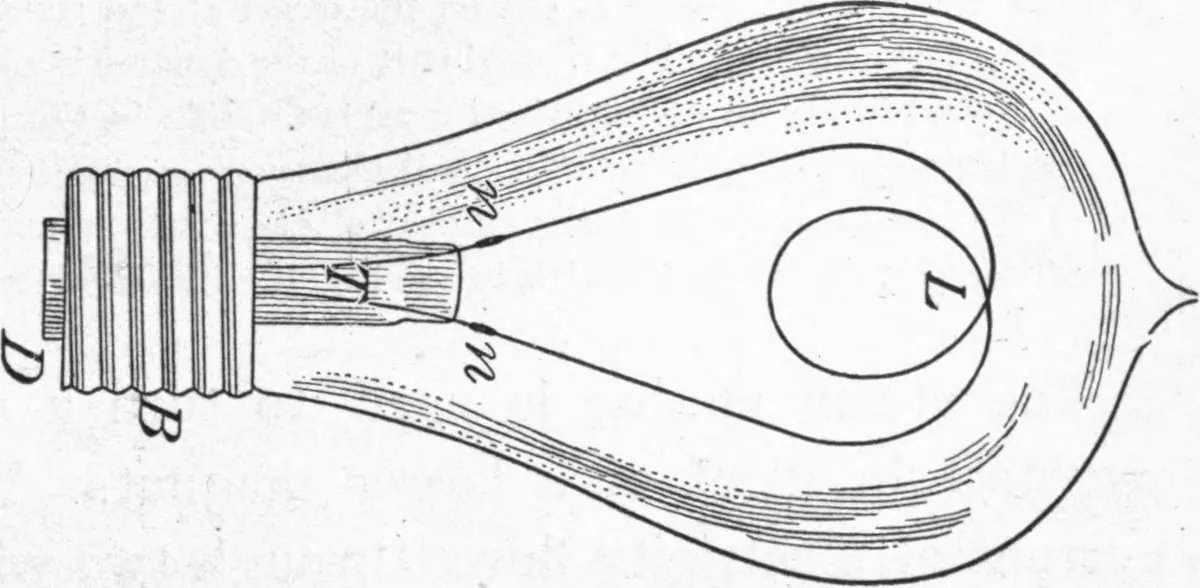
Original page 142
were obliged to use carbon ends (round sticks of coal dust or coke) at the ends, just as we do to-day.
The Dynamo. — It is possible to make batteries of thousands of cells, like those shown in Fig. 105, so powerful as to do the work of electric lighting; but it is very troublesome and expensive. A much simpler and cheaper way to get the current that is needed is to use a dynamo driven by a steam engine.
FIG. 136. A DYNAMO-ELECTRIC MACHINE
A belt from a steam engine is put on the wheel at the right of the picture and turns this wheel very rapidly. The central part of the dynamo is a large stationary electro-magnet. Fastened to the revolving wheel (and not visible in the picture) are a number of small electro-magnets. When these small electro-magnets are revolved very rapidly in front of the large magnet a strong current of electricity is made, and this current is carried off on wires to where we wish to use it. It will light lamps or drive a street car, etc.
The steam engine is used to turn a set of little electromagnets in front of a larger magnet. When this is done a current of electricity flows through two wires leading from the machine, and these wires can be led to the place where we want to use the current — to a distant part of the city to light
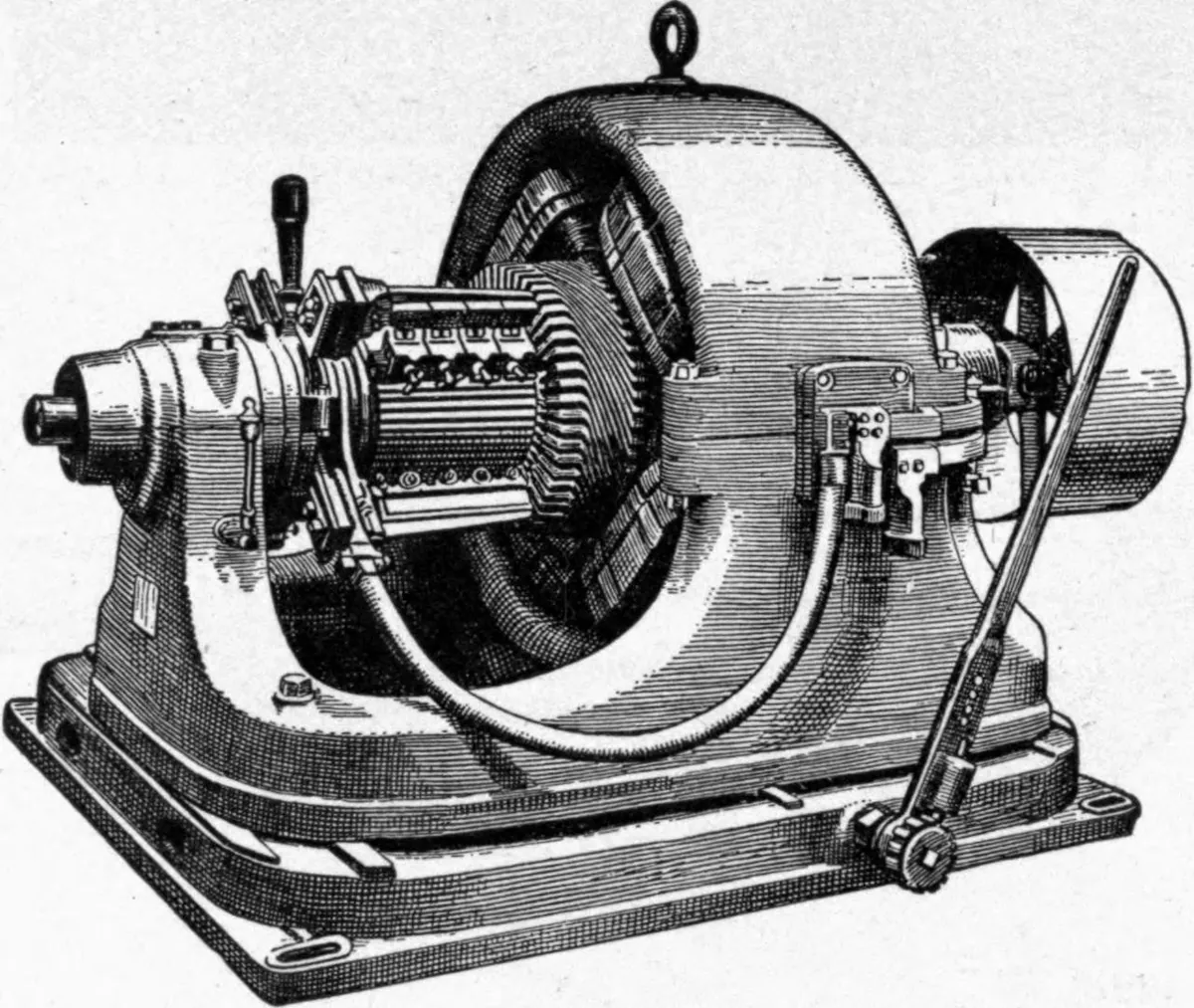
Original page 143
lamps, or to drive electric cars. Lamps are lighted by letting the current from the dynamo pass through them.
Electric Railways. — Street cars are driven in this way. Underneath each car is a dynamo (called a motor} fastened to the wheels.
FIG. 137. PART OF THE FRONT TRUCK OF A STREET CAR (SHOWING THE WHEELS AND THE MOTOR BETWEEN THEM)
FIG. 138. AN ELECTRIC STREET RAILWAY
The power house with its dynamo (D) driven by a large steam engine is shown on the lefthand side. From this dynamo a current goes out on an overhead wire (A*). A moving trolley (T) on each car takes the current to the motor. The motor turns the wheels whenever the motorman turns the current on, and stops turning them whenever he shuts the current off.
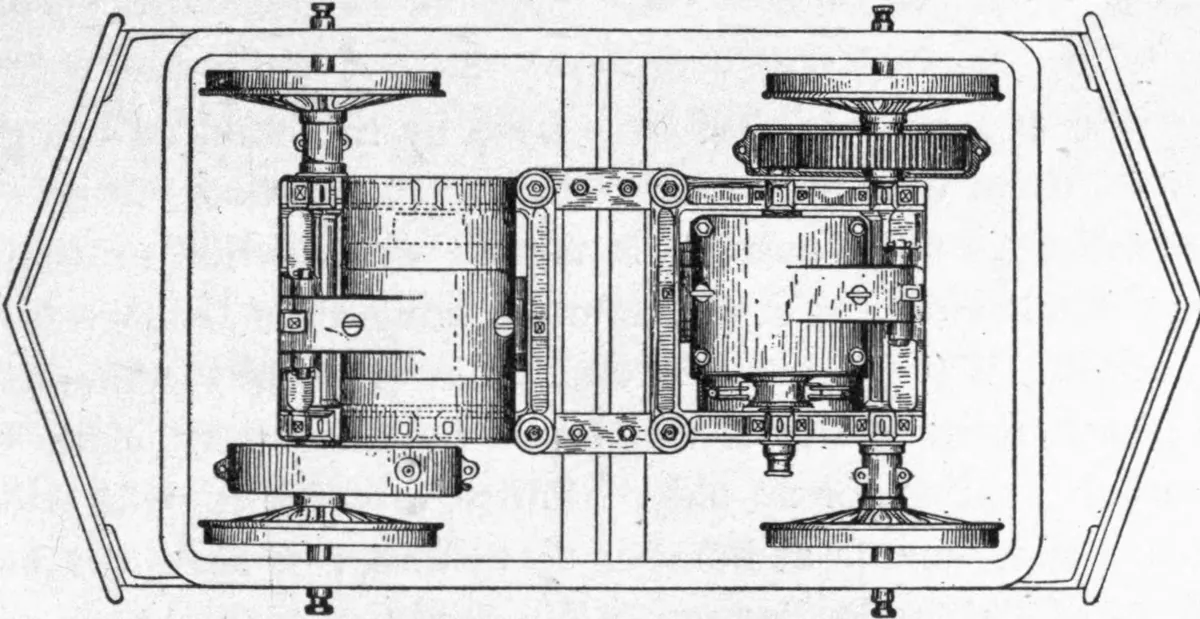
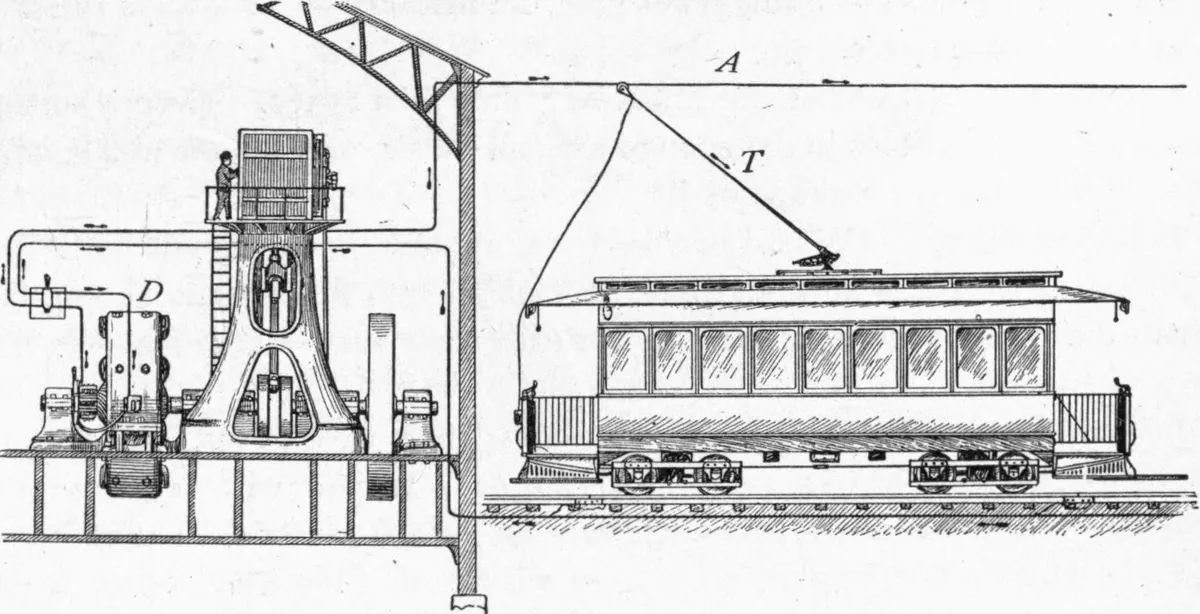
Original page 144
APPENDIX
SOME of the experiments that were tried by the children are given here. Nearly all of them can be repeated in the schoolroom or by children at home who will take the trouble. It is well worth while to do it, because we learn so much more by really doing a thing than by merely talking or reading about it. The teacher can readily buy or make the simple apparatus described; and, once made, it will serve for successive classes. Nearly every child has a father, or an older brother, or a friend, who will help him to make these experiments at home if they cannot be seen at school.
What Kind of Things Bodies are. — We need a convenient name for solids, liquids, and gases; let us call them bodies, and say that a piece of iron is a solid body, a lake of water is a body of liquid, etc. When we think about any body of this sort — a nugget of gold, for instance — we always think of it as filling some space.
Extension. — All bodies are extended; they fill a space. Even a sponge fills a space; the holes in the sponge are full of air, and the air in a sponge fills a space and has a shape of its own.
Impenetrability. — Where one body is, another body cannot be at the same time. Putty is soft and can be molded into almost any shape, but where the putty is, nothing else can be at the same time. It completely fills its own space.
Divisibility. — Every body can be divided into two halves, and each of those halves into halves again, and so on. If you will get from the druggist a little piece of permanganate of potash (write the name down) and put it into a hogshead of water, you will find that the whole of the water has been colored red. Every drop of water that you take up in your hand is red, and there are millions of drops in the hogshead. That means that the little piece of permanganate of potash has been divided into millions of smaller pieces, and that every single drop of water has several of those small pieces in it; for it takes more than one piece to color a whole drop of water.
Original page 145
PHYSICS — APPENDIX 1 45
If you put a piece of musk no larger than a green pea (you can buy musk from any druggist) in a room, it will scent the room and everything in it, and it will keep on doing so for years and years. Leave a towel in the room over night, and the next morning every thread of the towel will smell of musk. You could go on leaving towels in the room for a dozen years and taking them away after one night, and every thread of every towel would show that the musk had been near it. That means that every one of the threads of every one of the towels has several particles of musk on it; and it means that the original piece of musk (which seems hardly to grow any smaller) has been divided into millions of little pieces.
Cohesion. — If you take two bars of soap and press them together under a press, you can make one piece out of the two. That piece is held together by a force that we call cohesion. All solids are held together by such a force. One part of a lump of iron is held to the other parts by cohesion. It requires a good deal of pulling to pull one part of an iron rail away from the other parts (though it can be done). You can weld two pieces of iron together (by heating) so that they become one piece.
If you stretch a solid body (or compress it) and then take away the force that was stretching (or pressing) it, the body will usually spring back to its first shape. A piece of india rubber stretched (or compressed) flies back to its first shape as soon as you stop forcing it out of shape. A bent steel knitting needle flies back into shape very quickly. India rubber, steel, glass, and indeed most solid bodies, are elastic. If you strain them a certain amount, they will spring back into shape like the springs of a buggy. If you strain them too much, they sometimes lose their elasticity like the springs of a farm wagon that has been used to carry very heavy loads. Most solid bodies are elastic; all liquids are so.
Viscosity. — Did you ever see very cold molasses flowing from a spigot? It is viscous — a little like a solid and a little like a liquid at the same time. Warm it, and it becomes like a liquid. Tar that is very hot acts like a liquid; as it cools it is viscous; when it is perfectly cold it becomes a solid. Water is not viscous; it flows freely.
All Bodies are Heavy. — All bodies — solids, liquids, and gases — have weight. A cubic inch of any solid is usually (not always) heavier than a cubic inch of any liquid. Iron will sink in water, but wood will float on it. Iron itself will float on quicksilver. The gases have weight. Air has weight, for instance, as the barometer proves. (See page 84.)
Original page 146
Hardness. — By a little trouble any child can get pieces of soapstone (talc) (i), rock salt (2), fluor spar (4), feldspar (6), quartz (7). The numbers 1,2,4,6,7 denote the degree of hardness of these stones. The very hardest stone is the diamond, whose hardness is 10. Rock salt (2) will scratch soapstone (i); feldspar (6) will scratch fluor spar (4); quartz (7) will scratch all of them and will scratch glass, too. You can write your name on glass with a piece of pure quartz. A diamond will scratch every stone. If you want to say how hard a stone is, you can give its hardness in a number. Topaz is 8; it will scratch quartz but not diamond.
Ductility. — You can draw some metals out into long fine wires. These are the ductile metals, lik'e gold, silver, iron, copper, etc. Glass can be drawn out into fine threads by heating it. Gold can be hammered out into leaves so thin that 30,000 of them, piled one above another, would be only an inch high. If you were to press these leaves under a strong press, they would go back into a gold plate by cohesion. (See page 145.) A body is called malleable when it can be hammered out into thin sheets. Copper, for instance, is very malleable.
Crystals. — Buy three ounces of alum at the druggist's and pound it into a fine powder and put the powder into a tumbler full of very hot water, stirring the alum in with a glass rod until all is dissolved. Then lay a bit
FIG. 139. How TO MAKE ALUM CRYSTALS
of stick across the mouth of the tumbler with a short string hanging down into the water. (See Fig. 139.) Put the tumbler in a cool place and look at it the next day and see the beautiful crystals of alum that have formed. The hot water kept all the alum dissolved. As the water cooled,
Original page 147
PHYSICS — APPENDIX
some alum was freed, and it formed into its own kind of crystal. Everything has its particular way of crystallizing. Alum makes one kind of crystal, quartz another.
You can buy some rock salt, some bichromate of potash, and some blue vitriol at the druggist's also, and make crystals out of these substances,
FIG. 140. DIFFERENT FORMS OF SNOW CRYSTALS
just as you made the alum crystals. Each substance will crystallize in its own way. You can save some of the best crystals in wide-mouthed glass bottles, tightly corked, and begin to collect a cabinet of crystals for yourself. Freshly fallen snow (that is, frozen water) makes crystals, as you can see on a window pane in the winter time.
Original page 148
DIFFERENT FORMS OF CRYSTALS • 148
