Lecture VII
The Life of a Primrose
When the dreary days of winter and the early damp days of spring are passing away, and the warm bright sunshine has begun to pour down upon the grassy paths of the wood, who does not love to go out and bring home posies of violets, and bluebells, and primroses? We wander from one plant to another, picking a flower here and a bud there, as they nestle
Our work during the next hour will be to consider this question. You were asked last week to bring with you to-day a primrose-flower, or a whole plant if possible, in order the better to follow out with me the "Life of a Primrose."[14] This is a very different kind of subject from those of our former lectures. There
There is a beautiful little poem by Tennyson, which says—
I pluck you out of the crannies;
Hold you here, root and all, in my hand,
Little flower; but if I could understand
What you are, root and all, and all in all,
I should know what God and man is."
We cannot learn all about this little flower, but we can learn enough to understand that it has a real separate life of its own, well worth knowing. For a plant is born, breathes, sleeps, feeds, and digests just as truly as an animal does, though in a different way. It works hard both for itself to get its food, and for others in making the air pure and fit for animals to breathe. It often lays by provision for the winter. It sends young plants out, as parents send their children, to fight for themselves in the world; and then, after living sometimes to a good old age, it dies, and leaves its place to others.
We will try to follow out something of this life to-day; and first, we will begin with the seed.
I have here a packet of primrose-seeds, but they are so small that we cannot examine them; so I have also had given to each one of you an almond-kernel, which is the seed of the almond-tree, and which has been soaked, so that it splits in half easily. From this we can learn about seeds in general, and then apply it to the primrose.
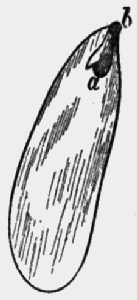 Fig. 37.—Half an almond, showing the plantlet.
a, rudiment of stem.
b, beginning of root.
If you peel the two skins off your almond-seed (the thick, brown, outside skin, and the thin, transparent one under it), the two halves of the almond will slip apart quite easily. One of these halves will have a small dent at the pointed end, while in the other half you will see a little lump, which fitted into the dent when the two halves were joined. This little lump (a b, Fig. 37) is a young plant, and the two halves of the almond are the seed-leaves which hold the plantlet, and feed it till it can feed itself. The rounded end of the plantlet (b) sticking out of the almond, is the beginning of the root, while the other end (a) will in time become the stem. If you look carefully, you will see two little points at this end, which are the tips of future leaves. Only think how minute this plantlet must be in a primrose, where the whole seed is scarcely larger than a grain of sand! Yet in this tiny plantlet lies hid the life of the future plant.
When a seed falls into the ground, so long as the earth is cold and dry, it lies like a person in a trance, as if it were dead; but as soon as the warm, damp spring comes, and the busy little sun-waves pierce down into the earth, they wake up the plantlet, and make it bestir itself. They agitate to and fro the particles of matter in this tiny body, and cause them to seek out for other particles to seize and join to themselves.
But these new particles cannot come in at the roots, for the seed has none; nor through the leaves, for they have not yet grown up; and so the plantlet begins by helping itself to the store of food laid up in the thick seed-leaves in which it is buried. Here it finds starch, oils, sugar, and substances called albuminoids,—the sticky matter which you notice in wheat-grains when you chew them is one of the albuminoids. This food is all ready for the plantlet to use, and it sucks it in, and works itself into a young plant with tiny roots at one end, and a growing shoot, with leaves, at the other.
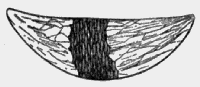 Fig. 38.—Juicy cells in a piece of orange.
But how does it grow? What makes it become larger? To answer this, you must look at the second thing I asked you to bring—a piece of orange. If you take the skin off a piece of orange, you will see inside a number of long-shaped transparent bags, full of juice. These we call cells, and the flesh of all plants and animals is made up of cells like these, only of various shapes. In the pith of elder they are round, large, and easily seen (a, Fig. 39); in the stalks of plants they are long, and lap over each other (b, Fig. 39), so as to give the stalk strength to stand upright. Sometimes many cells growing one on the top of the other, break into one tube and make vessels. But whether large or small, they are all bags growing one against the other.
In the orange-pulp these cells contain only sweet juice, but in other parts of the orange-tree or anyfirst form of life, for it is alive and active, and under a microscope you may see in a living plant streams of the little grains moving about in the cells.
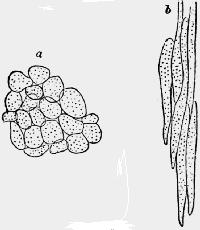 Fig. 39.—Plant-cells.
a, round cells in pith of elder.
b, long cells in fibres of a plant.
Now we are prepared to explain how our plant grows. Imagine the tiny primrose plantlet to be made up of cells filled with active living protoplasm, which drinks in starch and other food from the seed-leaves. In this way each cell will grow too full for its skin, and then the protoplasm divides into two parts and builds up a wall between them, and so one cell becomes two. Each of these two cells again breaks up into two more, and so the plant grows larger and larger, till by the time it has used up all the food in the seed-leaves, it has sent roots covered with fine hairs downwards into the earth, and a shoot with beginnings of leaves up into the air.
Sometimes the seed-leaves themselves come above ground, as in the mustard-plant, and sometimes they are left empty behind, while the plantlet shoots through them.
And now the plant can no longer afford to be idle and live on prepared food. It must work for itself. Until now it has been taking in the same kind of food that you and I do; for we too find many seeds very pleasant to eat and useful to nourish us. But now this store is exhausted. Upon what then is the plant to live? It is cleverer than we are in this, for while we cannot live unless we have food which has once been alive, plants can feed upon gases and water and mineral matter only. Think over the substances you can eat or drink, and you will find they are nearly all made of things which have been alive: meat, vegetables, bread, beer, wine, milk; all these are made from living matter, and though you do take in such things as water and salt, and even iron and phosphorus, these would be quite useless if you did not eat and drink prepared food which your body can work up into living matter.
But the plant, as soon as it has roots and leaves, begins to make living matter out of matter that has never been alive. Through all the little hairs of its roots it sucks in water, and in this water are dissolved more or less of the salts of ammonia, phosphorus, sulphur, iron, lime, magnesia, and even silica, or flint. In all kinds of earth there is some iron, and we shall see presently that this is very important to the plant.
Suppose, then, that our primrose has begun to drink in water at its roots. How is it to get this water up into the stem and leaves, seeing that the whole plant is made of closed bags or cells? It does it in a very curious way, which you can prove for yourselves. Whenever two fluids, one thicker than the other, such
When it gets there it finds our old friends the sunbeams hard at work. If you have ever tried to grow a plant in a cellar, you will know that in the dark its leaves remain white and sickly. It is only in the sunlight that a beautiful delicate green tint is given to them, and you will remember from Lecture II. that this green tint shows that the leaf has used all the sun-waves except those which make you see green; but why should it do this only when it has grown up in the sunshine?
The reason is this: when the sunbeam darts into the leaf and sets all its particles quivering, it divides the protoplasm into two kinds, collected into different cells. One of these remains white, but the other kind, near the surface, is altered by the sunlight and by the help of the iron brought in by the water. This particular kind of protoplasm, which is called "chloro
It is these little green cells that by the help of the sun-waves digest the food of the plant and turn the water and gases into useful sap and juices. We saw in Lecture III. that when we breathe-in air, we use up the oxygen in it and send back out of our mouths carbonic acid, which is a gas made of oxygen and carbon.
Now, every living thing wants carbon to feed upon, but plants cannot take it in by itself, because carbon is solid (the blacklead in your pencils is pure carbon), and a plant cannot eat, it can only drink-in fluids and gases. Here the little green cells help it out of its difficulty. They take in or absorb out of the air the carbonic acid gas which we have given out of our mouths, and then by the help of the sun-waves they tear the carbon and oxygen apart. Most of the oxygen they throw back into the air for us to use, but the carbon they keep.
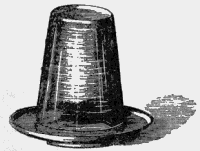 Fig. 40.—Oxygen-bubbles rising from laurel-leaves in water.
If you will take some fresh laurel-leaves and put them into a tumbler of water turned upside-down in a saucer of water, and set the tumbler in the sunshine, you will soon see little bright bubbles rising up and clinging to the glass. These are bubbles of
But what becomes of the carbon? And what use is made of the water which we have kept waiting all this time in the leaves? Water, you already know is made of hydrogen and oxygen; but perhaps you will be surprised when I tell you that starch, sugar, and oil, which we get from plants, are nothing more than hydrogen and oxygen in different quantities joined to carbon.
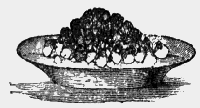 Fig. 41.—
Carbon rising up from white sugar.
It is very difficult at first to picture such a black thing as carbon making part of delicate leaves and beautiful flowers, and still more of pure white sugar. But we can make an experiment by which we can draw the hydrogen and oxygen out of common loaf sugar, and then you will see the carbon stand out in all its blackness. I have here a plate with a heap of white sugar in it. I pour upon it first some hot water to melt and warm it, and then some strong sulphuric acid. This acid does nothing more than simply draw the hydrogen and oxygen out. See! in a few moments a black mass of carbon begins to rise, all of which has come out of the white sugar you saw just now.[15] You see,
Now look at my plant again, and tell me if we have not already found a curious history? Fancy that you see the water creeping in at the roots, oozing up from cell to cell till it reaches the leaves, and there meeting the carbon which has just come out of the air, and being worked up with it by the sun-waves into starch, or sugar, or oils.
But meanwhile, how is new protoplasm to be formed? for without this active substance none of the work can go on. Here comes into use a lazy gas we spoke of in Lecture III. There we thought that nitrogen was of no use except to float oxygen in the air, but here we shall find it very useful. So far as we know, plants cannot take up nitrogen out of the air, but they can get it out of the ammonia which the water brings in at their roots.
Ammonia, you will remember, is a strong-smelling gas, made of hydrogen and nitrogen, and which is often almost stifling near a manure-heap. When you manure a plant you help it to get this ammonia, but at any time it gets some from the soil and also from the rain-drops which bring it down in the air. Out of this ammonia the plant takes the nitrogen and works it up with the three elements, carbon, oxygen, and hydrogen, to make the substances called albuminoids, which form a large part of the food of the plant, and it is these albuminoids which go to make protoplasm. You will notice that while the starch and other substances are only made of three elements,
And so hour after hour and day after day our primrose goes on pumping up water and ammonia from its roots to its leaves, drinking in carbonic acid from the air, and using the sun-waves to work them all up into food to be sent to all parts of its body. In this way these leaves act, you see, as the stomach of the plant, and digest its food.
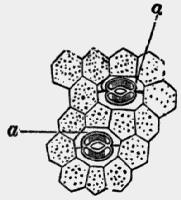 Fig. 32.—Stomates of a leaf.
Sometimes more water is drawn up into the leaves than can be used, and then the leaf opens thousands of little mouths in the skin of its under surface, which let the drops out just as drops of perspiration ooze through our skin when we are over-heated. These little mouths, which are called stomates (a, Fig. 42) are made of two flattened cells, fitting against each other. When the air is damp and the plant has too much water these lie open and let it out, but when the air is dry, and the plant wants to keep as much water as it can, then they are closely shut. There are as many as a hundred thousand of these mouths under one apple-leaf, so you may imagine how small they often are.
Plants which only live one year, such as mignonette, the sweet pea, and the poppy, take in just enough food to supply their daily wants and to make the seeds we shall speak of presently. Then, as soon as their seeds are ripe their roots begin to shrivel, and
But many plants are more industrious than the stock and mignonette, and lay by store for another year, and our primrose is one of these. Look at this thick solid mass below the primrose leaves, out of which the roots spring.[16] This is really the stem of the primrose hidden underground, and all the starch, albuminoids, &c., which the plant can spare as it grows, are sent down into this underground stem and stored up there, to lie quietly in the ground through the long winter, and then when the warm spring comes this stem begins to send out leaves for a new plant.
We have now seen how a plant springs up, feeds itself, grows, stores up food, withers, and dies; but we have said nothing yet about its beautiful flowers or how it forms its seeds. If we look down close to the bottom of the leaves in a primrose root in spring-time, we shall always find three or four little green buds nestling in among the leaves, and day by day we may see the stalk of these buds lengthening till they reach up into the open sunshine, and then the flower opens and shows its beautiful pale-yellow crown.
We all know that seeds are formed in the flower, and that the seeds are necessary to grow into new plants. But do we know the history of how they are formed, or what is the use of the different parts of the bud? Let us examine them all, and then I
Remember that the seed is the one important thing, and then notice how
the flower protects it. First, look at the outside green covering, which
we call the calyx. See how closely it fits in the bud, so that no
insects can creep in to gnaw the flower, nor any harm come to it from
cold or blight. Then, when the calyx opens, notice that the yellow
leaves which form the crown or corolla, are each alternate with one of
the calyx leaves, so that anything which got past the first covering
would be stopped by the second. Lastly, when the delicate corolla has
opened out, look at those curious yellow bags just at the top of the
tube (2 b, Fig 43). What is their use?
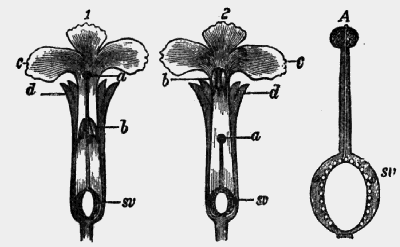
Fig. 43.—The two forms of the Primrose-flower.
a, Stigma or sticky head of the seed-vessel.
b, Anthers of the
stamens.
c, Corolla or crown of the flower.
d, Calyx or outer
covering.
sv, Seed-vessel.
A, Enlarged pistil, with pollen-grain
resting on the
stigma and growing down to the ovule.
o, Ovules.
But I fancy I see two or three little questioning faces which seem to say, "I see no yellow bags ata, Fig. 43), and will find the yellow bags (b) buried in the tube. Those, on the other hand, who have the yellow bags (2 b, Fig. 43) at the top will find the knob (a) half-way down the tube.
Now for the use of these yellow bags, which are called the anthers of the stamens, the stalk on which they grow being called the filament or thread. If you can manage to split them open you will find that they have a yellow powder in them, called pollen, the same as the powder which sticks to your nose when you put it into a lily; and if you look with a magnifying glass at the little green knob in the centre of the flower you will probably see some of this yellow dust sticking on it (A, Fig. 43). We will leave it there for a time, and examine the body called the pistil, to which the knob belongs. Pull off the yellow corolla (which will come off quite easily), and turn back the green leaves. You will then see that the knob stands on the top of a column, and at the bottom of this column there is a round ball (s v), which is a vessel for holding the seeds. In this diagram (A, Fig. 43) I have drawn the whole of this curious ball and column as if cut in half, so that we may see what is in it. In the middle of the ball, in a
"These, then, are seeds," you will say. Not yet; they are only ovules, or little bodies which may become seeds. If they were left as they are they would all wither and die. But those little yellow grains of pollen, which we saw sticking to the knob at the top, are coming down to help them. As soon as these yellow grains touch the sticky knob or stigma, as it is called, they throw out tubes, which grow down the column until they reach the ovules. In each one of these they find a tiny hole, and into this they creep, and then they pour into the ovule all the protoplasm from the pollen-grain which is sticking above, and this enables it to grow into a real seed with a tiny plantlet inside.
This is how the plant forms its seed to bring up new little ones next year, while the leaves and the roots are at work preparing the necessary food. Think sometimes when you walk in the woods, how hard at work the little plants and big trees are, all around you. You breathe in the nice fresh oxygen they have been throwing out, and little think that it is they who are making the country so fresh and pleasant, and that while they look as if they were doing nothing but enjoying the bright sunshine, they are really fulfilling their part in the world by the help of this sunshine; earning their food from the ground;
But why should the primroses have such golden crowns? plain green ones would protect the seed quite as well. Ah! now we come to a secret well worth knowing. Look at the two primrose flowers, 1 and 2, Fig. 43, p. 163, and tell me how you think the dust gets on to the top of the sticky knob or stigma. No. 2 seems easy enough to explain, for it looks as if the pollen could fall down easily from the stamens on to the knob, but it cannot fall up, as it would have to do in No. 1. Now the curious truth is, as Mr. Darwin has shown, that neither of these flowers can get the dust easily for themselves, but of the two No. 1 has the least difficulty.
Look at a withered primrose, and see how it holds its head down, and
after a little while the yellow crown falls off. It is just about as it
is falling that the anthers or bags of the stamens burst open, and
then, in No. 1 (Fig. 44), they are dragged over the knob and some of the
grains stick there. But in the other form of primrose, No. 2, when the
flower falls off, the stamens do not come near the knob, so it has no
chance of getting any pollen; and while the primrose is upright the tube
is so narrow that the dust does not easily fall. But, as I have said,
neither kind gets it
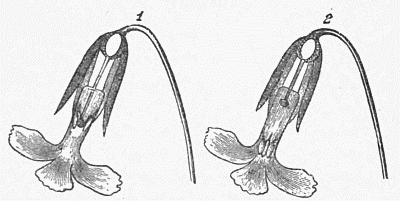
Fig. 44.—Corolla of Primrose falling off.
1, Primrose with long pistil, and stamens in the tube, same as 1 of Fig. 43.
2, Primrose with short pistil, and stamens at mouth of tube, 2, Fig. 43.
If you suck the end of the tube of the primrose flower you will find it tastes sweet, because a drop of honey has been lying there. When the insects go in to get this honey, they brush themselves against the yellow dust-bags, and some of the dust sticks to them, and then when they go to the next flower they rub it off on to its sticky knob.
Look at No. 1 and No. 2 (Fig. 43) and you will see at once that if an insect goes into No. 1 and the pollen sticks to him, when he goes into No. 2 just that part of his body on which the pollen is will touch the
Therefore, we can see clearly that it is good for the primrose that bees and other insects should come to it, and anything it can do to entice them will be useful. Now, do you not think that when an insect once knew that the pale-yellow crown showed where honey was to be found, he would soon spy these crowns out as he flew along? or if they were behind a hedge, and he could not see them, would not the sweet scent tell him where to come and look for them? And so we see that the pretty sweet-scented corolla is not only delightful for us to look at and to smell, but it is really very useful in helping the primrose to make strong healthy seeds out of which the young plants are to grow next year.
And now let us see what we have learnt. We began with a tiny seed, though we did not then know how this seed had been made. We saw the plantlet buried in it, and learnt how it fed at first on prepared food, but soon began to make living matter for itself out of gases taken from the water and the air. How ingeniously it pumped up the water through the cells to its stomach—the leaves! And how marvellously the sun-waves entering there formed the little green granules, and then helped them to make food and living protoplasm! At this point we might have
And so we came back to a primrose seed, the point from which we started; and we have a history of our primrose from its birth to the day when its leaves and flowers wither away and it dies down for the winter.
But what fairies are they which have been at work here? First, the busy little fairy Life in the active protoplasm; and secondly, the sun-waves. We have seen that it was by the help of the sunbeams that the green granules were made, and the water, carbonic acid, and nitrogen worked up into the living plant. And in doing this work the sun-waves were caught and their strength used up, so that they could no longer quiver back into space. But are they gone for ever? So long as the leaves or the stem or the root of the plant remain they are gone, but when those are destroyed we can get them back again. Take a handful of dry withered plants and light them with a match, then as the leaves burn and are turned back
And the life of the plant? What is it, and why is this protoplasm always
active and busy? I cannot tell you. Study as we may, the life of the
tiny plant is as much a mystery as your life and mine. It came, like all
things, from the bosom of the Great Father, but we cannot tell how it
came nor what it is. We can see the active grains moving under the
microscope, but we cannot see the power that moves them. We only know it
is a power given to the plant, as to you and to me, to enable it to live
its life, and to do its useful work in the world.