
BLOOD · HEART · PHYSIOLOGY
William Harvey
The Doctor Who Did the Math on the Heart
The old teaching said the liver kept making new blood. William Harvey counted heartbeats and the numbers said no.
- 1578 to 1657
- England
- Life science
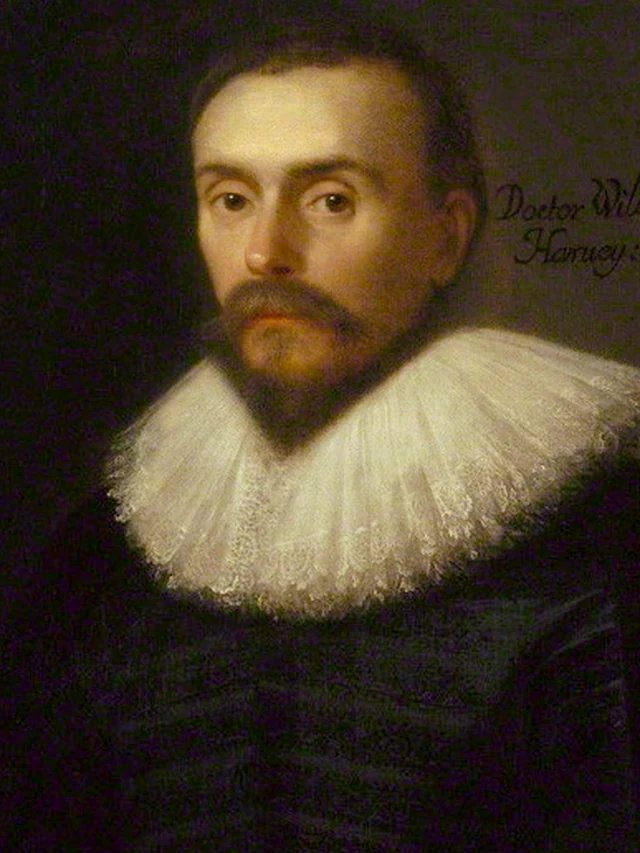

A life of discovery
The question they chased
William Harvey was born on 1 April 1578 in Folkestone, Kent, the eldest of nine children. His father was a town leader and later mayor. William studied at Cambridge and then at Padua in Italy, where he learned from the anatomist Hieronymus Fabricius, who had studied the little flaps inside veins. He earned his medical degree in 1602, and he came home to England with a question about the heart. Where does the blood actually go?
Back in London he worked at St Bartholomew's Hospital and became a doctor to King James I and then King Charles I. The kings' hunts gave him deer to study, and over the years he dissected many kinds of animals. In 1628 he published a short book on the motion of the heart and blood. He argued that the heart is a pump, and that the same blood travels in a circle through the body again and again.
The big ideas
What William figured out
The older teaching said the liver made blood that the body used up like fuel. Harvey showed that the heart pushes blood out through arteries and that it returns through veins. Think of a river that flows into a lake and then back to its source, not a spring that never stops pouring.
Harvey counted about 72 heartbeats a minute and estimated about two ounces of blood pushed out with each beat. That works out to 8,640 ounces in one hour. No body could make that much new blood so fast, so the same blood had to be going around.
Harvey pressed on the veins in a person's forearm and showed that tiny flaps inside them let blood flow only toward the heart. He could not see the thin vessels that link arteries to veins. In 1661, four years after he died, Marcello Malpighi saw them through a microscope.
Key moments
How it unfolded
- 1578William is born in Folkestone on 1 April.
- 1602He receives his medical degree at the University of Padua.
- 1618He becomes physician extraordinary to King James I.
- 1628His book on the motion of the heart and blood is published in Frankfurt.
- 1651He publishes a book on how animals develop and argues that animals begin as eggs.
- 1657He dies on 3 June at Roehampton, near London, at age 79.
The person behind the science
The careful man in a loud argument
Harvey did not rush. He waited years to print his idea. In the book he wrote a letter to the Royal College of Physicians, saying he had sought their testimony and support first, partly so no one could call him presumptuous. Even so, some doctors attacked him once it was out. For a man whose living depended on patients trusting him, that was a real risk.
Life at home was hard too. He and his wife, Elizabeth Browne, had no children, and she died before him. When the war came, his papers were plundered, and Aubrey wrote that he counted this among his saddest losses. And still he did not stop. He moved with the king to Oxford and became head of Merton College in 1645. With encouragement from his friend George Ent, he finished his book on how animals develop and published it in 1651, when he was in his seventies.
Small things that make them human
- Lecturer and hospital doctorHe was named lecturer at the College of Physicians in 1615, and he worked at St Bartholomew's from 1609.
- Walks for sleepless nightsJohn Aubrey wrote that he would walk about his room in his shirt when his thoughts kept him awake.
- Gout in old ageHe soaked his legs in cold water to ease the pain of gout, as Aubrey recorded.
- A gift to the CollegeIn his will he gave a large sum to the Royal College of Physicians, which began the yearly Harveian Oration in 1656.
A few surprising facts
Did you know
He showed his idea to colleagues for about nine years before he printed it, because he expected a storm of arguments.
Reports say his medical practice suffered after the book appeared, and the idea took about twenty years to be generally accepted.
During the English Civil War a mob plundered his rooms and took his papers, including notes on dissections.
John Aubrey, who knew him, wrote that Harvey sometimes walked about his room when he could not sleep and liked to think in the dark.
Why it still matters
What this means for you
Harvey changed medicine by counting. A student today can do what he did. Take a pulse, time it, and ask what the number means. His story also reminds us that a true idea is not always welcome at first. He prepared carefully, shared his reasoning, and kept working through losses. If your best work gets a cold reception, that does not mean it is wrong. It may just need time and patient evidence.
Count it. Then trust what the numbers say.
CURIOSITY ✦ RIGOR ✦ DISCOVERYTalk about it
Questions for your table
- Harvey used simple counting to question a famous teaching. What everyday question in your life could you answer by counting?
- He waited years to publish because he expected pushback. When is it wise to wait before sharing something you are proud of, and when is waiting just fear?
- Harvey lost people and years of notes and kept working. What helps you start again after a setback?
Try it today
Three small steps
- Notice: Find your pulse at your wrist and count the beats in one minute while sitting still.
- Question: Ask yourself how many beats your heart makes in an hour if the number stays the same, and write down the answer.
- Test: Do ten jumping jacks, count your pulse again for fifteen seconds, multiply by four, and compare it with your resting number.