
PHYSICS · COSMOLOGY · BLACK HOLES
Stephen Hawking
The Man Who Asked How Everything Began
He was told at 21 he had about two years to live, and he spent more than fifty asking how the universe began.
- 1942 to 2018
- United Kingdom
- Physics
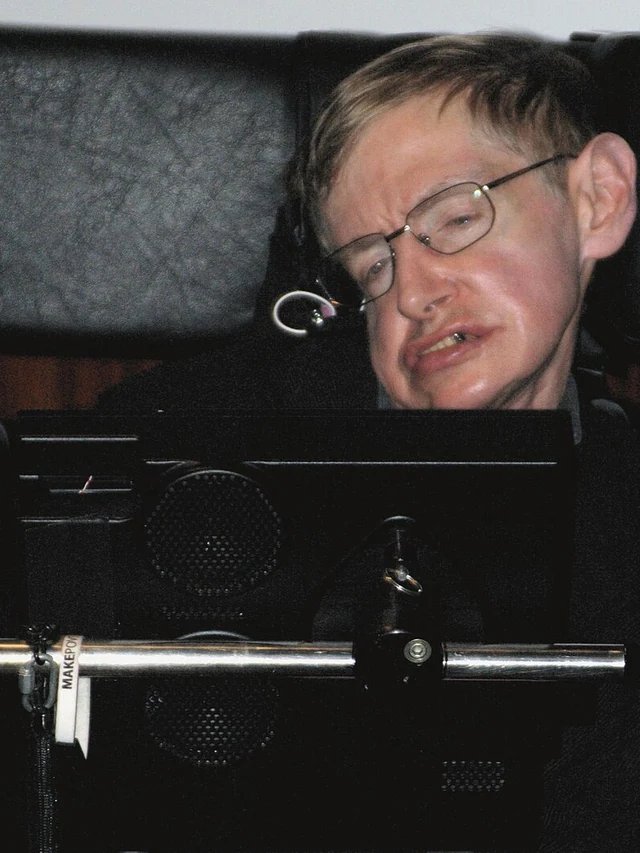

A life of discovery
The question they chased
Stephen Hawking was born in Oxford, England, on January 8, 1942. He passed the entrance exam for St Albans School a year early. At Oxford he found the early work too easy and felt bored and lonely. Later he steered a rowing crew as coxswain and took a first-class degree in physics. He wanted to know where the universe came from and what happens inside a black hole.
At Cambridge he worked on the mathematics of Einstein's general relativity. With Roger Penrose he worked on singularity theorems, which show that Einstein's equations lead to points of infinite density, like the start of the universe or the center of a black hole. In 1974 he proposed that black holes give off radiation. In 1979 he became Lucasian Professor, a chair Isaac Newton once held, and he kept it until 2009. His book "A Brief History of Time" came out in 1988 and sold an estimated nine million copies by 2009.
The big ideas
What Stephen figured out
A black hole is a region where gravity is so strong that nothing, not even light, can get out. In 1974 Hawking used quantum theory near the edge of a black hole and found that it should give off a faint glow. Over unimaginably long times, a black hole slowly loses energy and can shrink away.
Hawking and Penrose showed that if general relativity is right, the history of the universe runs back to a singularity. That is a point where our usual laws stop making sense. It points to a place where scientists need a deeper theory.
Cygnus X-1 is an X-ray source that astronomers thought held a black hole. In 1974 Hawking made a friendly bet with physicist Kip Thorne that it was not a black hole. Evidence built up, and he conceded in 1990. Science moves by testing guesses against evidence, even when it is personal.
Key moments
How it unfolded
- 1963At 21 he is diagnosed with motor neurone disease, and doctors tell him he may have about two years.
- 1965He marries Jane Wilde on July 14.
- 1974He proposes that black holes give off radiation.
- 1979He becomes Lucasian Professor of Mathematics at Cambridge.
- 1985Pneumonia leaves him unable to speak, and he later communicates through a computer voice.
- 1988"A Brief History of Time" is published and becomes a bestseller.
The person behind the science
The humor behind the equations
Hawking was 21 when doctors diagnosed motor neurone disease, also called ALS. They told him he might live about two years. He fell into a depression. His doctors urged him to keep working, and he did. He had been witty and popular as a student.
Jane Wilde, whom he had met at a party in 1962, stood by him. They became engaged in October 1964 and married in July 1965. Nurses, students, and friends helped as his body grew weaker. In 1985 pneumonia left him unable to speak. A program called Equalizer, written by Walt Woltosz for his own mother-in-law, who also had ALS, let Hawking pick words with his thumbs in 1986. Later he used a single cheek muscle to control his device.
Small things that make them human
- Spelling with his eyebrowsBefore the computer, he raised his eyebrows to pick letters on a spelling card.
- Music and science fictionHe loved classical music and science fiction.
- Three childrenHe and Jane had Robert, Lucy, and Timothy.
- A national honorIn 2009 he received the Presidential Medal of Freedom.
A few surprising facts
Did you know
He lived more than fifty years after his diagnosis.
His voice came from a speech synthesizer with an American accent. When it needed replacing in 2014, his team rebuilt it so he could keep that voice.
He was known for fast and reckless wheelchair driving.
He is buried in the nave of Westminster Abbey, near Isaac Newton and Charles Darwin.
Why it still matters
What this means for you
Hawking's body slowed down, but his mind kept working on some of the hardest questions there are. He did not wait for ideal conditions. He used the tools he had, accepted help when he needed it, and kept his humor. A student facing a hard stretch can see that a limit in one place does not close every door. His science is still alive too. Black holes remain a major area of research today.
Work with what you have, and keep wondering.
CURIOSITY ✦ RIGOR ✦ DISCOVERYTalk about it
Questions for your table
- Hawking fell into depression after his diagnosis and then returned to work. What helps you start again after a bad day or hard news?
- He depended on many helpers and on technology to communicate. When is asking for help a strength?
- He made a friendly bet and conceded when the evidence changed. How do you feel about admitting you were wrong, and how could you make it easier?
Try it today
Three small steps
- Notice: Look up at the night sky for ten minutes and count how many points of light you can see without a telescope.
- Question: Ask how far away the most distant thing you can see is, and how long its light took to reach you.
- Test: Stretch a sheet of cloth, set a heavy ball in the middle, and roll a marble nearby to see its path bend, a rough model of how gravity bends paths.