
CHEMISTRY · X-RAYS · DNA
Rosalind Franklin
The Scientist Who Photographed the Shape of Life
She turned X-rays into pictures of molecules, and her careful work helped reveal the shape of DNA and of a virus.
- 1920 to 1958
- United Kingdom
- Chemistry
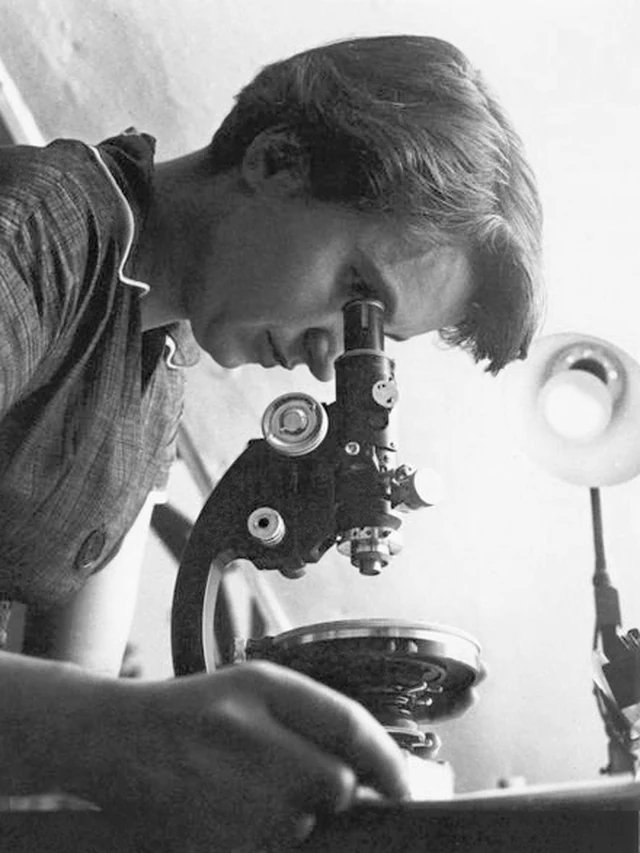

A life of discovery
The question they chased
Rosalind Franklin was born in London in 1920 into a well-off British Jewish family. She studied chemistry at Newnham College, Cambridge, and graduated in 1941. She earned her PhD in 1945 from research on coal and how porous it is. In 1947 she went to Paris and learned to use X-rays to study materials. The question she chased was what the hidden building blocks of life look like.
X-ray diffraction works by shooting X-rays through a tiny sample. The beams scatter onto film in a pattern, and the pattern reveals how the atoms are arranged. At King's College London she took on DNA in 1951. In May 1952 her student Raymond Gosling took a sharp image of DNA that became known as Photo 51. In 1953 Watson and Crick published the double helix, and Franklin and Gosling's data appeared in the same issue of "Nature."
The big ideas
What Rosalind figured out
When X-rays pass through a fiber or crystal, they bend and land on film as spots and arcs. The pattern is like a shadow of the structure inside. The cross shape in Photo 51 is a sign of a helix.
DNA is a long molecule of two strands wound around each other like a twisted ladder. Franklin's measurements helped show that DNA is helical and how tightly it is packed. Her 1951 lecture already described a helix with the phosphate groups on the outside.
At Birkbeck College she studied tobacco mosaic virus, a rod made of protein with a strand of RNA inside. She and her team showed that the RNA winds inside the protein shell. In 1955 she also showed that all the virus particles were the same length.
Key moments
How it unfolded
- 1945She earns her Cambridge PhD, based on her work on coal.
- 1951She starts at King's College London and takes on the X-ray study of DNA.
- 1952In May, Raymond Gosling takes Photo 51 in her lab.
- 1953Watson and Crick publish the double helix, and Franklin moves to Birkbeck College.
- 1955She shows that tobacco mosaic virus particles are all the same length.
- 1958Franklin dies at 37. The next day, a model of the virus she studied opens at the Brussels World's Fair.
The person behind the science
The careful mind behind the camera
Franklin's years at King's College were hard. She had been told she would lead the DNA work, but Maurice Wilkins had not been told ahead of time, and the two never found an easy way to work together. Some who knew her described a sexist atmosphere. Others, including her sister, dispute that picture. Historians still argue about how Watson and Crick came to see Photo 51. In 1953 she moved to Birkbeck College and built her own group.
In 1956 she became seriously ill and had surgery in September. She stayed with friends and family, including Francis and Odile Crick, and she kept doing science. Her team started work on the polio virus. She died on April 16, 1958, at age 37. In 1962 the Nobel Prize for the double helix went to Crick, Watson, and Wilkins. Prizes were not given after death.
Small things that make them human
- A rough first startIn 1941 she began a PhD with Ronald Norrish, found it unproductive, and left to work on coal.
- Love of trekkingShe loved walking and trekking in the mountains.
- Friends who took her inAfter surgery she stayed with the Cricks and with her brother Roland's family.
- Generous with her workIn 1956 she wrote much of Donald Caspar's manuscript on the virus.
A few surprising facts
Did you know
In July 1952 she and Gosling wrote a joke funeral notice for the crystalline helix, a form of DNA they doubted was a helix at the time.
Her notes from early 1953 show she was moving toward a double helix for one form of DNA. Historians still argue about how far along she was.
In 1955 her data contradicted Norman Pirie on the virus. Later work proved her right.
Aaron Klug, who continued her virus work, won the 1982 Nobel Prize in Chemistry.
Why it still matters
What this means for you
Franklin teaches that careful work counts even when credit comes slowly. Her measurements helped show the shape of DNA, and her virus work opened the way for the scientists after her. A good measurement and a clean set of notes are things others can build on. You will not always get the credit you earned. The work can still last.
Measure carefully and trust the evidence.
CURIOSITY ✦ RIGOR ✦ DISCOVERYTalk about it
Questions for your table
- Franklin did not always get along with her colleagues, yet she did excellent work. How do you do your best work with people who are hard to work with?
- Her data helped others solve a puzzle. How should credit be shared on a team or a group project?
- She kept working while she was ill. What helps you keep going on a project when life gets hard?
Try it today
Three small steps
- Notice: In a dark room, shine a flashlight through a bird feather or a piece of fine cloth and look at the pattern it makes on a wall.
- Question: Ask what hidden shape inside something you use every day, like a spring or a spiral staircase, helps it do its job.
- Test: Twist two pieces of yarn into a rope and compare how it holds up against a single strand, then write what you found.