
PHYSICS · LIGHT · ELECTROMAGNETISM
James Clerk Maxwell
The Quiet Scot Who Saw Light as a Wave of Electricity
A curious Scottish boy who lost his mother young went on to show that light, electricity, and magnetism belong to one family.
- 1831 to 1879
- Scotland
- Physics
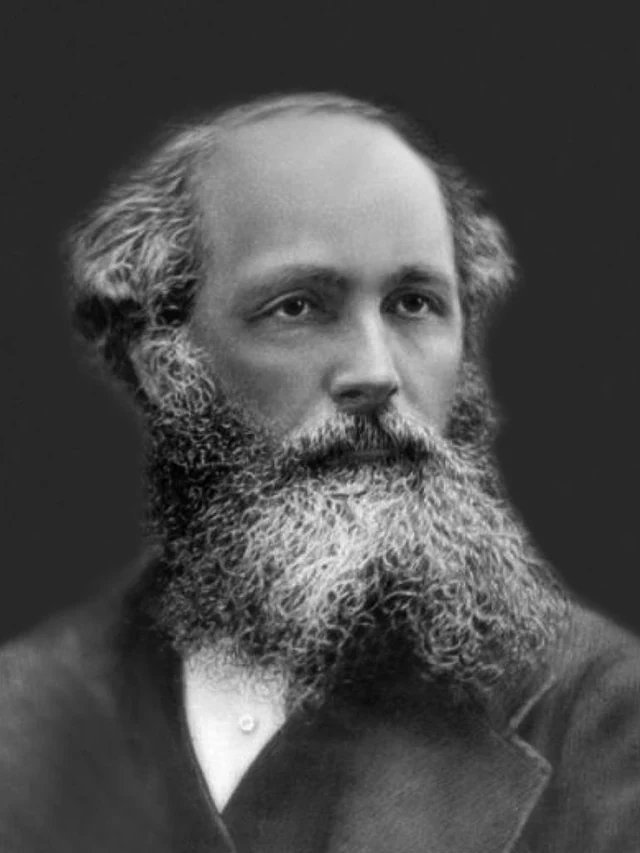

A life of discovery
The question they chased
James Clerk Maxwell was born in Edinburgh in 1831 and grew up mostly at Glenlair, his family's country estate. His mother Frances died of cancer in 1839, when he was eight. At school in Edinburgh, classmates gave him the nickname Daftie. At age 14 he wrote his first science paper, about drawing oval curves with pins and string. It was read to the Royal Society of Edinburgh in 1846.
Maxwell became a professor at Aberdeen in 1856, then at King's College London in 1860. He showed that Saturn's rings must be made of many small solid pieces. In 1861 he demonstrated the first color photograph made from three filtered images. His great work tied electricity and magnetism together and showed that light is an electromagnetic wave. In 1871 he became the first Cavendish Professor of Physics at Cambridge.
The big ideas
What James figured out
Maxwell showed that shaking electric and magnetic fields can travel through space as waves. When he worked out their speed from electrical measurements, it matched the measured speed of light. So light must be one of these waves.
Some thought Saturn's rings were solid or liquid. Maxwell showed they would not be stable that way. They had to be made of countless small solid pieces. Later spacecraft confirmed it.
Maxwell had three black and white photographs taken of a tartan ribbon through red, green, and blue filters. He then projected the three pictures through matching filters at the same spot on a screen. The colors appeared.
Key moments
How it unfolded
- 1846At age 14 his first paper was read to the Royal Society of Edinburgh.
- 1856He became a professor at Marischal College in Aberdeen.
- 1861He showed a color photograph made from three filtered images.
- 1865He published the idea that light is an electromagnetic disturbance and returned to Glenlair.
- 1873His "Treatise on Electricity and Magnetism" appeared.
- 1879He died in Cambridge at age 48.
The person behind the science
The gentle boy they called Daftie
Maxwell lost his mother at age eight. That is a heavy thing for a child. At school he was teased with the nickname Daftie. He bore it without complaint for many years. He stayed friends for life with Peter Guthrie Tait and Lewis Campbell, who knew him from school. In 1860 he nearly died of smallpox and recovered.
In 1858 he married Katherine Dewar, the daughter of the principal at Aberdeen. She helped in his laboratory. In 1865 he left London to work at Glenlair, where he finished a great deal of writing. He was a devout Presbyterian and an elder in the Church of Scotland. In 1879 he died at age 48 of cancer, as his mother had. By then he had left behind work that changed physics.
Small things that make them human
- Memorized poemsHe learned many Scottish poems by heart and wrote his own verse.
- A wife in the labKatherine helped with his experiments, including work on how gases flow.
- School friends for lifeHis friendships with Tait and Campbell lasted all his life.
- A boy with stringAt 14 he drew ovals with pins and string and wrote a paper about it.
A few surprising facts
Did you know
Maxwell's equations are often shown as four equations. Oliver Heaviside reduced his original longer set to four.
In 1931 Einstein called Maxwell's work the most profound and fruitful physics had known since Newton.
Maxwell wrote poems, and a collection was published in 1882. He also wrote a funny parody of a Robert Burns poem and sang it while playing guitar.
His wife Katherine worked in his laboratory on experiments with the viscosity of gases, which is how much a gas resists flowing.
Why it still matters
What this means for you
Your phone, Wi-Fi, radio, microwave, and your eyes all rely on electromagnetic waves. Maxwell showed they are all the same kind of wave, just with different wavelengths. His math predicted radio waves before anyone had made them. His life also tells a student something kind. Being teased, being shy, or being a bit different does not shut a person out of great work. He kept his friends, kept his curiosity, and stayed gentle.
Stay curious. Be kind. Follow the pattern.
CURIOSITY ✦ RIGOR ✦ DISCOVERYTalk about it
Questions for your table
- Maxwell was teased as a boy but never stopped being curious. How do you hold on to what you love when others laugh?
- Maxwell grieved his mother at age eight. What does it look like to grow up carrying a loss and still find joy?
- Maxwell's math predicted things nobody had seen yet. What could you predict from a pattern in your own life?
Try it today
Three small steps
- Notice: Find three things at home that use invisible waves, such as a remote control, a microwave, and a Wi-Fi router.
- Question: If light and radio are the same kind of wave, what could be different between them?
- Test: Shine a flashlight through red, green, and blue plastic or cellophane onto a white wall and overlap the three spots to see what color appears.