
PHYSICS · OPTICS · EXPERIMENT
Ibn al-Haytham
The Man Who Said Test It
More than a thousand years ago in Cairo, he showed that we see because light enters our eyes and tested every claim he could.
- about 965 to about 1040
- Iraq and Egypt
- Physics
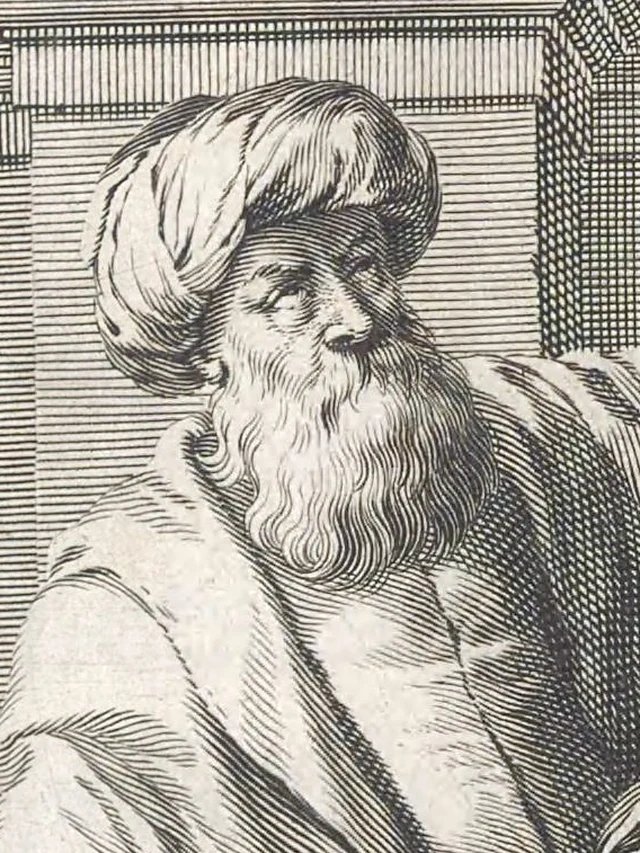

A life of discovery
The question they chased
Ibn al-Haytham was born around 965 in Basra, in what is now Iraq. Europe later knew him as Alhazen. Later biographers say he trained for government work and held a post in the Basra region before turning to science. He wanted to know how seeing works and how a person can be sure of an answer about nature.
He spent most of his productive years in Cairo. Between 1011 and 1021 he wrote the “Book of Optics” in seven volumes. It argued against the old view of Euclid and Ptolemy that rays shoot out from the eye. He said vision happens when light from an object enters the eye, and he backed his claims with experiments.
The big ideas
What Ibn figured out
If your eyes sent out rays, looking at the bright Sun should not hurt them. It does hurt, and the glare stays as spots. Ibn al-Haytham argued that light from the object enters the eye. That is the model scientists accept today.
Make a small hole in a dark room's wall and light from outside makes an upside-down picture on the opposite wall. This is the camera obscura. He described it carefully and used it to show that light travels in straight lines.
His book rests on experiments, not only on old authority. He still got things wrong. He followed older thinkers and believed the lens of the eye was where seeing happens, which is wrong. The lens only focuses light. But he showed a way to fix errors, which is to test again.
Key moments
How it unfolded
- About 965He is born in Basra.
- 1011 to 1021He writes the seven volumes of the “Book of Optics.”
- 1021Caliph al-Hakim dies. A later report says this ended a period when Ibn al-Haytham had been confined to his house.
- 1024He finishes his handwritten copy of Apollonius's “Conics,” which survives today.
- 1027He writes a short autobiography about how his mind developed.
- About 1040He dies, probably in Cairo.
The person behind the science
The scholar who had to start over
Much of what people repeat about his life comes from a biographer who wrote long after he died. That report says Caliph al-Hakim heard that Ibn al-Haytham could regulate the Nile. When the plan proved impossible, the story says he pretended to be ill in his mind, and stayed confined to his house until al-Hakim died in 1021. Some historians call this a legend. We cannot be sure any of it happened. The book dates fit, since he wrote the “Optics” from 1011 to 1021, but the confinement itself is only a report.
What is documented is quieter. He lived in Cairo near the Al-Azhar mosque, according to the same later account. He earned his living from writing, teaching nobles, and copying books. His own handwriting survives on one copy. His 1027 autobiography shows a man who cared about how his own mind had changed. We do not have the names of friends who stood by him. We do have the work he finished, and Latin readers in Europe had it by around 1200.
Small things that make them human
- A copy in his handHis handwritten copy of “Conics” from 1024 is one of the few direct traces of the man.
- The Nile planThe story of his failed Nile project comes from a later writer. Treat it as a report, not a record.
- Living by his penHe earned money from writing treatises and tutoring nobles, and a later biographer adds that he copied texts.
- Two namesEurope called him Alhazen, a Latin form of his name.
A few surprising facts
Did you know
A copy of an ancient geometry book, Apollonius's “Conics,” survives in his own handwriting, dated 1024.
His “Book of Optics” was translated into Latin around 1200 and spread through European universities.
A story says he promised to control the flooding of the Nile and then found it could not be done. That tale comes from a later biographer and is treated as tradition.
He wrote an autobiography in 1027, but it says little about events and mostly describes how his thinking grew.
Why it still matters
What this means for you
Every camera, pair of glasses, and screen you use depends on the study of light that Ibn al-Haytham pushed forward. He also gave students a sturdy habit. When someone makes a claim, test it. His mistakes remind us that science grows as others check and correct. And his story shows that a scholar can work through hard years and still leave a book that people read a thousand years later.
Check the claim. Then check again.
CURIOSITY ✦ RIGOR ✦ DISCOVERYTalk about it
Questions for your table
- Ibn al-Haytham challenged ideas held by famous authorities. When is it right to question what experts say, and how should you do it?
- A story says he faced trouble when a big plan failed. How do you handle it when something you promised does not work out?
- His work spread across centuries and continents. Why do you think good ideas can travel so far?
Try it today
Three small steps
- Notice: Look at a bright lamp for one second, look away, and note the spot that stays in your sight.
- Question: Ask what would be different if your eyes sent light out instead of taking it in.
- Test: Punch a small hole in a card, hold it between a window and a white wall in a dim room, and see the upside-down picture.