
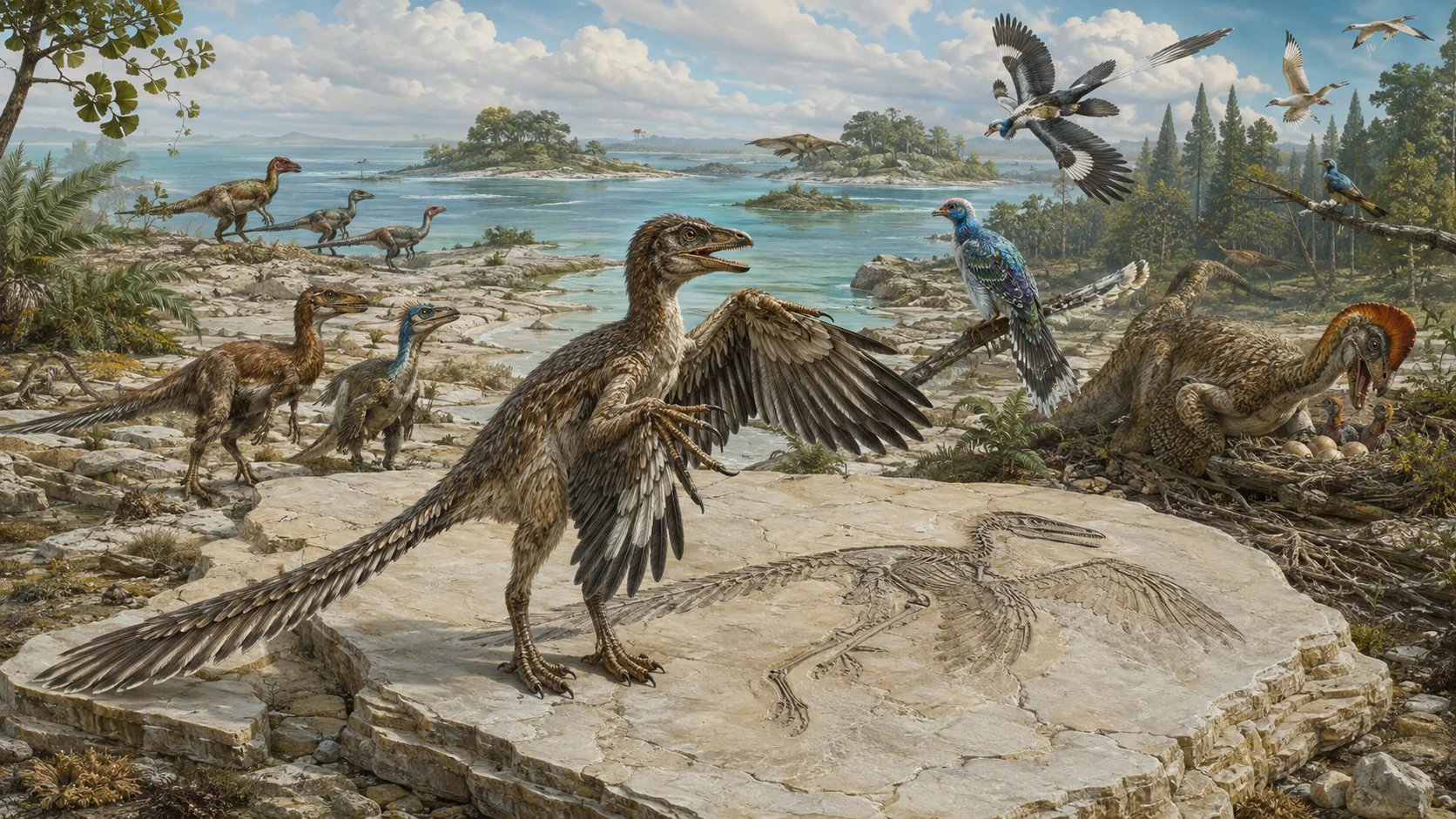
About 150 million years ago, fine carbonate mud settled in quiet, salty lagoons near what is now Solnhofen, Bavaria. Oxygen-poor bottom conditions and rapid burial sometimes preserved delicate structures that normally vanish. In 1860 a fossil feather was described; soon afterward a nearly complete Archaeopteryx skeleton emerged from the lithographic limestone quarries.
Archaeopteryx was a mosaic, not a perfect halfway creature. It had flight feathers and wings, yet also teeth, clawed fingers, and a long vertebral tail. Its discovery arrived just after Darwin published On the Origin of Species and gave scientists a vivid example of features shared across groups. Archaeopteryx was close to the origin of birds, though it need not have been the direct ancestor of every bird alive today.
Then spectacular fossils from Liaoning, China, transformed the picture. Sinosauropteryx preserved simple filaments. Caudipteryx carried complex feathers despite arms too short for flight. Microraptor bore long feathers on arms and legs. Oviraptorosaurs sat over nests in birdlike postures. Fossils, bone anatomy, air sacs, wishbones, nesting behavior, and family-tree analyses now converge: birds are living theropod dinosaurs.
Feathers probably did not begin as wings. Simple coverings could insulate a warm body, signal to mates or rivals, camouflage an animal, shield eggs, or help balance and maneuver. Branching filaments later formed vanes; asymmetrical vaned feathers became useful aerodynamic surfaces. Evolution reused and modified an existing structure.
Not every dinosaur was covered head to toe, and preservation is biased. Skin impressions show scales on many body regions and lineages; some dinosaurs combined scales, filaments, and feathers. Color reconstructions can sometimes use fossil melanosomes, but much remains uncertain. The modern image is therefore not ‘every dinosaur was a giant chicken.’ It is a diverse family in which feathers evolved in stages—and one branch never went extinct.