
Brothers LearningFREE LESSONS FOR EVERY CLASSROOM
Brothers Learningany school district
← All Science TalesMR. BOUYER SCIENCETALE 18 OF 20

Physics • Chemistry • IPC • Astronomy • SCIENCE TALE 18

What a Star Becomes

Mass, fusion, supernovae, and a teaspoon that would outweigh a mountainEnter the story ↓

BEGIN WITH THE ORDINARY

Look again.
Something remarkable is hiding here.

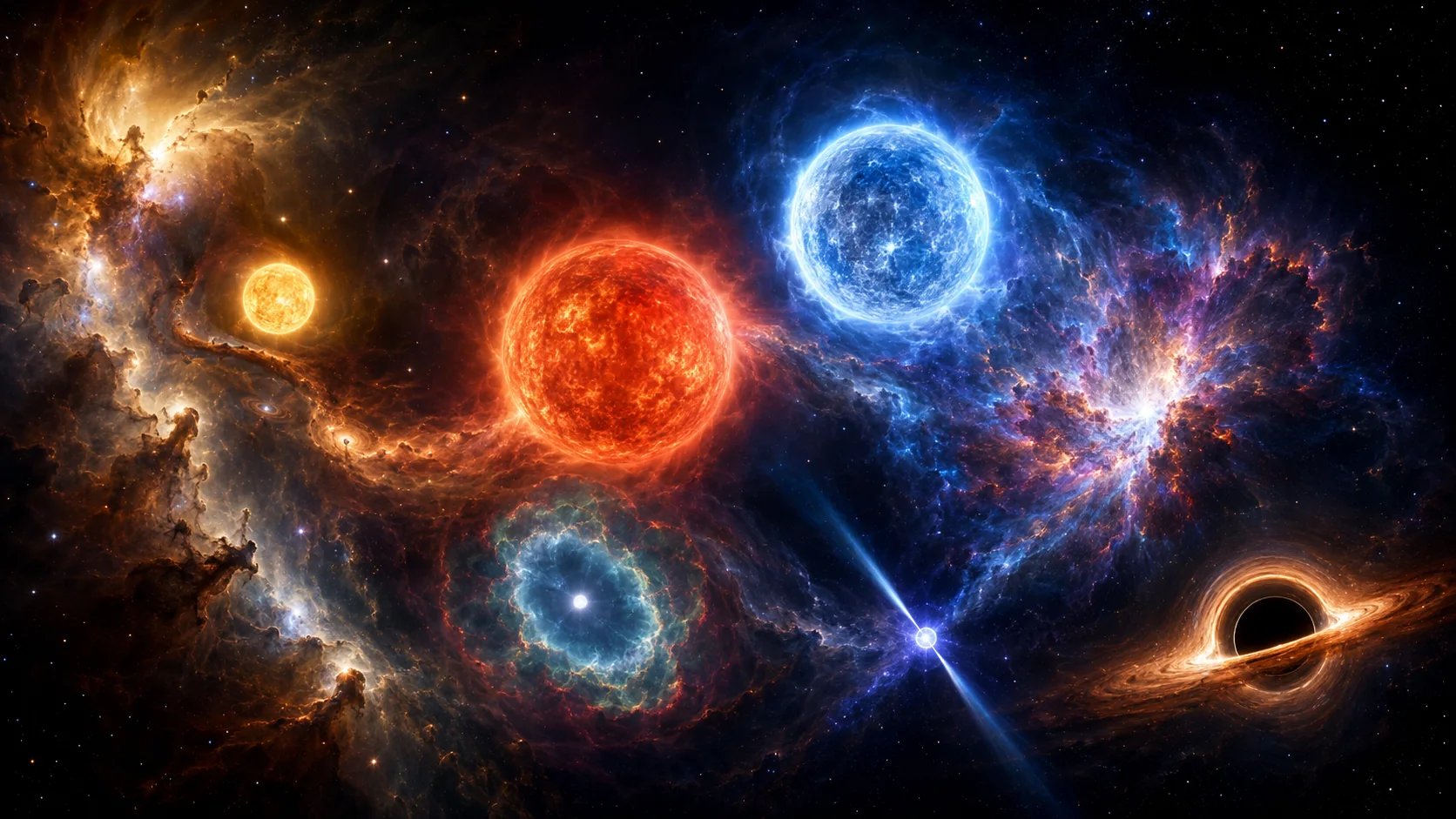
Two stars can be born in the same glowing cloud and die in completely different ways. The deciding clue is the mass they begin with.
18

A star begins in a cold molecular cloud. Gravity gathers gas into a protostar until the core becomes hot and dense enough for hydrogen fusion. For most of the star’s life, inward gravity and outward pressure reach a dynamic balance called hydrostatic equilibrium.

A Sun-like star eventually exhausts core hydrogen, expands into a red giant, sheds its outer layers as a planetary nebula, and leaves an Earth-sized white dwarf. Our Sun is not massive enough to become a neutron star or black hole.

A much more massive star fuses heavier elements in successive stages. When an iron-rich core can no longer supply supporting energy, the core collapses and the outer star can explode as a supernova. The crushed remnant may become a neutron star—a city-sized object containing more mass than the Sun—or, if the collapsing core is massive enough, a black hole.

Neutron-star matter is so dense that a teaspoon is commonly estimated to weigh around a billion tons on Earth. That is an order-of-magnitude illustration, not material we could actually scoop: outside the star’s immense pressure it would not remain a stable spoonful. The startling estimate comes from packing stellar mass into a sphere only tens of kilometers wide.

01

Hydrostatic balance

Gravity pulls inward while hot gas and radiation pressure push outward.

02

Mass decides

Lower-mass stars leave white dwarfs; massive collapsing cores can leave neutron stars or black holes.

03

Nuclear density

Neutron stars compress roughly stellar mass into a city-sized sphere, producing almost unimaginable density.

INTERACTIVE MODEL

Change one thing.
Watch the system answer.

NEBULA→STAR→SUPERGIANT→?
Move BIRTH MASS to change the branch. This is a teaching model; exact thresholds depend on composition and mass loss.
THE SCIENCE BENEATH THE STORY

A star’s life is a contest between gravity and pressure, and its starting mass largely decides how that contest ends.

BRING IT BACK TO THE ROOM

Questions worth
slowing down for.

  1. 01Why does a massive star have a shorter life even though it begins with more fuel?
  2. 02Why will the Sun become a white dwarf rather than a neutron star?
  3. 03What causes the core of a massive star to collapse?
  4. 04Why is the teaspoon comparison useful but physically incomplete?
MR. BOUYER’S SCIENCE TALES

The ordinary world
is not ordinary at all.

Choose another tale →