
Metric Prefixes
| Prefix | Symbol | Factor |
|---|---|---|
| giga | G | ×1,000,000,000 |
| mega | M | ×1,000,000 |
| kilo | k | ×1,000 |
| base unit | — | ×1 |
| centi | c | ×0.01 |
| milli | m | ×0.001 |
| micro | µ | ×0.000001 |
| nano | n | ×0.000000001 |
King Henry Died By Drinking Chocolate Milk — kilo, hecto, deca, base, deci, centi, milli.
Common Conversions
- Length: 1 in = 2.54 cm · 1 m ≈ 3.28 ft · 1 mi ≈ 1.61 km
- Mass: 1 kg ≈ 2.2 lb · 1 oz ≈ 28.3 g
- Volume: 1 L ≈ 1.06 qt · 1 gal ≈ 3.79 L
- Time: 60 s = 1 min · 60 min = 1 hr
Temperature
°F = (°C × 9/5) + 32
°C = (°F − 32) × 5/9
K = °C + 273.15
Water freezes 0°C / 32°F / 273 K · boils 100°C / 212°F / 373 K.
The Mole Road Map
grams ↔ moles ↔ particles
- grams ÷ molar mass = moles
- moles × 6.022 × 1023 = particles
- moles × 22.4 L = liters of gas at STP
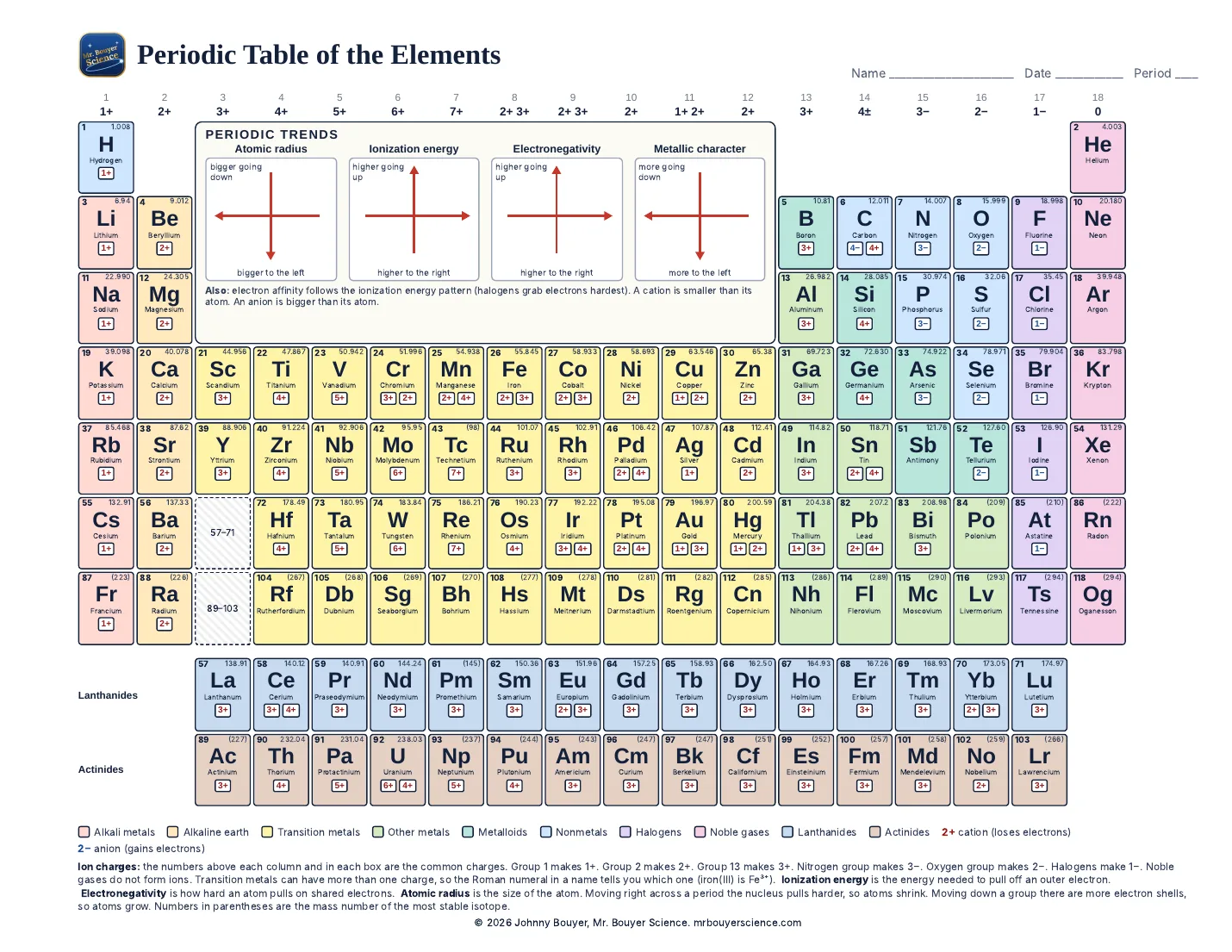
- Molar mass = the sum of the atomic masses from the periodic table.
Always go through moles. It is the bridge between every pair of units.
Moles & Molarity
moles = mass ÷ molar mass
Molarity (M) = mol solute ÷ L solution
Avogadro's number: 1 mol = 6.022 × 10²³ particles.
Solutions
M1V1 = M2V2
Dilution. Moles of solute stay the same.
% by mass = mass solute ÷ mass solution × 100
Percent Composition & Yield
% element = mass of element ÷ mass of compound × 100
% yield = actual ÷ theoretical × 100
Gas Laws
| Boyle's (T const.) | P1V1=P2V2 |
| Charles's (P const.) | V1/T1=V2/T2 |
| Gay-Lussac's (V const.) | P1/T1=P2/T2 |
| Combined | P1V1/T1=P2V2/T2 |
| Ideal Gas Law | PV = nRT |
R = 0.0821 L·atm/(mol·K) · STP = 0°C, 1 atm → 1 mol gas = 22.4 L. T must be in kelvin.
Pressure & Gas Constants
| Item | Value |
|---|---|
| 1 atm | 101.3 kPa |
| 1 atm | 760 mmHg = 760 torr |
| 1 atm | 14.7 psi |
| R | 0.0821 L·atm/(mol·K) |
| R | 8.314 J/(mol·K) |
| STP | 0°C and 1 atm |
Heat & Energy
q = mcΔT
- q = heat (J) · m = mass (g) · c = specific heat · ΔT = change in °C
- c of liquid water = 4.18 J/(g·°C)
- 1 calorie = 4.184 J
- Melting ice: 334 J per gram · Boiling water: about 2,260 J per gram
Acids & Bases
pH = −log[H+]
pOH = −log[OH−]
pH + pOH = 14 · neutral pH = 7 · acid < 7 < base (at 25°C).
Common Acids & Bases
| Strong acids | Strong bases |
|---|---|
| HCl | LiOH |
| HBr | NaOH |
| HI | KOH |
| HNO3 | Ca(OH)2 |
| H2SO4 | Sr(OH)2 |
| HClO4 | Ba(OH)2 |
Acetic acid (vinegar) is a weak acid. Ammonia is a weak base.
Polyatomic Ions
| Name | Formula |
|---|---|
| ammonium | NH4+ |
| hydronium | H3O+ |
| hydroxide | OH− |
| nitrate | NO3− |
| nitrite | NO2− |
| acetate | C2H3O2− |
| cyanide | CN− |
| permanganate | MnO4− |
| chlorate | ClO3− |
| hydrogen carbonate | HCO3− |
| carbonate | CO32− |
| sulfate | SO42− |
| sulfite | SO32− |
| chromate | CrO42− |
| dichromate | Cr2O72− |
| phosphate | PO43− |
Solubility Rules
- Soluble: all salts of Group 1 metals and ammonium (NH4+)
- Soluble: all nitrates, acetates and chlorates
- Soluble: chlorides, bromides, iodides, except with Ag+, Pb2+, Hg22+
- Soluble: sulfates, except with Ba2+, Sr2+, Pb2+ (Ca2+ and Ag+ only slightly)
- Not soluble: carbonates, phosphates, sulfides, hydroxides, chromates, except with Group 1 and ammonium
- Hydroxides of Ca, Sr and Ba are slightly soluble.
Types of Reactions
| Type | Pattern |
|---|---|
| Synthesis | A + B → AB |
| Decomposition | AB → A + B |
| Single replacement | A + BC → AC + B |
| Double replacement | AB + CD → AD + CB |
| Combustion | hydrocarbon + O2 → CO2 + H2O |
Balance last. Change coefficients only, never subscripts.
Naming & Diatomics
| Prefix | # |
|---|---|
| mono | 1 |
| di | 2 |
| tri | 3 |
| tetra | 4 |
| penta | 5 |
| hexa | 6 |
| hepta | 7 |
| octa | 8 |
| nona | 9 |
| deca | 10 |
Seven diatomic elements: H2, N2, O2, F2, Cl2, Br2, I2. Have No Fear Of Ice Cold Beer.
Density & Error
Density = mass ÷ volume
% Error = |exp − accepted| ÷ accepted × 100
Water: 1.0 g/mL.
Scientific Notation
Write as a × 10n, where 1 ≤ a < 10.
= 6.02 × 1023
= 4.5 × 10⁻⁸
Dimensional Analysis (Unit Cancellation)
Multiply by conversion fractions so unwanted units cancel top-to-bottom, leaving only the unit you want.
65 mi/hr × 1609 m/mi × 1 hr/3600 s ≈ 29.1 m/s
Significant Figures
- Nonzero digits always count.
- Zeros between nonzero digits count.
- Leading zeros never count.
- Trailing zeros count only if there's a decimal point.