
Interactive · Grades 6–12 Science
Explore a Water Molecule
One oxygen, two hydrogens, and a bend of 104.5°. That bend is the reason water sticks to itself, climbs up a straw, floats when it freezes, and dissolves half the things on Earth. Spin the molecule, switch on its charges, then watch a crowd of them link up.
- Grades 6–12
- 15–25 min
- Chemistry · IPC · Biology
- Projector ready
- 5-question check
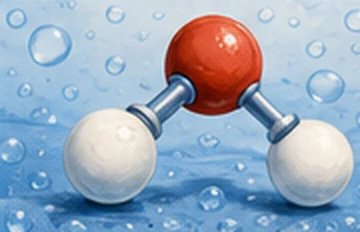
The model
Drag to rotate. Use the switches to show the partial charges, the bond angle, and the two lone pairs on oxygen. Then choose A crowd of molecules to see hydrogen bonds form and break.
Reading the model
- Formula
- H2O — 2 hydrogen atoms, 1 oxygen atom
- Bond angle
- (not 180° — the lone pairs push the hydrogens down)
- Bond length
- (96 trillionths of a metre)
- Shape
- Bent
- Polarity
- Polar — oxygen pulls the shared electrons toward itself, so it is slightly negative and each hydrogen is slightly positive
- Between molecules
- Hydrogen bonds: a δ+ hydrogen on one molecule is attracted to the δ− oxygen on another. Each water can join up to four neighbours.
Tip: in the crowd view, count how many dashed hydrogen bonds one molecule holds at once.
Why the bend matters
Water sticks to water
Because every molecule has a charged “plus” side and a “minus” side, water molecules grab each other. That is surface tension — why a bug can walk on a pond and a full glass bulges above the rim.
Ice floats
Hydrogen bonds hold frozen water in an open six-sided lattice with more empty space than the liquid has. Solid water is less dense than liquid water, so lakes freeze from the top down and life survives underneath.
The universal solvent
The charged ends pull apart salts and pull in sugars. Almost everything a cell does happens in water because water can carry almost everything a cell needs.
Quick check
Five questions. Pick an answer and you will see why it is right or wrong.